

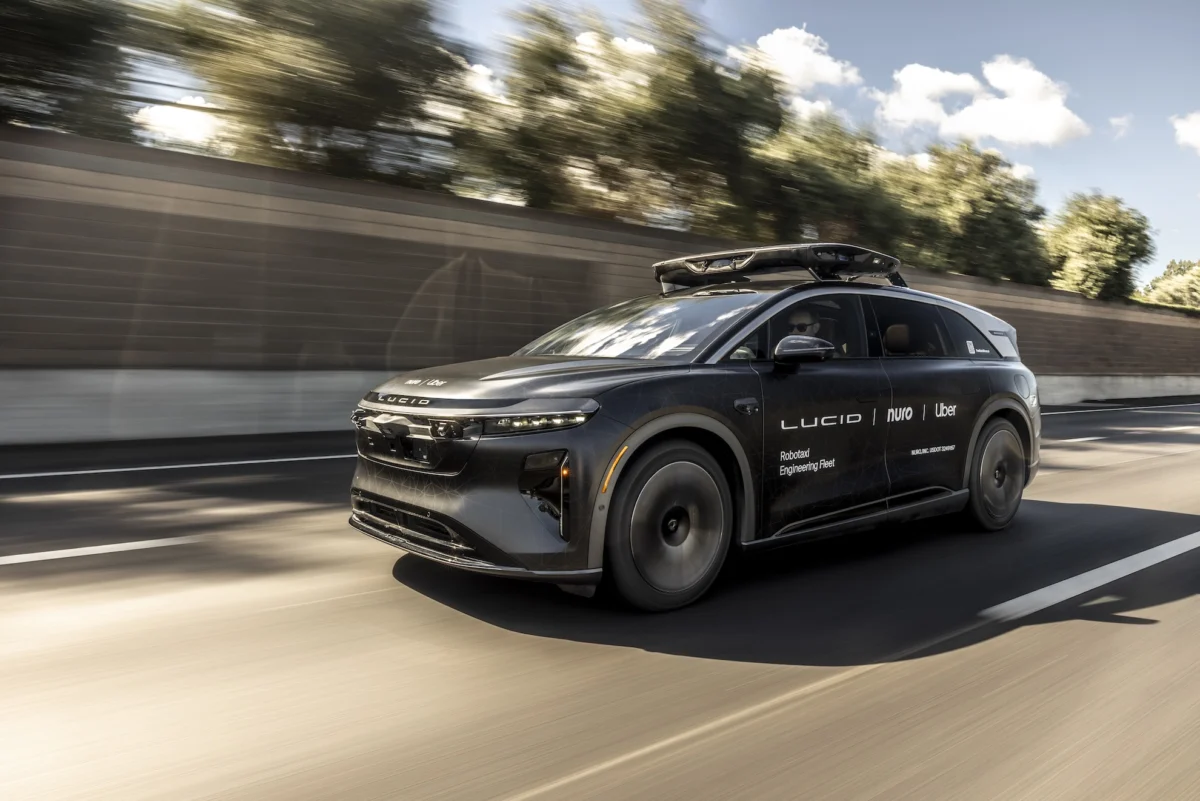
The streets of San Francisco, long the unofficial laboratory for the future of transportation, are witnessing the arrival of a new contender in the increasingly crowded autonomous vehicle landscape. If you find yourself navigating the city’s steep inclines and foggy intersections, you may encounter a fleet of Lucid Gravity SUVs distinguished by an intricate array of roof-mounted sensors and sleek, high-resolution camera housings. These are not merely high-end electric vehicles; they are the physical manifestation of a multi-billion-dollar strategic pivot by Uber, powered by the autonomous "brain" developed by Nuro.
Currently, these vehicles are part of an exclusive pilot program available only to select Uber employees. By utilizing the standard Uber app, these internal testers can summon a Lucid Gravity robotaxi for transit across the city, marking a critical transition from closed-course validation to real-world operational testing. While a human safety operator remains behind the wheel for the duration of this phase, the objective is clear: to refine a premium, driverless experience that Uber intends to debut to the general public later this year.
This milestone is the result of a massive industrial convergence first signaled in July 2025, when Uber announced a transformative partnership involving a $300 million investment in Lucid and a "multi-hundred-million dollar" injection into Nuro. Beyond the capital, the agreement includes a commitment from Uber to purchase at least 20,000 Lucid Gravity SUVs over the next six years. This move signals a departure from Uber’s historical "asset-light" model, suggesting the ride-hailing giant is ready to exert more control over the hardware that will define its autonomous future.
The Hardware: Lucid Gravity as the Premium Vessel
The choice of the Lucid Gravity as the flagship vehicle for this service is a calculated branding and engineering move. As the autonomous vehicle (AV) market matures, the industry is bifurcating into utilitarian "pods" and premium experiences. Uber is clearly aiming for the latter. The Gravity, Lucid’s flagship electric SUV, offers the interior volume, range, and luxury aesthetic necessary to distinguish a "premium" robotaxi service from the more utilitarian offerings currently on the market.
From a technical perspective, the Gravity provides a robust power architecture capable of supporting the immense energy demands of an autonomous compute stack without significantly compromising range. These vehicles have been heavily modified from their consumer versions. Each unit is outfitted with a comprehensive sensor suite that includes solid-state lidar, high-dynamic-range cameras, and advanced radar arrays. These sensors provide the "eyes" for the vehicle, creating a 360-degree, high-fidelity map of the environment that can detect obstacles, pedestrians, and erratic traffic behavior in real-time, even in the challenging lighting and weather conditions for which San Francisco is famous.
The Intelligence: Nuro’s Pivot to Passenger Autonomy
While Lucid provides the physical form, Nuro provides the cognitive function. Nuro, originally known for its compact, driverless delivery bots designed for groceries and last-mile logistics, has successfully pivoted its technology stack to handle the much higher stakes of passenger transport. The heart of this system is the Nvidia Drive AGX Thor computer—a centralized platform designed specifically for safe and secure autonomous driving.
The Thor chip is a marvel of modern silicon, capable of performing up to 2,000 teraflops of floating-point operations. This massive compute power allows Nuro’s software to run complex deep-learning models simultaneously, handling everything from sensor fusion and path planning to predicting the behavior of human drivers. For Nuro, the partnership with Uber represents a scaling opportunity that was previously out of reach. By moving into the passenger space, Nuro is positioning itself as a direct competitor to industry incumbents like Alphabet’s Waymo and Amazon’s Zoox.
The Operational Challenge: Solving the "PUDO" Problem
The current employee-only testing phase in San Francisco is designed to iron out the most granular friction points of the ride-hailing experience. One of the most significant challenges in the AV sector is what insiders call "PUDO"—pickup and drop-off. While navigating a four-way stop or a highway merge is a matter of logic and sensor range, identifying a safe, legal, and convenient spot to pull over on a crowded city street is a matter of nuance and social intuition.
Uber and Nuro are using these test rides to evaluate how the vehicle handles the chaos of San Francisco’s curbsides. Does the car pull over too far from the rider? Does it block a bike lane? How does the interface inside the app communicate with the hardware on the car to ensure the rider can identify their vehicle instantly? By using their own employees as the initial user base, Uber can gather high-fidelity feedback on the "rider journey," from the moment the ride is requested to the second the door closes at the destination.
A Strategic Rebirth for Uber
To understand the weight of this development, one must look back at Uber’s tumultuous history with self-driving technology. Years ago, Uber’s Advanced Technologies Group (ATG) was tasked with building an in-house autonomous system—an effort that was eventually shuttered and sold to Aurora Innovation following a series of technical setbacks and legal challenges.
Instead of retreating from the space, Uber has reinvented itself as the ultimate "platform of platforms." By investing directly in Lucid and Nuro, Uber is ensuring it has a "white glove" service that it can own and operate, likely through third-party fleet management partners. This hybrid approach allows Uber to maintain its dominance in the ride-hailing market while diversifying its technological bets. If Waymo represents the "Google" of the AV world—verticalized and tightly controlled—Uber is positioning itself as the "Amazon," providing the marketplace and the logistics infrastructure for various autonomous stacks to thrive.
Industry Implications and the Competitive Landscape
The timing of this rollout is critical. Waymo has already established a firm foothold in San Francisco, Phoenix, and Los Angeles, providing thousands of driverless rides every week. Tesla continues to promise a "Cybercab" future, though its reliance on a vision-only system remains a point of intense industry debate.
The Uber-Lucid-Nuro alliance brings a different value proposition: the integration of a massive existing user base (Uber’s app) with a luxury automotive brand (Lucid) and a specialized AI developer (Nuro). This partnership bypasses the "cold start" problem many AV startups face. Uber doesn’t need to find customers; it already has millions. It simply needs to transition them from human-driven cars to autonomous ones.
Furthermore, the commitment to 20,000 vehicles suggests a level of industrial scaling that few other players can match. Production of these specialized Gravity SUVs is slated to begin in earnest in late 2026. Until then, the engineering fleet—currently numbering around 100 vehicles—will continue to roam U.S. cities, ingesting petabytes of data to train the "long tail" of edge cases that still plague autonomous systems.
Future Impact: Towards a Driverless Economy
As the pilot expands, the implications for urban mobility are profound. A premium robotaxi service could potentially disrupt not just the ride-hailing market, but also the luxury car ownership segment. If a consumer can summon a Lucid Gravity—a $100,000+ vehicle—for a fraction of the cost of a private lease, the incentive to own a car in a dense urban environment like San Francisco continues to diminish.
However, the path forward is not without regulatory and social hurdles. San Francisco has been the epicenter of a pushback against robotaxis, with activists and city officials citing concerns over traffic congestion and emergency vehicle interference. The success of the Uber-Nuro-Lucid venture will depend as much on its social integration as its technical prowess.
The next 12 to 18 months will be a defining period for this partnership. As the service moves from employee testers to the general public, the world will see if the combination of Lucid’s luxury, Nuro’s intelligence, and Uber’s scale can finally deliver on the long-promised dream of a seamless, driverless urban future. For now, the sensor-laden SUVs navigating the hills of San Francisco serve as a high-tech vanguard, signaling that the race for autonomous supremacy has entered its most sophisticated chapter yet.
