


The cloud-native development landscape has been jolted by a significant security disclosure from Vercel, the platform underpinning much of the modern web’s infrastructure. In a formal communication released to its user base, the company confirmed that unauthorized parties gained entry to specific internal systems. This incident, which is currently the subject of an intensive forensic investigation, has prompted immediate concern across the developer community, particularly given Vercel’s pivotal role in the hosting of high-traffic applications, serverless architectures, and CI/CD pipelines. As the company works to remediate the vulnerability, the broader tech sector is left to grapple with the implications of a platform breach that potentially touches the sensitive supply chains of thousands of enterprise-level software projects.
The Anatomy of the Disclosure
Vercel’s official bulletin, while measured in its tone, acknowledges a "security incident" that involved unauthorized access to internal environments. The company has moved quickly to engage third-party incident response experts to determine the scope of the intrusion. Critically, Vercel has maintained that its core service infrastructure—the actual hosting and deployment platform utilized by its millions of users—remains operational and, as of the current assessment, uncompromised.
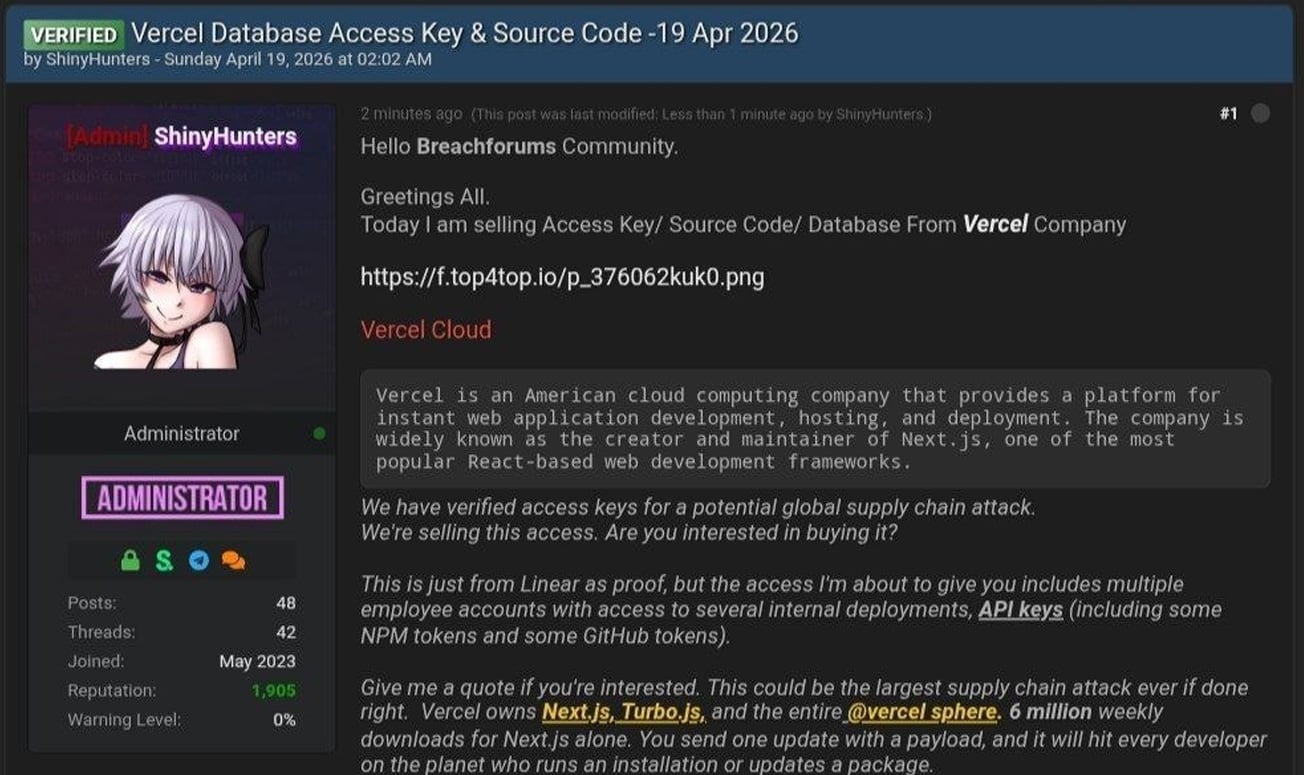
However, the threat landscape surrounding this event has grown complicated. Concurrent with Vercel’s admission, a threat actor has emerged on various dark web forums and encrypted messaging channels, claiming responsibility for the breach. This individual or group is asserting control over a repository of sensitive information, which they claim includes internal source code, access tokens, and database segments. The situation is further complicated by the actor’s alleged solicitation of a $2 million ransom, a demand they claim to have communicated directly to Vercel leadership.
Industry Context and the "ShinyHunters" Narrative
The claim of responsibility has been linked by the attacker to the "ShinyHunters" moniker, a name well-known in cyber-extortion circles. However, the attribution remains highly suspect. Security analysts have noted that the perpetrator’s tactics and the lack of verification regarding the stolen data have led some to conclude this may be a case of opportunistic impersonation rather than a coordinated operation by the actual group.

In the modern threat environment, the use of established brand names by lower-tier hackers is a common tactic intended to increase the credibility of extortion demands. Even if the data itself is legitimate, the provenance of the attack remains unclear. The actor has published samples of internal employee directories and screenshots of what appear to be enterprise-level dashboards, yet these fragments do not provide definitive proof of a widespread systemic collapse. The tech industry is increasingly wary of such claims, as they are often designed to sow panic and devalue a company’s market position or developer trust without providing substantive evidence of a massive breach.
The Risks to the Software Supply Chain
For the average Vercel customer, the primary concern is not just the loss of internal Vercel records, but the potential for lateral movement into their own applications. Vercel’s infrastructure is deeply integrated into the DevOps workflows of modern companies. By providing edge computing, serverless functions, and seamless GitHub integrations, the platform effectively manages the keys to the kingdom for many organizations.
If a threat actor gains access to API keys, NPM tokens, or GitHub credentials stored within Vercel, the risk of a "downstream" attack is profound. An adversary could theoretically inject malicious code into a customer’s deployment pipeline, a move that would compromise the end-user applications themselves. This is the nightmare scenario of software supply chain security: a platform used to build trust becomes the vector for distributing compromised code.
Consequently, Vercel’s directive to its customers is both urgent and necessary. The company has explicitly advised users to conduct a comprehensive audit of their environment variables. Specifically, they are urging developers to transition to Vercel’s sensitive environment variable feature, which provides an additional layer of encryption and obfuscation. Furthermore, the mandatory rotation of API secrets and tokens is not merely a suggestion—it is an essential defensive measure to invalidate any credentials that may have been harvested during the intrusion.

The Broader Implications for Cloud-Native Platforms
This incident highlights the precarious nature of the "Platform-as-a-Service" (PaaS) model. When development platforms become so highly abstracted and convenient, they naturally become high-value targets for nation-state actors and sophisticated cyber-criminal syndicates. The centralization of infrastructure creates a singular point of failure that, if breached, provides an attacker with a high-leverage position against a massive portfolio of enterprise clients.
Industry experts argue that this event serves as a wake-up call for the "Shift Left" security philosophy. While developers have been encouraged to build faster using platforms like Vercel, the responsibility for securing the underlying configuration often remains ambiguous. The incident underscores the necessity of "zero-trust" internal architecture. Even internal tools and dashboards should be protected by hardware-based multi-factor authentication (MFA) and granular access controls that limit the potential blast radius if a single employee account is compromised.
Analysis of the Investigative Process
As the investigation proceeds, the spotlight is on how Vercel manages the delicate balance between transparency and operational security. Disclosing a breach is a double-edged sword; full transparency is vital for customer trust, but revealing too much detail can inadvertently provide a roadmap for other threat actors.
The involvement of law enforcement indicates that Vercel is treating the extortion claim with the gravity it deserves. However, the legal and ethical dilemmas surrounding ransom negotiations remain a significant topic of debate. Companies that pay ransoms often do so to protect their customers’ data, yet they risk funding future operations and creating a target on their own backs. Vercel’s refusal to confirm or deny the negotiation process reflects the standard industry playbook of maintaining silence to protect the integrity of ongoing law enforcement cooperation.
Future Trends in Cloud Security
The Vercel breach is likely to accelerate several trends in cloud security:
- Ephemeral Secrets: We will likely see a move away from static API keys and tokens in favor of short-lived, dynamic credentials that expire automatically after a deployment or build process. This minimizes the utility of stolen data for an attacker.
- Increased Scrutiny of CI/CD Integrations: Organizations will begin to implement more rigorous audits of the third-party platforms that hold their repository access. We can expect to see more companies treating their deployment providers as "zero-trust" entities, limiting the permissions granted to these platforms.
- Automated Security Validation: Technologies that allow for continuous, automated validation of security controls—such as identifying unpatched vulnerabilities or misconfigurations in real-time—will become standard requirements for any cloud-native organization. The focus will shift from "securing the code" to "securing the entire ecosystem" that deploys the code.
Conclusion
As the dust settles on this incident, the developer community remains in a state of heightened vigilance. While Vercel appears to have contained the unauthorized access to its internal systems, the incident serves as a stark reminder that even the most robust and innovative platforms are susceptible to the persistent efforts of threat actors.
The resilience of the modern internet depends on the trust placed in these cloud-native providers. For Vercel, the path forward involves not just fixing the specific vulnerability that allowed for this breach, but also transparently communicating the systemic changes they are implementing to ensure this does not recur. For their users, the incident is a reminder that in an interconnected ecosystem, security is a shared responsibility. The era of "set it and forget it" deployment is over; the future requires a proactive, defensive posture that treats every line of configuration and every environment variable as a critical asset worthy of constant protection. As the investigation progresses, the industry will be watching closely to see what lessons are learned and what defensive standards will be raised in the wake of this significant security event.
