

In the rapidly evolving landscape of mobile cinematography, the barrier between amateur snapshots and professional-grade content has never been thinner. As smartphone camera sensors continue to push the boundaries of computational photography and high-bitrate video, the physical stability of the handheld device remains the final frontier for aspiring creators. For those looking to elevate their production quality without investing in bulky cinema rigs, Hohem has emerged as a pivotal player, and a new round of aggressive discounts on their flagship stabilization hardware presents a compelling entry point for both hobbyists and seasoned influencers.
The Evolution of Mobile Stabilization
Gimbal technology has traveled a long way from the early days of jittery, oversized motors and complex balancing acts. Today, modern stabilizers are characterized by their "fold-and-go" portability, intelligent software integration, and—most importantly—artificial intelligence (AI) assistance. The industry has shifted toward making the stabilization process invisible, allowing the creator to focus on narrative and composition rather than hardware calibration.
Hohem’s current lineup, which is seeing significant price reductions across major retail platforms through April 26th, reflects this shift. By integrating AI-powered tracking modules that function independently of smartphone applications, the company is effectively decoupling the hardware from the constraints of specific software ecosystems. This is a critical development for creators who prefer the native camera apps of their smartphones or third-party professional tools like Blackmagic Camera or Filmic Pro, as they no longer have to sacrifice tracking intelligence for creative freedom.
Analyzing the Hohem iSteady V3: The Compact Powerhouse
At the $99.99 price point, the iSteady V3 represents arguably the most value-dense entry in the mobile gimbal market. While budget-conscious shoppers might hesitate at the triple-digit barrier, a technical breakdown of its feature set reveals why it outperforms cheaper, non-stabilized alternatives.
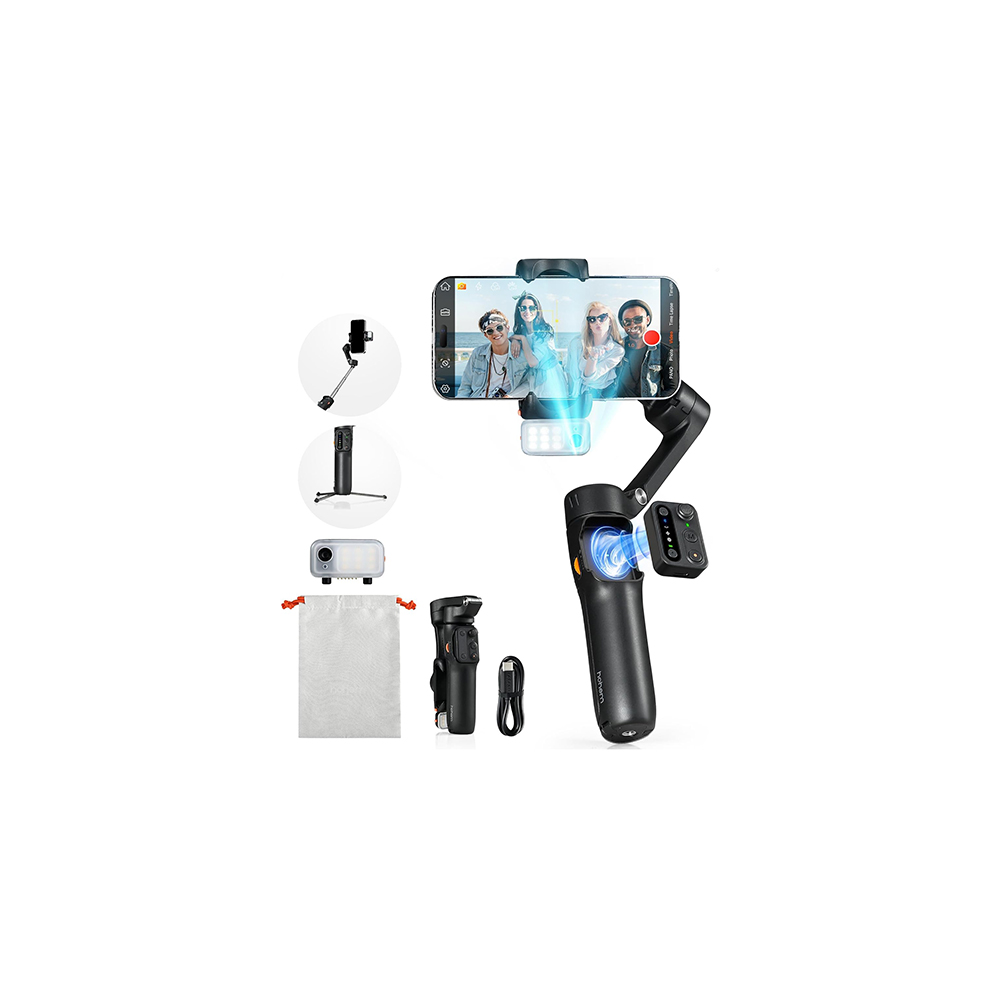
The V3 utilizes a robust 3-axis stabilization architecture, which physically compensates for the pitch, roll, and yaw movements inherent in walking or hand-held shooting. What distinguishes this model is the magnetic AI sensor module. Unlike systems that rely on the smartphone’s processor to perform object detection—which can lead to latency and battery drain—the V3’s sensor is self-contained. This onboard processing allows the gimbal to lock onto a subject’s face or body with high-speed precision, regardless of the app being used. Furthermore, the inclusion of a multi-color fill light directly on the tracking module addresses the "low-light" dilemma that often plagues mobile videographers, providing consistent subject illumination without the need for additional bulky LED panels.
Stepping Up: The iSteady V3 Ultra
For users who require more creative headroom, the iSteady V3 Ultra bridges the gap between a portable stabilizer and a professional cinema tool. The most notable upgrade here is the introduction of 360-degree infinite panning. In standard gimbals, the motor has a physical "stop," which can disrupt a long, sweeping cinematic take. The Ultra model eliminates this constraint, facilitating complex shots like "Inception-style" rolls or long-duration tracking around a subject.
The addition of a touchscreen interface on the detachable remote is a significant industry-forward feature. By allowing the user to preview their framing and adjust gimbal parameters remotely, Hohem is catering to the "solo creator" economy. This design philosophy acknowledges that many content creators are working without a dedicated camera operator; having the ability to see the shot and adjust gimbal speed or orientation from a distance is a professional convenience that was previously reserved for much more expensive stabilization systems. With increased motor torque, the Ultra also comfortably accommodates larger, heavier flagship smartphones, ensuring that the motors do not strain under the weight of oversized camera bumps or protective cases.
The Apex: The iSteady M7 Experience
At the top of the hierarchy sits the iSteady M7, a device that signals Hohem’s intent to compete with premium-tier stabilizers. The M7 is not merely a refinement of the V3 line; it is a platform designed for heavy-duty content creation.
The M7’s payload capacity of up to 1.1 pounds (roughly 500g) is a standout specification. In an era where flagship phones are trending toward larger form factors, many compact gimbals struggle to maintain balance. The M7’s stronger motors ensure that the gimbal remains agile even when tasked with carrying a modern smartphone equipped with an anamorphic lens or an external microphone.
The inclusion of 360-degree RGB lighting is another strategic move. By allowing users to customize the color temperature and hue of their fill light, creators can match the mood of their environment, a feature common in high-end studio lighting but rare in portable gimbal hardware. Furthermore, the ability to use the gimbal as a power bank—reverse charging the smartphone—solves a long-standing pain point: the limited battery life of smartphones during high-intensity 4K video recording.
Industry Implications and Future Trends
These aggressive pricing strategies highlight a broader trend: the commoditization of high-end stabilization features. As AI integration becomes standard, the competition is shifting from "who can make the smoothest motor" to "who can provide the most intelligent workflow." We are moving toward a future where gimbals act as an extension of the camera’s OS.
Future developments in this space will likely focus on deeper integration between the gimbal’s AI sensor and the smartphone’s camera firmware. We expect to see more "gesture control" capabilities, where the gimbal anticipates the movement of the subject before it happens, using predictive algorithms. Additionally, the trend of modularity—seen in Hohem’s detachable remotes—is likely to expand, perhaps into modular tripod feet that can be replaced with specialized attachments for mounting microphones or specialized sensors.
Purchasing Considerations
For those considering these deals, it is important to analyze your specific needs. The iSteady V3 is the ideal "daily driver" for vloggers and social media creators who value portability and quick setup. The Ultra is recommended for those who prioritize cinematic movement and flexibility, particularly for landscape photography or complex B-roll. The M7 is an investment for the professional creator who intends to push their mobile rig to its physical limits, potentially adding lens accessories or external audio gear.
The current window for these discounts, closing on April 26th, represents a rare opportunity to acquire high-fidelity stabilization hardware at prices that typically align with entry-level, non-AI equipment. As mobile devices continue to displace traditional dedicated cameras in professional workflows, tools that bridge the gap between "handheld" and "cinematic" are becoming essential, not just for professionals, but for anyone looking to produce high-quality digital assets. By lowering the entry price for their entire range, Hohem is effectively lowering the barrier to entry for professional-level video production, allowing a broader demographic of creators to explore the technical nuances of movement-based storytelling. Whether you are filming a travel vlog, an athletic performance, or a corporate interview, the stability provided by these devices is the difference between a video that looks "amateur" and one that commands attention.
