

International cybersecurity agencies and law enforcement authorities have published a sweeping multi-national intelligence advisory exposing the scale of operations conducted by WaterPlum, a sophisticated North Korean threat group. Between December 2025 and July 2026, the state-backed cyber-espionage and financial crime collective successfully compromised a minimum of 30,000 computing devices across over 100 countries. During this sustained offensive, the operators systematically drained victim assets, siphoning in excess of $10.7 million—or roughly 1.7 billion Japanese yen—in stolen cryptocurrency directly back to the Democratic People’s Republic of Korea to finance state-level programs.
This comprehensive threat assessment represents a collaborative effort among premier intelligence and policing bodies, including the United States Federal Bureau of Investigation, Japan’s National Police Agency, the Australian Signals Directorate’s Australian Cyber Security Centre, and Germany’s Federal Office for the Protection of the Constitution (BfV). The coordinated public disclosure underscores the escalating convergence of state-sponsored cyber warfare, cryptocurrency theft, and industrialized employment fraud designed to bypass international economic sanctions.
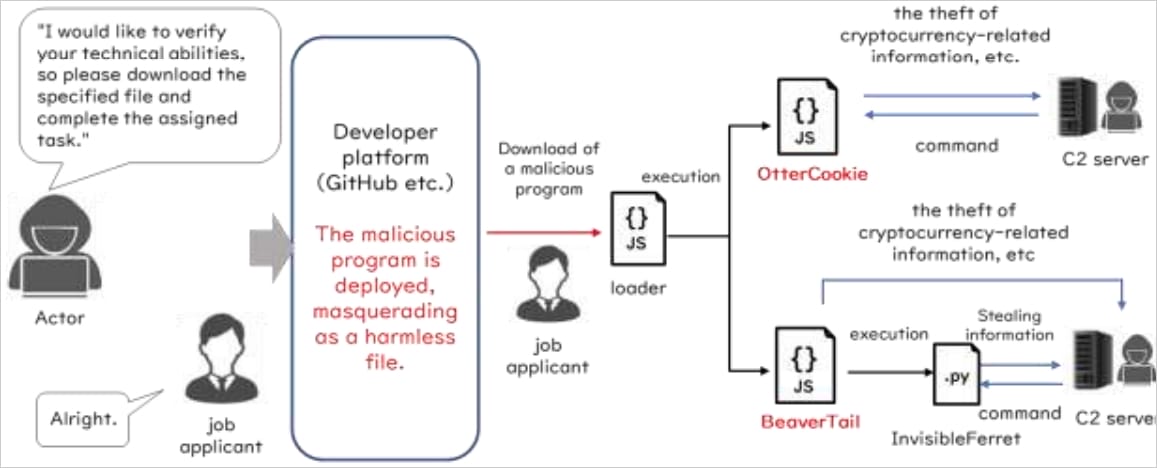
At the heart of WaterPlum’s operational playbook is a prolonged, highly targeted social engineering initiative widely tracked by cybersecurity researchers as the "Contagious Interview" campaign. Rather than relying on traditional perimeter breaches or broad phishing campaigns, the threat actors exploit the deep trust inherent in the global technology hiring ecosystem. Targeting ambitious job seekers, software developers, and IT specialists, the hackers establish initial contact through legitimate-seeming freelance platforms, professional networking sites, and job boards. They frequently mask their true identities by impersonating well-known artificial intelligence firms, cryptocurrency startups, and non-fungible token (NFT) organizations.
The trap is meticulously constructed to catch technical professionals off guard. During faux job interviews, technical assessments, and collaborative coding evaluations, victims are instructed by their supposed prospective employers to download and configure proprietary project repositories, troubleshoot simulated video-conferencing glitches, or execute specialized command-line utilities. Unbeknownst to the applicants, these actions trigger the deployment of malicious payloads—including custom malware families distributed via compromised open-source software registries like malicious Node Package Manager (npm) libraries.
Once a victim’s machine is successfully compromised, WaterPlum’s toolset rapidly goes to work. The deployed malware is engineered for deep espionage and asset theft, capturing browser-stored credentials, clipboard contents, active keystrokes, and continuous screenshots. Furthermore, the operators specifically hunt for high-value targets, successfully extracting private keys and seed phrases from over 7,000 individual cryptocurrency wallets. Beyond direct financial theft, the initial foothold acts as a strategic beachhead. The hackers leverage compromised workstations to pivot laterally into corporate, academic, and client networks, facilitating advanced intellectual property theft, corporate espionage, and long-term persistence within high-value enterprise environments.
One of the most alarming revelations detailed in the joint Western and Asian law enforcement advisory is the direct operational nexus between WaterPlum and North Korea’s sprawling network of fraudulent overseas IT workers. Intelligence agencies have established that individual hackers operating within the WaterPlum syndicate also moonlight as remote information technology contractors, securing freelance web development and software engineering roles with international clients. Investigators have repeatedly identified shared infrastructure, overlapping tactics, and identical Internet Protocol (IP) addresses bridging the cyber-attack wing and the fraudulent workforce operations.
To maintain these lucrative remote employment arrangements, the threat actors utilize stolen identity documents—often harvested directly from victims compromised during the "Contagious Interview" campaigns—to successfully pass background checks and KYC (Know Your Customer) verifications. Moreover, investigators uncovered concrete evidence that WaterPlum operatives routinely deploy advanced generative AI face-swapping software during live video interviews. When questioned or pressed during these online sessions, the actors intentionally disable their video feeds, attributing the sudden visual blackout to transient local network connectivity issues.
Attribution analyses compiled by the FBI and Japanese law enforcement link both the WaterPlum hacking collective and the broader fraudulent IT worker network directly to North Korea’s 313 General Bureau. This specialized entity operates under the umbrella of the Munitions Industry Department, the central governing body responsible for overseeing the regime’s illicit ballistic missile and nuclear weapons research and production. By establishing industrial-scale revenue streams through cybercrime and IT outsourcing, the bureau effectively bypasses international financial blockades.
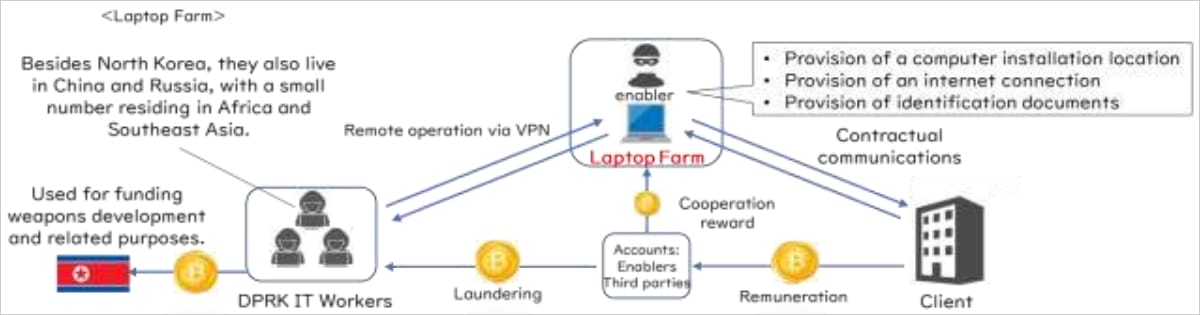
The operational footprint of this ecosystem extends far beyond digital code, as demonstrated by physical enforcement actions. In a landmark operation, Japan’s National Police Agency successfully identified, raided, and dismantled a domestic "laptop farm"—the first such infrastructure hub uncovered within the country. Investigators discovered that this localized proxy network had been utilized by North Korean IT workers to route remote desktop traffic, bypass geographic restrictions, and funnel hundreds of millions of yen back to foreign handlers.
The implications of this joint advisory for the global technology sector are profound. The intersection of generative AI, social engineering, and supply-chain poisoning has fundamentally altered the threat landscape for human resources and technical recruitment departments. Organizations can no longer rely on traditional trust models when hiring remote contractors or evaluating open-source code dependencies.
Security architects and industry analysts emphasize that defending against this sophisticated threat model requires a complete overhaul of internal security postures. Enterprises are strongly advised to implement rigorous verification protocols for prospective remote employees, including out-of-band identity confirmation, enhanced background checks, and strict adherence to the principle of least privilege. Workstations assigned to developers and IT personnel must be strictly isolated, ensuring that unknown code is exclusively executed within heavily monitored sandbox environments capable of detecting unexpected outbound network requests and payload-fetching mechanisms. As threat actors continue to weaponize professional recruitment pipelines, the burden falls on both employers and the broader developer community to fortify their defenses against state-sponsored infiltration.
