


The intersection of artificial intelligence and malicious software has crossed a critical threshold, transitioning from experimental generation scripts to sophisticated operational optimization. Security researchers have uncovered a new remote access trojan (RAT) called Dolphin X, which integrates a specialized machine-learning subsystem designed to solve one of the most persistent bottlenecks in modern cybercrime: the manual triage of stolen data. Rather than relying solely on raw data exfiltration, this platform attempts to introduce intelligence-driven analytics directly into the attacker’s command-and-control workflow, allowing illicit operators to instantly identify and monetize the most lucrative nodes within a compromised enterprise or consumer environment.
Discovered and scrutinized by threat intelligence specialists, the Dolphin X framework was brought to light following an exhaustive investigation into underground cybercrime forums. Marketed aggressively by an underground vendor operating under the alias "Kontraktnik," the software is packaged as a comprehensive, all-in-one suite capable of handling nearly every phase of a digital compromise. The sheer scale of the administrative infrastructure accompanying the malware underscores a broader industrialization trend within the modern threat landscape, where commercialization and feature bloat mirror legitimate enterprise software development cycles.
An Examination of the Command-and-Control Architecture
Deep-dive analyses of the Dolphin X operator panel reveal a staggering degree of functional complexity. The administrative dashboard boasts an inventory of 329 distinct features distributed across ten operational categories. This breadth of capability positions the tool not merely as a targeted reconnaissance utility, but as a sweeping surveillance and harvesting instrument. Among its advertised functions is an extensive credential-harvesting apparatus engineered to compromise more than 300 distinct applications, ranging from mainstream productivity software to specialized developer environments.
Security analysts who dissected the malware’s builder, configuration panels, and associated network communications in a controlled sandbox environment noted that the architecture is built for mass deployment. The credential-stealing module alone targets at least nine major Chromium- and Gecko-based web browsers, one hundred cryptocurrency wallet browser extensions, sixty-five standalone desktop cryptocurrency wallets, ten dedicated password management solutions, and upwards of thirty cloud-native command-line utilities. Furthermore, the threat toolkit is designed to scour local file systems for sensitive development artifacts, including environment configuration (.env) files, secure shell (SSH) private keys, cloud platform access tokens, and browser-cached authentication cookies.

Despite the expansive scope of these traditional data-gathering mechanisms, the defining hallmark of Dolphin X lies in its departure from unstructured collection. Historically, mass-credential harvesters inundate attackers with millions of individual records, creating a massive data-processing hurdle. Threat actors frequently waste valuable time sifting through thousands of low-value consumer accounts, vanity cryptocurrency wallets, and dormant corporate logins before stumbling upon an asset of genuine financial or strategic significance. Dolphin X attempts to eliminate this friction through the integration of its proprietary "AI Profiler."
The Mechanics of the AI Profiler
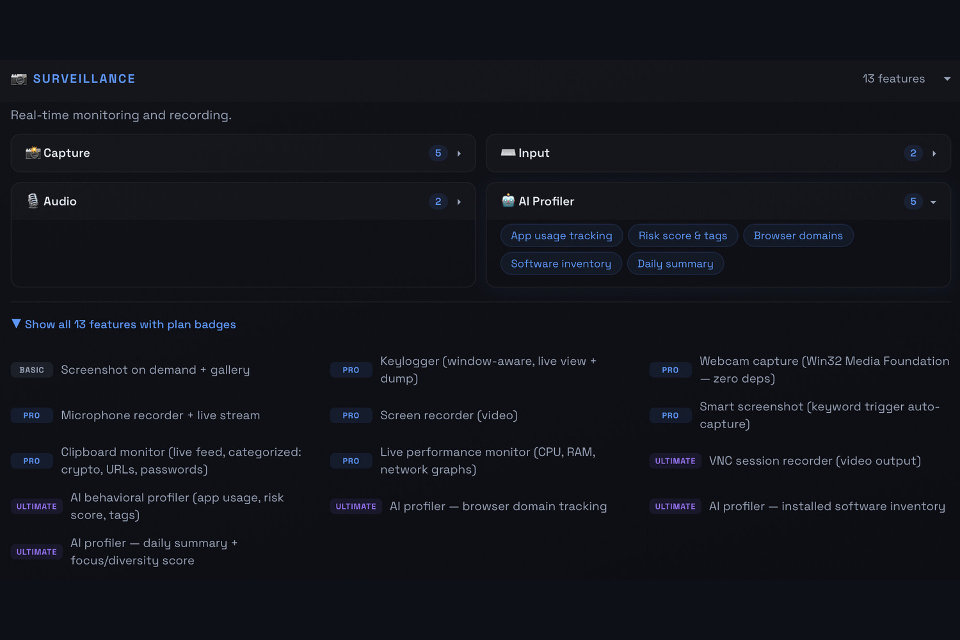
According to documentation provided within the administrative interface and corroborated by technical indicators found within the malware binaries, the AI Profiler is explicitly designed to function as an automated sorting and scoring engine. Once the agent successfully compromises a host machine and begins harvesting telemetry, the backend panel processes the incoming data stream to assign a quantitative risk score and a series of behavioral tags to each infected user.
The system evaluates multiple vectors simultaneously. It analyzes application usage patterns, reviews the specific browser domains visited by the victim, catalogues the installed software ecosystem, and correlates this information against predefined enterprise and financial indicators. The resulting output is structured into organized daily summaries that rank victim profiles in descending order of value.
Investigators confirmed the structural legitimacy of this workflow by uncovering explicit configuration strings within the operator panel’s codebase. Identifiers such as Auto-Start AI Profiler, ProfilerStart, ProfilerGetData, risk_score, risk_factors, and categoryusage demonstrate that the data-processing pipelines are fully implemented within the control software. While analysts could not definitively isolate the exact underlying machine learning model or third-party artificial intelligence engine driving the rankings—due to the absence of a live-executing malware agent in the initial phase of the study—the presence of these analytical hooks indicates a clear shift toward data-driven prioritization.
By automating the triage process, the Dolphin X operator panel enables cybercriminals to bypass the tedious manual review of exfiltrated logs. Instead of treating every compromise equally, an attacker logging into the dashboard is immediately directed toward machines that grant privileged access to high-net-worth accounts, enterprise cloud environments, proprietary source code repositories, or production server infrastructure. This efficiency directly increases the velocity of follow-on attacks, such as targeted ransomware deployment or corporate espionage.

Broader Industry Implications and the Evolution of Threat Engineering
The emergence of Dolphin X highlights a maturing trend in how malicious actors leverage artificial intelligence. Over the past several years, the security community has observed a proliferation of AI-assisted cybercrime services, ranging from text-generation models fine-tuned to write convincing spear-phishing emails—such as SpamGPT—to autonomous agent frameworks designed to navigate compromised networks without human intervention.
However, Dolphin X represents a different application of the technology. Rather than using artificial intelligence to orchestrate the initial intrusion or generate social engineering lures, the developers have harnessed analytical modeling to solve an internal operational bottleneck: data overload. As organizations harden their defenses and threat actors cast wider nets using infostealers distributed via malvertising, drive-by downloads, and compromised software installers, the volume of harvested credentials has reached unprecedented levels. The criminal underground is increasingly reliant on automated data parsing to remain profitable.
This development signals a broader shift toward data-driven cybercrime operations. As threat intelligence platforms and automated security solutions inside enterprises grow more sophisticated at detecting anomalous network traffic and endpoint behavior, malware authors are racing to make their own operations faster and more discreet. By letting an automated profiling engine handle the heavy lifting of target selection, human operators reduce their active footprint within a compromised network, spending less time rummaging through useless files and more time executing high-impact monetization strategies.
Defensive Strategies and Future Outlook
For corporate security teams and security operations centers (SOCs), the capabilities embodied by platforms like Dolphin X underscore the critical need for robust, defense-in-depth security architectures. Traditional perimeter defenses and reactive signature-based detection are increasingly inadequate against multi-faceted threats that combine broad credential theft with advanced internal reconnaissance.
Defenders must assume that initial compromises involving infostealers are almost inevitable given the ubiquity of modern web-based threats and targeted social engineering. Consequently, mitigation strategies must pivot heavily toward identity protection and behavioral monitoring. Implementing robust multi-factor authentication (MFA)—specifically cryptographically bound, phishing-resistant tokens such as FIDO2-compliant hardware keys—drastically diminishes the utility of stolen browser cookies and session tokens.
Furthermore, organizations must prioritize continuous breach and attack simulation (BAS) to test the efficacy of Security Information and Event Management (SIEM) and Endpoint Detection and Response (EDR) rules. Industry data consistently demonstrates that many successful intrusions go unnoticed by standard logging mechanisms, allowing threat actors to move quietly through an environment long before a human analyst intervenes. Regularly auditing cloud service configurations, strictly enforcing least-privilege access models, and monitoring for unusual command-line tool execution can help intercept attackers before an automated profiler can flag a compromised endpoint as a high-value asset.
As artificial intelligence continues to mature, its integration into both defensive cybersecurity tools and offensive malware platforms will only accelerate. The debut of tools like Dolphin X serves as an early indicator of a future where cybercrime is increasingly automated at every stage of the lifecycle. Security professionals must anticipate adversaries who are not only faster and more organized, but fundamentally smarter in how they identify and exploit enterprise vulnerabilities.
