

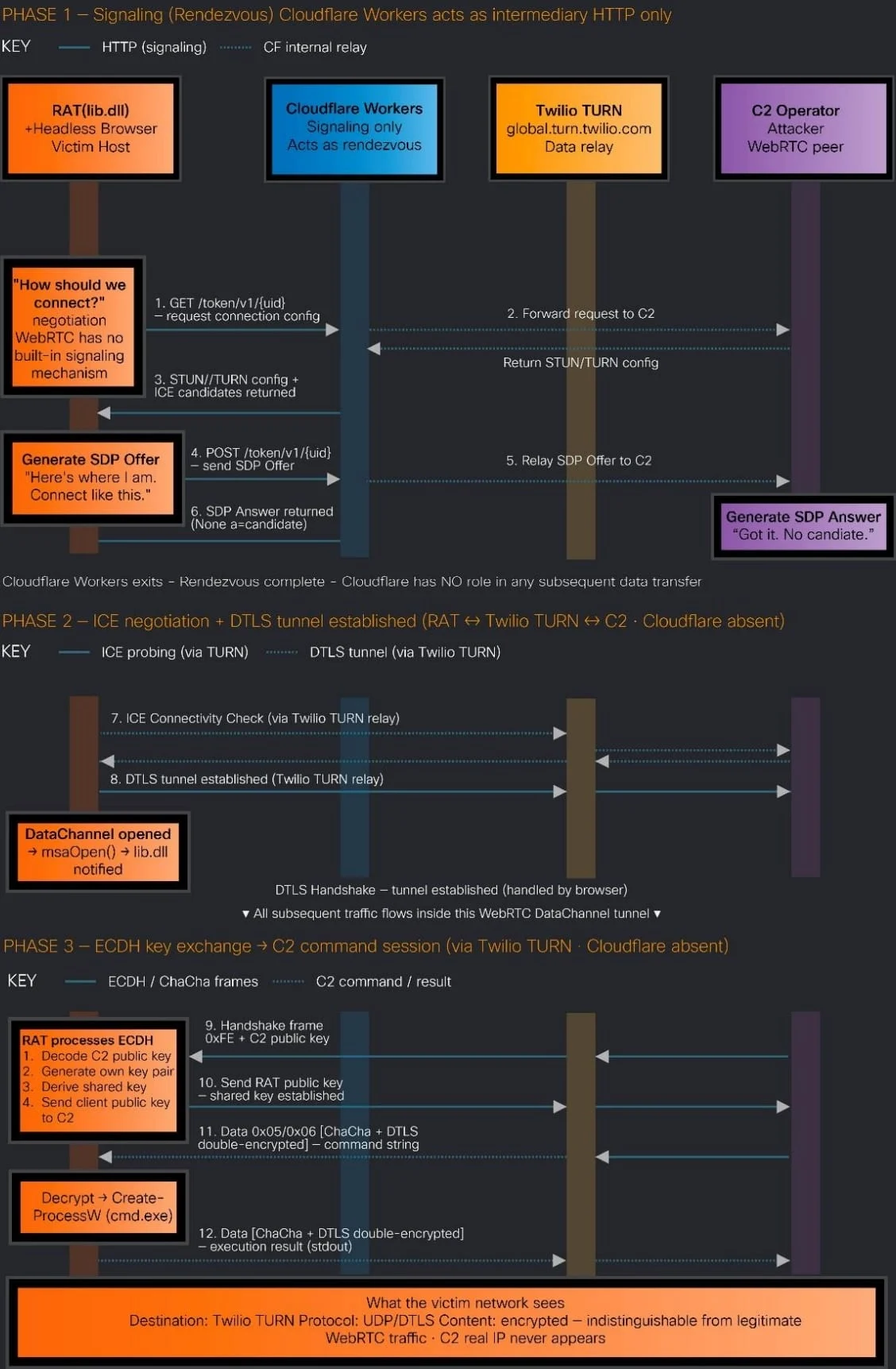
The ongoing evolution of offensive cyber capabilities continues to blur the lines between legitimate administrative tooling and malicious execution. Threat actor syndicates constantly seek innovative vectors to blend their operational traffic with benign network flows, effectively neutralizing traditional perimeter defenses. Among the latest developments in this adversarial arms race is the emergence of msaRAT, a sophisticated backdoor deployed by the Chaos ransomware operation. Designed to exploit the structural integrity of popular Chromium-based web browsers, this utility weaponizes everyday applications like Google Chrome and Microsoft Edge to shroud its command-and-control (C2) communication in absolute obscurity.
By leveraging native developer features and established cloud platforms, msaRAT bypasses standard socket-level detection mechanisms entirely. Security analysts and threat intelligence researchers examining the artifact have underscored its architectural elegance—and its distinct danger. Rather than generating bespoke network packets or querying suspicious domain names directly from an executable binary, the malware delegates all connectivity to an invisible, headless browser instance. This design paradigm shift forces defenders to reconsider how they monitor endpoint behavior and inspect application-layer traffic.
The Evolution of the Chaos Threat Group
To understand the tactical significance of msaRAT, one must examine the operational landscape of its parent organization. The Chaos ransomware ecosystem, which surfaced in early 2025 as a distinct entity unrelated to legacy ransomware variants bearing the same moniker, has quickly established itself as a formidable force in the cybercrime underground. Its trajectory has been characterized by operational adaptability and strategic partnerships.

Earlier observations by incident response and threat intelligence providers revealed that the Chaos framework had been adopted by advanced persistent threat (APT) actors, notably the Iranian state-backed collective known as MuddyWater. In those campaigns, the ransomware infrastructure served as a sophisticated decoy, allowing state-sponsored espionage operators to mask intelligence-gathering missions behind the chaotic, financially driven facade of standard extortion attacks. This convergence of financially motivated tooling and nation-state tradecraft highlights a broader industry trend: the commodification and sharing of advanced attack surfaces across distinct threat categories.
Recent telemetry captured by enterprise threat research organizations indicates that modern intrusions orchestrated by this cluster frequently begin via traditional social engineering vectors, such as highly targeted email phishing or voice phishing (vishing) campaigns. Once initial access is secured, operators deploy remote management software to anchor persistence within the compromised enterprise. The ultimate payload delivery involves an MSI installer disguised as an authentic operating system patch, which silently unpacks and injects the msaRAT dynamic-link library (lib.dll) straight into system memory, ensuring minimal disk footprint and reduced exposure to static file-scanning tools.
Architectural Breakdown: Hijacking Chromium via Developer Protocols
The core innovation of msaRAT lies in its abuse of the Chrome DevTools Protocol (CDP). Written primarily in Rust—a systems programming language increasingly favored by malware authors for its performance and memory safety characteristics—the backdoor begins its execution cycle by querying the host environment for the presence of Google Chrome or Microsoft Edge.
Upon identifying a valid browser installation, the backdoor forces the application to launch in headless mode. In this operational state, the browser runs as a background process completely devoid of any graphical user interface, rendering it invisible to the everyday user logged into the workstation. The malware then activates the browser’s integrated remote debugging interface, anchoring a connection through CDP.

Through these developer channels, msaRAT instantiates a hidden browser tab and injects custom JavaScript payloads directly into the context of the session. This injected code accomplishes several crucial objectives: it establishes the foundation of the covert communication pipeline, overrides the browser’s Content Security Policy (CSP) enforcement parameters, and registers specific CDP bindings required to sustain bidirectional data exchange.
Navigating the Multi-Layered Tunneling Infrastructure
Once the browser-based environment is fully provisioned, the operational mechanics shift toward a complex, multi-tiered relay network designed to break traditional heuristic analysis and packet inspection.
First, the headless browser initiates a connection with a Cloudflare Workers endpoint (is-01-ast[.]ols-img-12[.]workers[.]dev). This serverless environment acts as a signaling mechanism, supplying the necessary WebRTC connection parameters required to instantiate an encrypted data channel. Security researchers emphasize that msaRAT enforces a dual-layered encryption model. The initial layer relies on WebRTC Datagram Transport Layer Security (DTLS), which is natively provisioned by the browser engine itself. Wrapped inside this native transport security is a secondary, application-level encryption scheme driven by ChaCha20-Poly1305 coupled with an Elliptic-Curve Diffie-Hellman (ECDH) key exchange implemented directly by the malware author.
To ensure that the attacker’s true infrastructure remains masked behind layers of legitimate third-party services, the communication flow is intentionally routed through Twilio TURN (Traversal Using Relays around NAT) servers. Standard WebRTC communications typically attempt to establish direct peer-to-peer (P2P) connections by gathering Interactive Connectivity Establishment (ICE) candidates. However, msaRAT explicitly strips these ICE candidates from the handshake process.
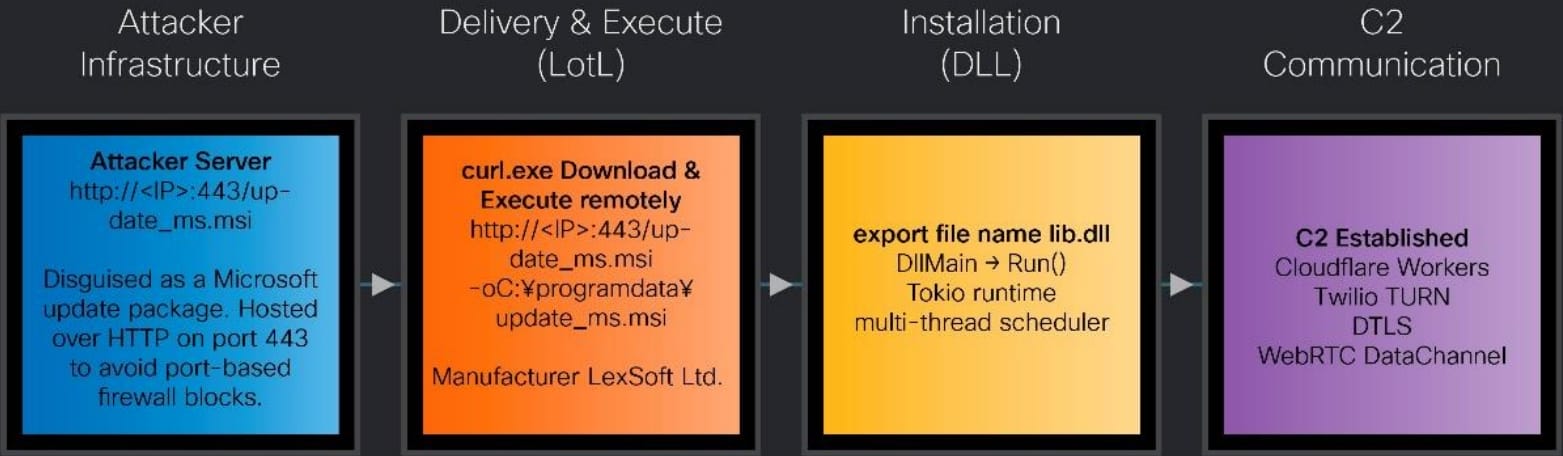
By omitting ICE candidates, the malware deliberately prevents direct P2P connections from forming, compelling all data traffic to pass continuously through the Twilio relay nodes. Consequently, the actual IP address of the command-and-control server never appears in raw network telemetry. Network defenders investigating the flow observe traffic interacting exclusively with reputable, trusted cloud services—Twilio and Cloudflare—rendering standard IP-based blocklists and reputation filters entirely obsolete.
Operational Frames and Data Exchange
Data moving across this heavily obfuscated pipeline is broken down into structured binary segments designated as "frames." These frames handle diverse operational directives, including cryptographic key exchanges, channel provisioning and termination, session resets, and native Windows command execution. By packaging commands in this granular fashion, the operators can execute remote shell tasks on the victim machine while ensuring that the network signature mirrors standard, benign browser-based web socket or WebRTC activity.
Furthermore, the utilization of the *.workers.dev subdomain namespace introduces significant operational security challenges for enterprise network administrators. Because this free subdomain is universally utilized by legitimate software developers and enterprise tooling for edge computing deployments, blocking or heavily throttling the domain wholesale is rarely viable. Doing so would invariably disrupt critical business operations and benign web services, giving sophisticated threat actors a durable, high-reputation hiding spot for their malicious signaling infrastructure.
Industry Implications and the Shift Toward Living-Off-The-Trusted-App
The deployment of msaRAT marks a profound escalation in the ongoing cat-and-mouse dynamic between enterprise security teams and advanced threat actors. For years, the security industry has focused heavily on detecting anomalous outbound connections, unauthorized ports, and direct beaconing to known malicious IP addresses. The architectural design of msaRAT subverts these foundational detection models by shifting the execution of network protocols into the exact same browser processes that knowledge workers utilize every single hour of the workday.
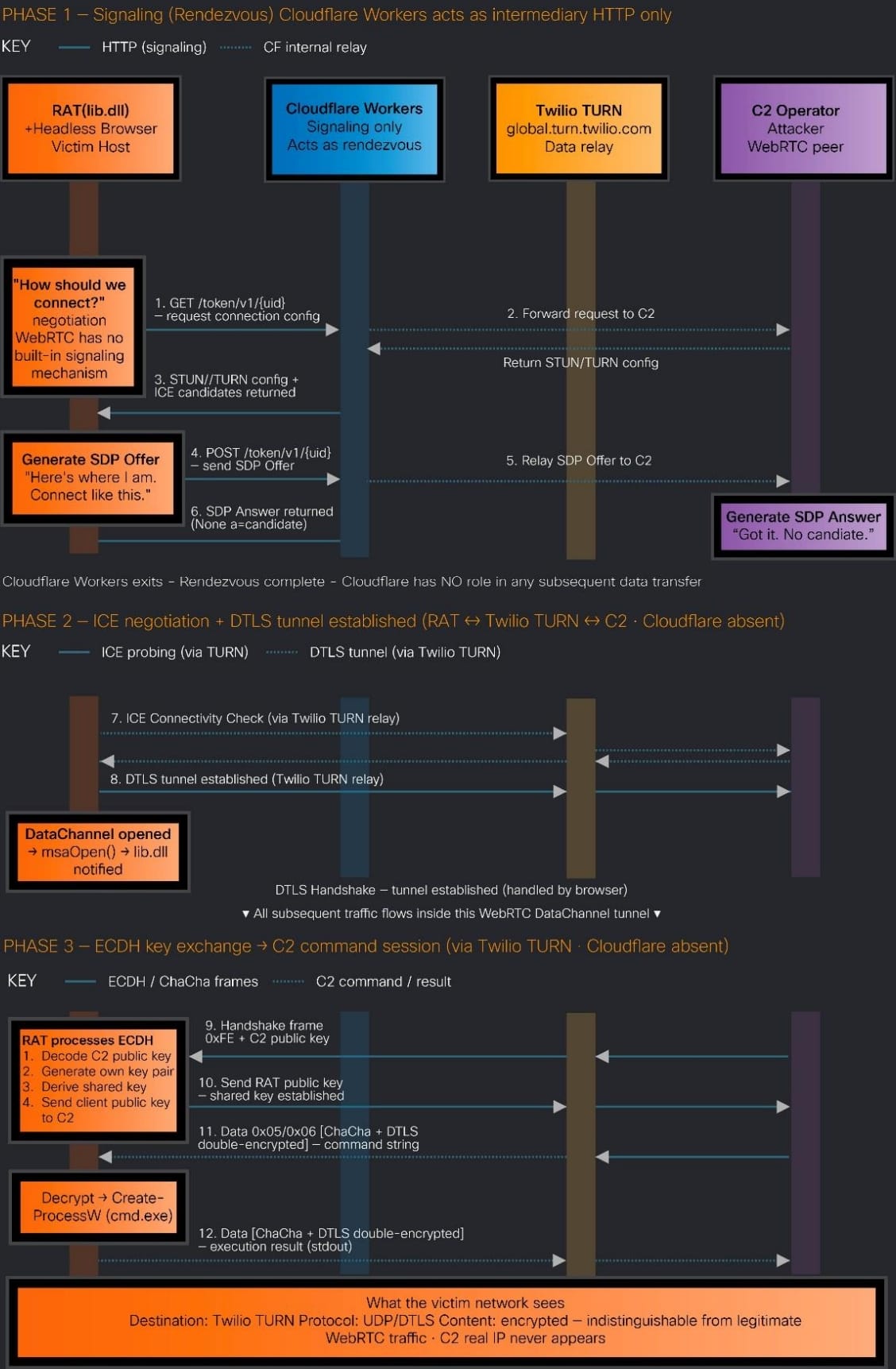
When malicious command-and-control traffic is indistinguishable from legitimate web application usage, traditional Endpoint Detection and Response (EDR) agents and Next-Generation Firewalls (NGFWs) face severe visibility blind spots. Because the browser process holds valid certificates, communicates over standard ports (HTTPS/WebRTC), and interacts with trusted global cloud infrastructure, alerting thresholds based on simple network behavior often result in unacceptable levels of false positives or complete missed detections.
Security analysts point out that combating this class of threat requires a pivot toward deep behavioral monitoring inside the endpoint operating system. Organizations must increasingly scrutinize anomalous command-line arguments used to launch browsers—such as unexpected flags enabling remote debugging or headless execution—alongside abnormal inter-process communication (IPC) patterns where unknown binaries interact with browser debugging sockets.
Future Outlook and Defensive Countermeasures
As offensive methodologies continue to incorporate legitimate administrative tools and dual-use cloud primitives into their kill chains, the security community must adapt its defensive posture accordingly. Threat actors will undoubtedly refine techniques that leverage native software features—such as browser developer tools, cloud serverless functions, and enterprise relay networks—to maintain persistence and exfiltrate data without triggering perimeter alarms.
Mitigating threats like msaRAT necessitates a comprehensive, defense-in-depth strategy. Enterprise security architects should consider enforcing rigid endpoint policies that disable unnecessary browser debugging features via Group Policy Objects (GPO) or Mobile Device Management (MDM) profiles, particularly on high-value workstations and domain controllers. Additionally, implementing advanced breach and attack simulation (BAS) testing can help security operations centers (SOCs) evaluate whether their Security Information and Event Management (SIEM) and EDR correlation rules are capable of catching subtle anomalies, such as headless browser spawning events paired with unusual script injection behaviors.
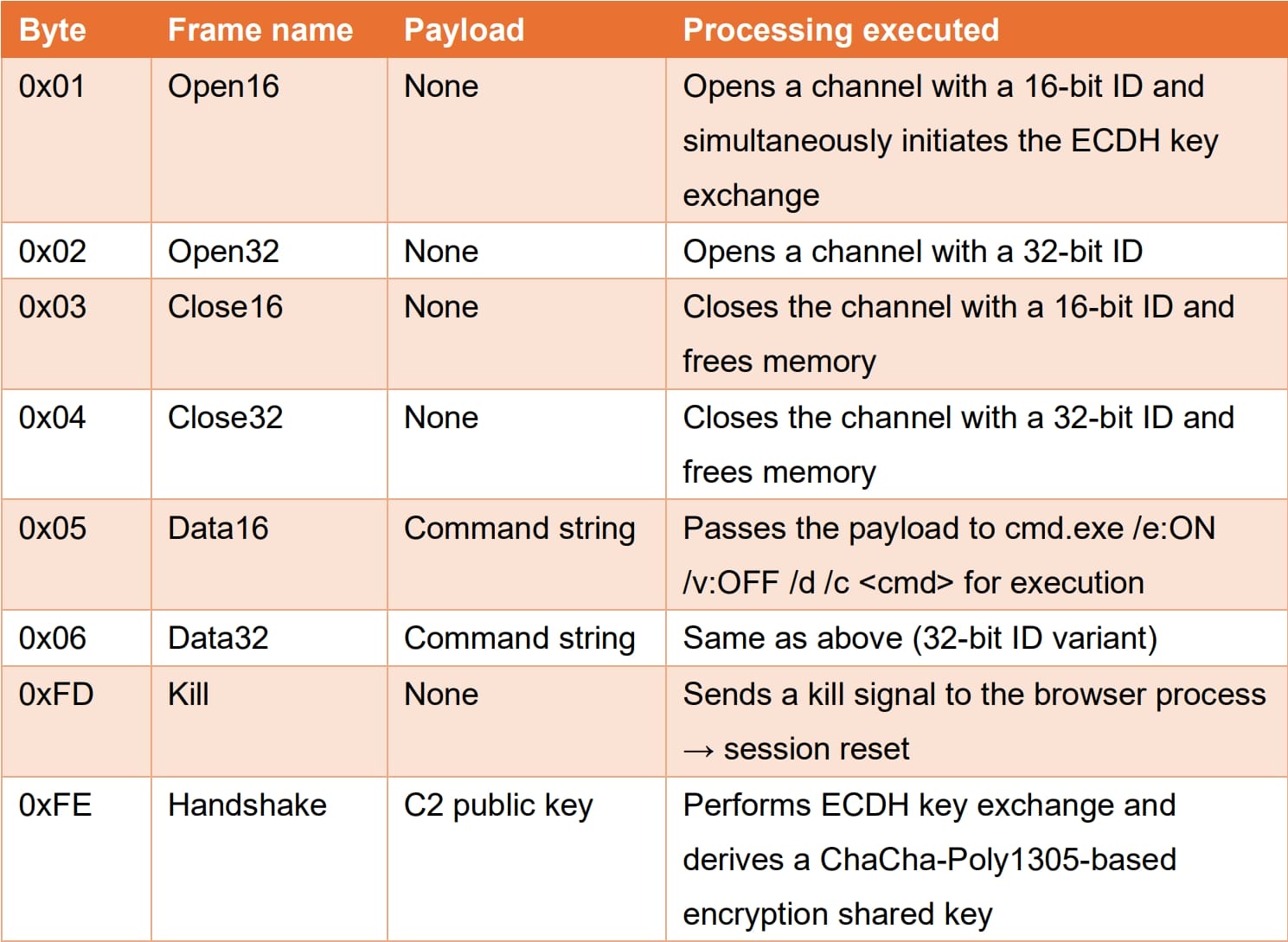
Ultimately, the emergence of browser-routed backdoors serves as a stark reminder that the perimeter has dissolved inward. As malware continues to hide in plain sight behind the trusted glass of enterprise web browsers, defenders must rely on holistic endpoint visibility, rigorous behavioral telemetry analysis, and proactive threat hunting to uncover the sophisticated threats lurking within everyday network traffic.
