

The landscape of software supply chain security has faced yet another severe stress test following widespread disclosures and active exploitation targeting a high-severity security flaw within Gitea, a globally popular self-hosted Git and software development platform. As modern engineering teams increasingly lean on self-hosted ecosystems to maintain absolute data sovereignty and customized infrastructure controls, these localized environments have progressively transformed into high-value targets for sophisticated threat actors. Federal watchdogs and cybersecurity researchers alike have raised urgent alarms as automated exploitation routines begin sweeping across internet-accessible deployments, weaponizing an internal application programming interface to achieve unhindered remote code execution.
The architectural appeal of platforms like Gitea lies in their comprehensive, all-in-one DevOps utility, offering organizations localized code hosting, issue tracking, continuous integration pipelines, and code review workflows mirroring those of major cloud-native SaaS providers. However, this dense concentration of administrative capabilities, repository data, and build pipelines also represents a dangerous single point of failure if core validation layers are compromised. The ongoing incident highlights a troubling dichotomy in enterprise technology: while self-hosted tools grant organizations granular visibility and regulatory independence, they concurrently shift the burden of patch management, perimeter defense, and threat monitoring squarely onto internal IT and security teams—groups that are frequently overburdened or lack real-time visibility into emerging edge-case vulnerabilities.
Anatomy of the Vulnerability: Unpacking CVE-2026-60004
Tracked officially in vulnerability databases as CVE-2026-60004, the underlying flaw centers around improper input sanitization and execution control within Gitea’s specialized diffpatch API endpoint. The issue was initially brought to light through the analytical efforts of Salesforce security researcher Shai Rod, whose meticulous investigation revealed how structured patch submissions could be manipulated. Under normal operational circumstances, the diffpatch mechanism is designed to ingest and apply code modifications seamlessly across repositories. However, the architectural oversight allowed malicious actors with standard repository write permissions to construct and transmit specially crafted patches containing unauthorized instructions.
When a vulnerable Gitea instance processes these malicious patch files, the application fails to adequately isolate or restrict the underlying system calls. Consequently, an adversary can abuse the endpoint to drop, install, and directly execute a customized Git hook using repository-controlled data. Because these Git hooks execute within the native context of the host operating system, the executing shell commands inherit the full privileges and permissions of the Gitea service account. Depending on how the host environment was initially provisioned, this can easily translate to broad read and write access across the underlying filesystem, potential lateral movement vectors into adjacent internal network segments, or immediate privilege escalation scenarios.
The severity of CVE-2026-60004 is magnified exponentially when default installation configurations are taken into account. Out-of-the-box deployments of Gitea frequently ship with public self-registration enabled by default. This permissive posture implies that an unauthenticated, external malicious actor requires no prior credentials, valid enterprise invites, or social engineering pretexts to interface with the server. An attacker can simply navigate to an exposed instance, provision a new user account through the standard web UI, establish an isolated repository, and immediately leverage the diffpatch API vector to trigger remote code execution. This frictionless pathway from an anonymous internet visitor to an authenticated code-level attacker transforms what might otherwise be a restricted insider threat into a wide-open vector for automated botnets and opportunistic cybercriminals.
The Scale of Exposure and Early Field Exploitation
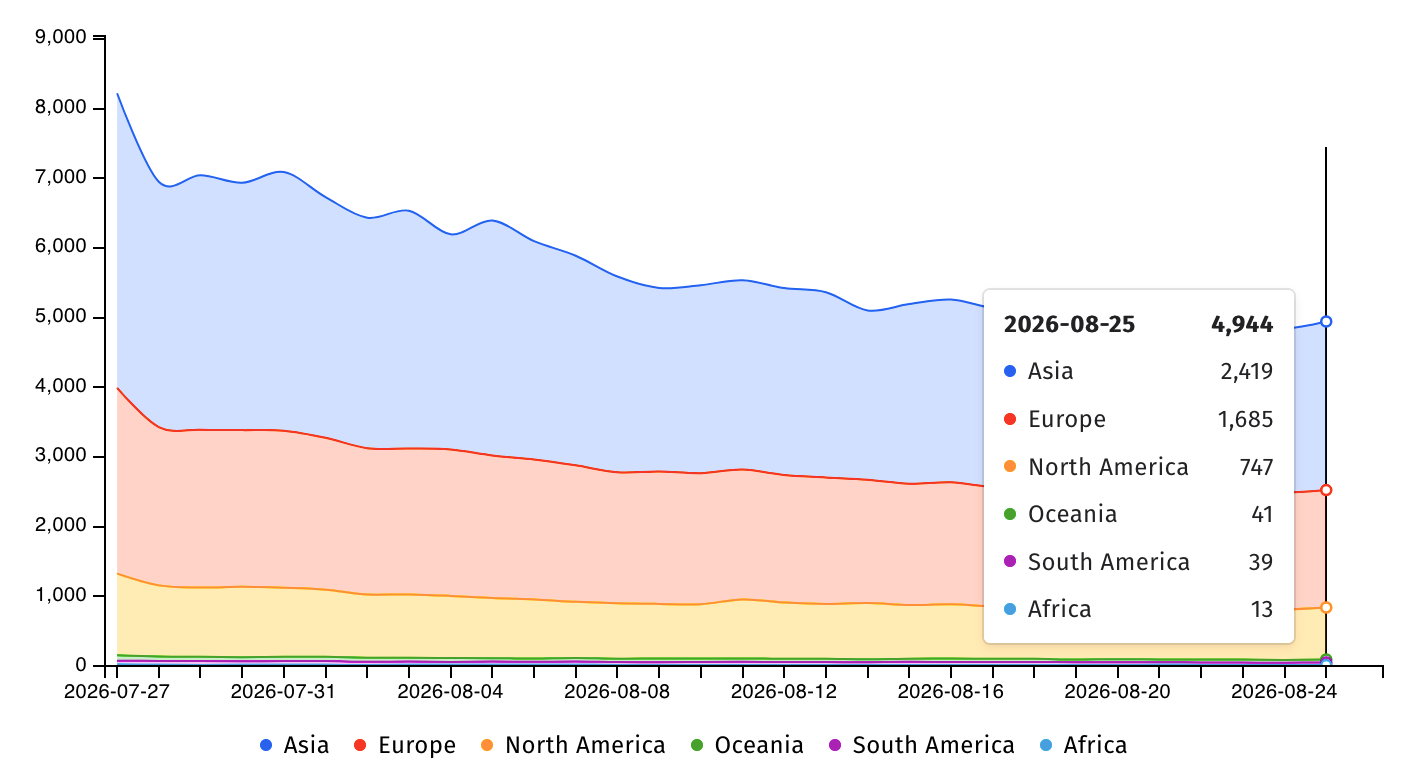
In the immediate wake of the vulnerability disclosure, telemetry gathered by global cybersecurity observability organizations like Shadowserver painted a precarious picture of global internet infrastructure. Analysts quickly mapped nearly 5,000 distinct Gitea instances actively exposed to the public internet. While this aggregate tally undoubtedly includes a mix of production environments, internal testing servers, and security researcher honeypots, the sheer volume of reachable targets illustrates the profound challenge of securing modern software development perimeters.
Real-world exploitation campaigns did not lag far behind the initial advisory drops. Independent telemetry and regional security reports highlighted automated exploitation scripts actively probing the web for unpatched endpoints. Rather than engaging in highly targeted, stealthy corporate espionage, initial wave actors frequently favored widespread financial opportunism—specifically, the covert deployment of resource-intensive cryptocurrency mining malware. While cryptojacking campaigns are often viewed as relatively low-sophistication noise compared to state-sponsored persistent threats, they serve as a glaring warning sign. The presence of commodity miners on a software development server often indicates that threat actors have successfully established persistent root-level access, meaning sensitive source code repositories, proprietary intellectual property, cryptographic signing keys, and integrated CI/CD secrets could easily have been exfiltrated concurrently.

This incident is not an isolated occurrence within the Gitea ecosystem, but rather part of a broader, concerning trend of targeted assaults against alternative code hosting infrastructure. Earlier in the structural lifecycle of the platform, security analysts documented active exploitation targeting a critical authentication bypass flaw cataloged as CVE-2026-20896. That particular defect specifically imperiled Gitea instances utilizing reverse proxy authentication headers—such as X-WEBAUTH-USER—allowing adversaries to effortlessly spoof administrative identities and bypass standard verification controls. When viewed collectively, these security events underscore a shifting threat landscape where cybercriminal collectives systematically probe DevOps toolchains, recognizing that compromising a company’s central code repository provides a master key to its entire digital supply chain.
Regulatory Pressure, Directives, and Immediate Remediation Imperatives
Recognizing the systemic danger posed by unpatched code execution flaws in software development infrastructure, the U.S. Cybersecurity and Infrastructure Security Agency (CISA) moved swiftly. CISA formally incorporated CVE-2026-60004 into its authoritative Known Exploited Vulnerabilities (KEV) catalog. Accompanying this inclusion was a legally binding directive instructing U.S. Federal Civilian Executive Branch (FCEB) agencies to completely remediate or isolate their vulnerable Gitea servers under strict operational timelines, emphasizing a mandatory three-day turnaround window governed by binding emergency directives.
Federal cybersecurity officials issued explicit warnings emphasizing that vulnerabilities granting arbitrary command execution over enterprise infrastructure represent an exceptionally high-risk vector for catastrophic supply chain compromises. Although Binding Operational Directives carry direct legal enforcement mechanisms exclusively for federal civilian agencies, CISA strongly urged the broader private sector, critical infrastructure operators, and commercial software houses to embrace risk-based vulnerability management paradigms. Organizations operating self-hosted development tools were advised to immediately prioritize the patching of KEV-listed items to prevent automated exploitation chains from taking root.
In direct response to the discovery of CVE-2026-60004, core maintainers worked expeditiously to engineer and distribute a formal security update. Gitea officially published version 1.27.1, containing critical cryptographic and input-validation patches designed to neutralize the diffpatch API exploitation vector. Security teams across the industry universally echoed the developer community’s urgent advisory: administrators managing self-hosted instances must immediately upgrade their environments to version 1.27.1 or later. Furthermore, security architects recommend auditing existing user directories to disable public self-registration where open sign-ups are unnecessary, enforcing strict multi-factor authentication, and ensuring that continuous integration runners operate within strictly sandboxed, isolated containerized environments with minimal system privileges.
Future Outlook: Securing the Self-Hosted DevOps Frontier
The ongoing crisis surrounding Gitea’s security posture serves as a powerful microcosm of the wider vulnerabilities inherent in modern software development lifecycles. As organizations grapple with the rising costs and data governance complexities associated with third-party SaaS platforms, the pendulum has steadily swung back toward self-hosted and hybrid infrastructure models. Yet, migrating infrastructure in-house does not eliminate risk; it merely transfers the operational responsibility of proactive defense, continuous monitoring, and rapid patch deployment onto internal engineering departments.
Looking toward the future, the security community anticipates an intensification of threat actor interest directed at developer tooling, CI/CD pipelines, and internal artifact registries. Because these platforms inherently bridge the gap between human-written code and automated production deployments, compromising a single DevOps node yields an outsized return on investment for attackers seeking to inject malicious payloads directly into software supply chains.
To withstand this evolving threat matrix, organizations relying on self-hosted version control and DevOps suites must fundamentally alter their security methodologies. Adopting a zero-trust architecture for internal development tools—encompassing rigorous API input validation, granular role-based access control, strict runtime sandboxing for build agents, and continuous automated vulnerability scanning—is no longer an optional best practice. It is an absolute operational necessity for safeguarding the integrity of digital infrastructure against increasingly resourceful and automated adversaries.
