

As modern computing infrastructure shifts increasingly toward massive parallel processing architectures, the hardware security landscape faces unprecedented challenges. Graphic processing units, once isolated engines dedicated solely to rendering visual assets, have evolved into the beating heart of artificial intelligence training, scientific simulation, and cloud computing. This dramatic pivot has transformed GPUs into prime targets for sophisticated threat actors. A glaring vulnerability has now been thrust into the spotlight following academic research that exposes deep-seated physical weaknesses in modern silicon design.
A newly detailed hardware exploit known as GPUThor has fundamentally altered how security architects view graphics memory safety. Developed by a team of computer science researchers at the University of Toronto, the technique successfully bypasses Error-Correcting Code (ECC) protections implemented on high-performance accelerators. By exploiting fundamental physical traits of dynamic random-access memory, GPUThor achieves what was previously thought nearly impossible: practical, repeatable bit-manipulation capable of inducing catastrophic system denial-of-service conditions and executing root-level privilege escalation from unprivileged execution environments.
Deconstructing the Rowhammer Phenomenon in Modern Accelerators
To understand the severity of the GPUThor vulnerability, one must examine the underlying mechanics of Rowhammer exploits. Rowhammer is not a software bug in the traditional sense; rather, it is a hardware-level phenomenon rooted in the extreme physical density of modern memory chips. As semiconductor manufacturers cram billions of microscopic transistors and capacitors into increasingly compact spaces, electrical isolation between adjacent memory rows degrades.
When a specific row of memory is accessed repeatedly and at high frequency—a process colloquially termed "hammering"—it induces electrical disturbances. These disturbances can cause electric charge to leak from capacitors in adjacent rows, causing individual bits to spontaneously flip from a state of one to zero, or vice versa. In consumer or enterprise environments, these unintended state changes translate directly into unpredictable memory corruption, silent data degradation, or system instability. Within the context of modern machine learning pipelines, where massive tensors are continuously manipulated in video RAM, an attacker leveraging these principles could silently corrupt model weights, poisoning AI outputs without ever touching the application source code.
For years, hardware vendors implemented defensive countermeasures to curb these physical vulnerabilities. Chief among these defenses is single-error correcting, double-error detecting (SECDED) ECC memory architecture, alongside specialized in-DRAM firmware logic like Target Row Refresh (TRR). TRR was explicitly designed to monitor aggressive row accesses and proactively refresh vulnerable neighboring rows before a bit flip can occur. Consequently, earlier academic attempts to mount memory-based hardware exploits against graphics processors—such as the researchers’ own older frameworks, GPUHammer and GPUBreach—were largely neutralized once vendors integrated robust ECC and refresh defenses into contemporary silicon generations.
The Engineering Breakthrough Behind GPUThor
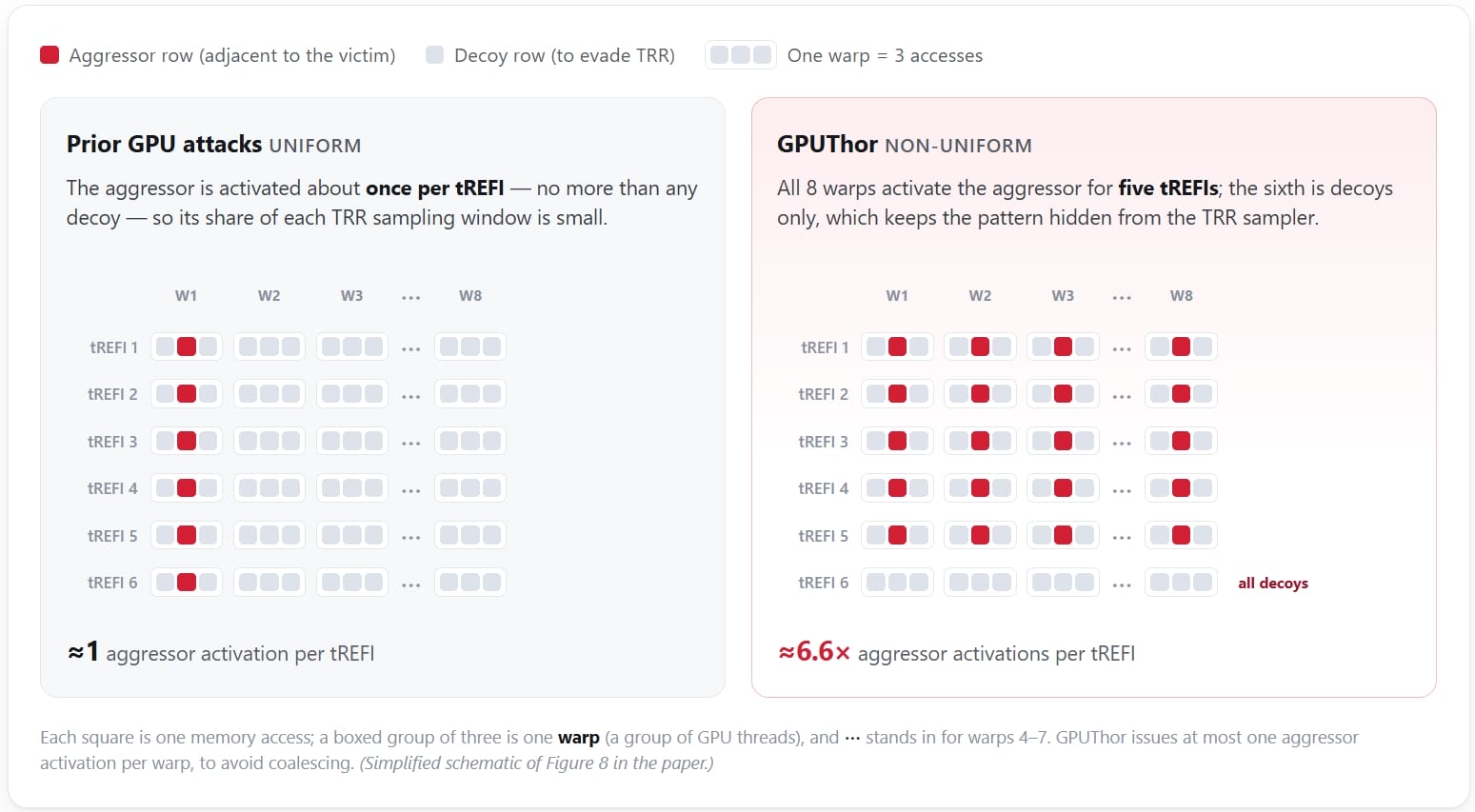
The breakthrough represented by GPUThor lies in its sophisticated evasion methodology. Rather than attempting to brute-force memory rows in a uniform manner that easily trips built-in safety mechanisms, the University of Toronto team reverse-engineered undocumented hardware behaviors specific to modern GDDR6 architectures. By carefully studying how memory request coalescing functions beneath the operating system level and measuring the exact thresholds that trigger Target Row Refresh routines, the researchers engineered a non-uniform hammering pattern.
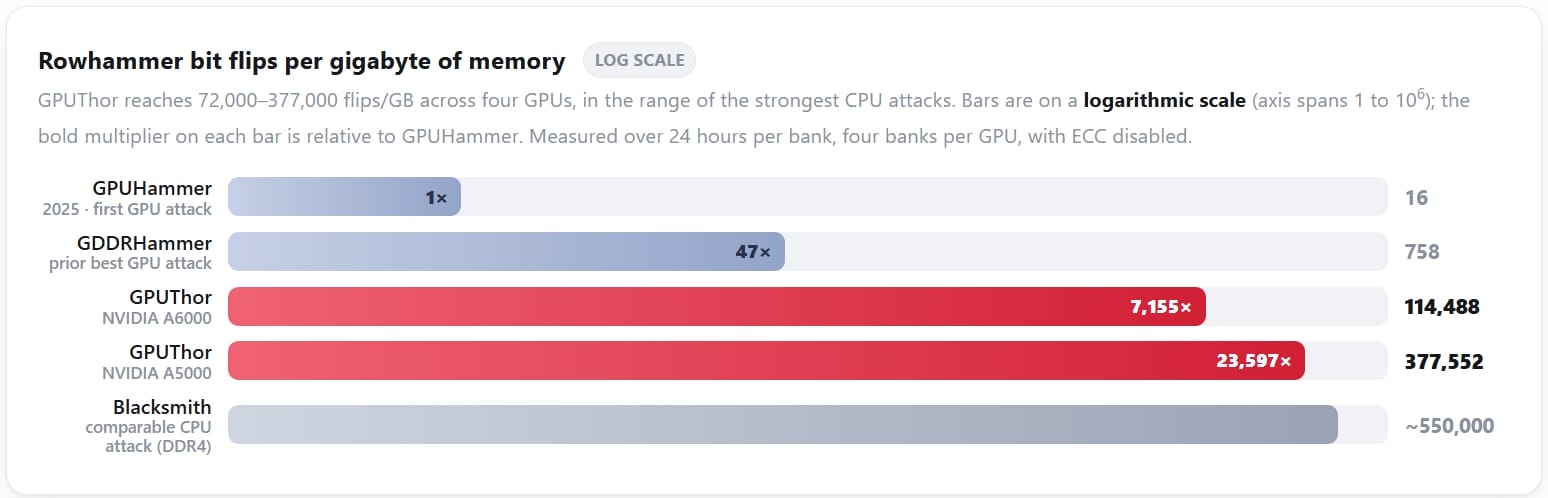
This bespoke approach bypasses the defensive cadence of TRR entirely. According to technical documentation released alongside their academic paper, the modified attack strategy yields an astonishing 6.6-fold increase in aggressor-row activations compared to earlier iterations. On test benchmarks utilizing unshielded memory spaces, GPUThor achieved between 72,000 and 377,000 discrete bit flips per gigabyte.

To put these metrics into perspective, these rates represent an efficiency multiplier ranging from 4,548 to 23,597 times higher than the legacy GPUHammer technique. More importantly, it bridges the performance gap between graphics hardware exploits and the most aggressive CPU-focused memory attacks, such as Blacksmith. Under optimal operational conditions, the time required for an attacker to locate a weaponized, exploitable bit flip plummets from a grueling 21.9 hours down to a mere 1.1 minutes.
Even when confronting hardware running active ECC protections, the Toronto team’s methodology proved devastatingly effective. During controlled trials, the attack successfully generated 387 double-bit errors—which standard ECC can detect but fundamentally cannot repair—alongside two triple-bit errors. Because the correction logic failed when facing multiple simultaneous corruptions in close proximity, the system miscalculated the repair, resulting in active, silent data corruption.
Cascading System Failures: From Denial of Service to Host Compromise
The practical consequences of executing GPUThor extend far beyond localized data corruption. The researchers demonstrated that the exploit can successfully trigger an immediate denial-of-service (DoS) state on enterprise-grade workstation accelerators, specifically targeting platforms like the NVIDIA RTX A6000 equipped with active ECC configurations.
When subjected to the targeted hammering pattern, the affected processor experiences forced, recurring hardware resets approximately every two hours. This persistent instability effectively renders the host workload unusable, continuously crashing computational pipelines. If the attack is sustained or repeated on the exact same physical board, the device telemetry eventually registers irreversible hardware degradation, marking the unit as faulty and demanding physical replacement—a scenario that could be weaponized by malicious actors to inflict severe financial and operational damage on cloud service providers.
However, the most alarming dimension of the research involves privilege escalation. By deliberately corrupting critical GPU page tables via controlled bit manipulation, an unprivileged user running isolated CUDA code can break out of application sandboxes. This grants the rogue process arbitrary memory access across the system boundary, ultimately allowing the attacker to spawn an unconstrained root shell on the underlying host operating system. Once root access is achieved, the security perimeter of the entire machine is effectively dismantled.
Industry Implications and the Broader Threat Landscape
While initial demonstrations focused primarily on Ampere-class workstation accelerators utilizing GDDR6 memory—such as the RTX A4000, A4500, A5000, and A6000—the implications of the research ripple across the entire semiconductor ecosystem.
The investigators caution that while server-class architectures like the A100 feature structural mitigations that dampen denial-of-service vectors, they remain susceptible to the privilege escalation vector due to their continued reliance on standard SECDED-level ECC. Furthermore, newer hardware iterations incorporating advanced resilience layers, such as the RAS Repair feature found in select Blackwell-class products, merely lengthen the time required to execute the exploit rather than preventing the underlying physical phenomenon.
Theoretical analysis included in the research indicates that even high-bandwidth memory implementations, including HBM3/e and emerging GDDR7 standards featuring on-die error correction, could theoretically harbor similar vulnerabilities if threat actors succeed in engineering multi-bit flip cascades that overwhelm local silicon logic.
Mitigation Strategies and the Road Ahead for Hardware Security
Following responsible disclosure protocols initiated by the academic team in late April, major hardware vendors have begun issuing technical guidance to help system administrators harden their infrastructure against physical memory attacks. Official advisories emphasize the deployment of multi-layered defensive postures.
Recommendations include enabling System-level ECC (SYS-ECC) alongside strict IOMMU and Direct Memory Access (DMA) isolation configurations to limit the blast radius of potential memory corruption. Administrators are also urged to continuously monitor low-level hardware telemetry for anomalous error correction spikes, which often serve as the earliest indicator of active probing or hammering attempts. Furthermore, organizations operating shared cloud environments or multi-tenant GPU clusters are strongly advised to restrict the execution of untrusted or unverified CUDA workloads.
Nevertheless, industry experts agree that software-level workarounds and configuration adjustments offer only partial relief. True resilience against advanced physical memory exploits like GPUThor will necessitate a paradigm shift in silicon engineering. Future hardware generations will likely require the integration of stronger multi-bit error correction algorithms directly into the memory fabric, alongside advanced hardware-enforced isolation barriers designed to detect and neutralize abusive access patterns at the transistor level before physical state degradation can occur. As artificial intelligence and high-performance computing continue to anchor modern technological infrastructure, securing the foundational hardware layers against sophisticated physical attacks remains one of the most critical imperatives facing the cybersecurity community.
