

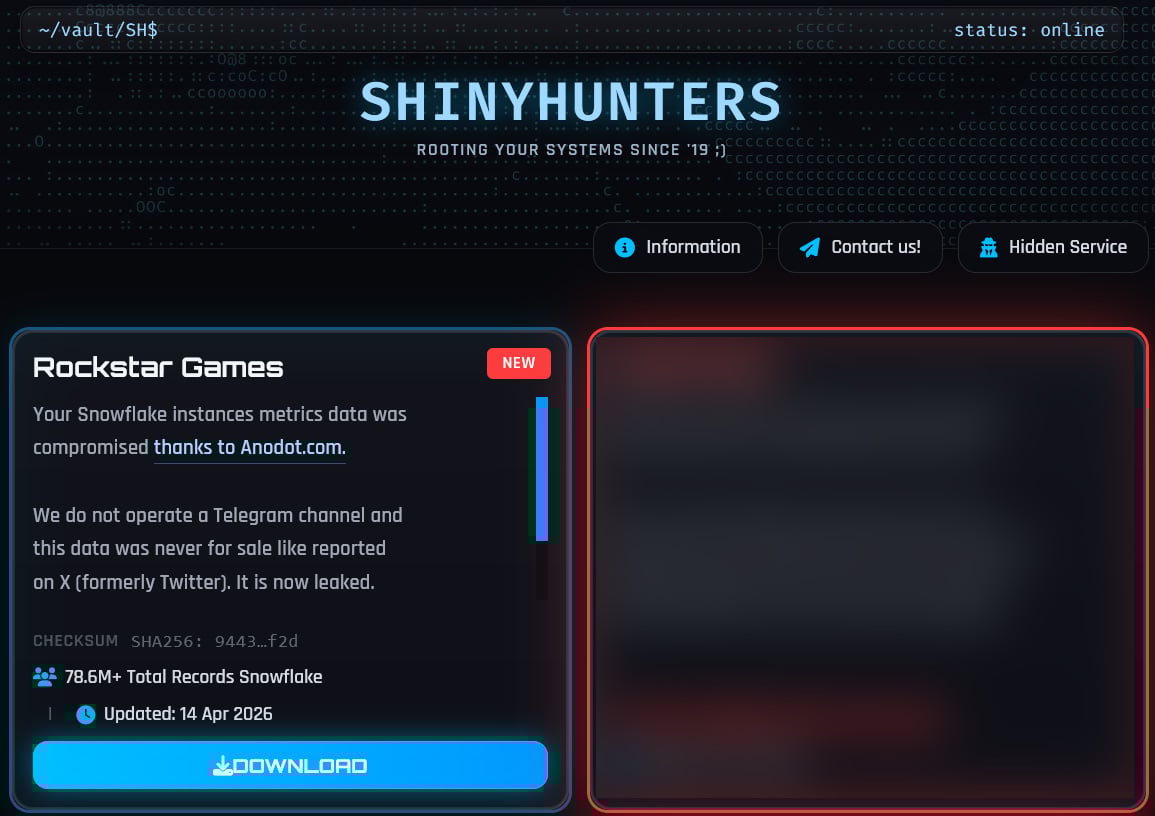
The gaming industry is reeling from a significant security incident that underscores the precarious nature of modern enterprise connectivity, as Rockstar Games has confirmed a data breach originating from a compromised third-party integration. The breach, which has seen the notorious extortion collective ShinyHunters release approximately 78.6 million records, highlights how even industry titans with rigorous internal security protocols can be undermined by the vulnerabilities of their vendors. The incident, which centered on the data anomaly detection service Anodot, serves as a sobering reminder that in the era of hyper-integrated SaaS ecosystems, an organization’s security posture is only as robust as its weakest point of connectivity.
The Mechanics of the Breach
The intrusion did not result from a direct compromise of Rockstar’s core infrastructure. Instead, it was facilitated through an indirect path involving Anodot, a platform that provides analytical oversight for various cloud-based services. Threat actors, identified as members of the ShinyHunters group, managed to exfiltrate authentication tokens associated with Anodot’s integration services. Armed with these credentials, the attackers bypassed traditional perimeter defenses, gaining unauthorized access to Rockstar’s environments hosted on Snowflake—a cloud-based data warehousing platform—as well as Amazon S3 and Kinesis instances.
By masquerading as legitimate system services through the stolen tokens, the perpetrators were able to siphon vast troves of data that were ostensibly stored for internal telemetry and analytical purposes. The leaked dataset is expansive, reportedly encompassing nearly 80 million records that offer a granular look into the back-end operations of Rockstar’s most successful titles, including Grand Theft Auto Online and Red Dead Online.
Anatomy of the Leaked Data
While Rockstar Games has characterized the information as "non-material," the sheer volume and nature of the leaked content raise significant privacy and operational concerns. The data primarily consists of internal analytics, which, while not containing passwords or credit card numbers, provides a detailed blueprint of how the company manages its digital ecosystem.
The files contain deep insights into:
- Monetization Metrics: Real-time tracking of in-game revenue and consumer purchase behavior, which is vital for the company’s ongoing financial modeling and microtransaction strategies.
- Player Behavior Analytics: Extensive telemetry on how users interact with game worlds, movement patterns, and engagement levels within online multiplayer modes.
- Customer Support Logs: Interactions originating from Zendesk instances, which, although often anonymized, can still inadvertently reveal user identifiers or specific support-related grievances.
- Operational Integrity: Documentation regarding internal fraud detection algorithms and the testing of anti-cheat models. The exposure of these specific security mechanisms is particularly damaging, as it provides malicious actors with a "roadmap" to develop bypasses for current anti-cheat systems, potentially compromising the integrity of online play for millions of users.
The Fragility of the SaaS Ecosystem
This incident is a textbook example of the "supply chain contagion" effect. As companies increasingly rely on third-party SaaS providers to manage complex data analytics, automated security monitoring, and cloud-native infrastructure, the attack surface expands exponentially. Rockstar Games is not an isolated victim; the breach is part of a larger, coordinated campaign by threat actors targeting the integration points between Anodot and various enterprise-level cloud customers.
The industry has moved toward a model of "composable" architecture, where distinct platforms are linked via APIs and authentication tokens to provide a seamless flow of data. While this enables operational efficiency and real-time business intelligence, it creates a "trust transitive" environment. When one entity—in this case, a specialized analytics service—is compromised, the threat actors can potentially leapfrog into the environments of hundreds of its clients, effectively turning a single point of failure into a systemic crisis.

The Perspective of the Enterprise
Rockstar Games has maintained that the breach has no material impact on its organization or its player base. In a landscape where high-profile companies are often targets of massive data extortion campaigns, this messaging is a standard damage-control tactic aimed at maintaining investor confidence and player trust. However, cybersecurity experts suggest that the "materiality" of such a leak is often subjective.
Beyond the immediate financial or regulatory costs, there is the long-term issue of "data leakage fatigue." Rockstar is no stranger to high-profile security incidents, having suffered a devastating leak in 2022 where source code and early gameplay footage for the highly anticipated Grand Theft Auto 6 were released to the public by the Lapsus$ group. That incident was a direct attack on internal intellectual property, whereas this current breach is a failure of operational security. The repetition of these incidents, regardless of their source, can gradually erode the perceived reliability of a brand in the eyes of its user base.
Strategic Implications for Cybersecurity
The fallout from this breach will likely trigger a re-evaluation of how large corporations vet their third-party integrations. For years, the focus of enterprise security has been on "hardening the perimeter"—building firewalls, implementing zero-trust network access, and securing endpoints. However, this incident proves that the perimeter is no longer a physical or logical boundary; it is a fluid collection of connections.
Moving forward, companies will likely be required to adopt a more aggressive posture regarding "Third-Party Risk Management" (TPRM). This involves not just asking vendors for security certifications, but implementing strict technical controls over how those vendors interact with their data. These include:
- Token Expiration and Rotation: Enforcing shorter lifespans for authentication tokens so that if they are stolen, their utility is short-lived.
- Least Privilege Integration: Restricting the permissions of third-party tools so they can only access the specific data buckets necessary for their function, rather than having broad read-access to an entire cloud environment.
- Anomaly Detection at the Integration Level: Implementing secondary monitoring systems that alert security teams specifically when a third-party tool is accessing data in patterns that deviate from its typical behavior.
The Future of Extortion Tactics
The rise of groups like ShinyHunters demonstrates a shift in the extortion business model. Rather than focusing solely on encrypting data for ransom (ransomware), these groups are increasingly focusing on "data harvesting for leak-based extortion." By stealing analytical data, they can pressure companies by threatening to reveal business strategies, fraud detection methods, or sensitive internal metrics that could harm the company’s competitive edge or provide bad actors with tools to ruin the user experience.
This shift necessitates a change in how organizations prepare for incidents. Companies can no longer simply rely on backups to restore their data. They must assume that their internal, non-public data will eventually be exposed, and they must build systems that are resilient even if their internal "blueprints" are made public.
Final Thoughts
As the digital landscape continues to integrate further, the boundary between "internal" and "external" data becomes increasingly blurred. The Rockstar Games incident is a bellwether for the gaming industry and the broader software sector. It serves as a stark reminder that while companies focus on building the next generation of immersive, interconnected virtual experiences, they must concurrently invest in a new generation of defensive architecture—one that acknowledges that in a connected world, the security of the partner is, quite literally, the security of the firm.
As the investigation into the Anodot-related breaches continues, it is expected that more companies will come forward, revealing the extent of this widespread supply chain compromise. For now, Rockstar Games remains under the spotlight, a prominent target demonstrating that even for the biggest names in entertainment, the digital frontier remains a dangerous and highly volatile territory.
