

The landscape of enterprise communication is undergoing a significant security transformation as Google formally extends its client-side encryption (CSE) capabilities to the mobile realm. With the latest update, users across Android and iOS platforms can now compose and decrypt sensitive emails directly within the native Gmail application, effectively removing the historical friction that often discouraged the use of robust encryption in mobile workflows. This development marks a pivotal shift in how organizations handle high-stakes data transmission, bridging the gap between stringent regulatory compliance and the modern, mobile-first demands of the global workforce.
For years, the promise of end-to-end encryption (E2EE) in professional email environments was frequently hampered by cumbersome user experiences. Previously, professionals needing to transmit confidential data—such as proprietary trade secrets, sensitive legal filings, or protected health information—were often forced to utilize third-party plugins, dedicated secure portals, or browser-based workarounds that were notoriously difficult to manage on smartphones. By integrating these advanced cryptographic controls directly into the Gmail app’s interface, Google is attempting to democratize security, making it a frictionless component of the daily email experience rather than an IT-mandated hurdle.
The Technical Foundation of Client-Side Encryption
At the core of this update is Google’s proprietary Client-Side Encryption (CSE) architecture. Unlike standard encryption-at-rest or encryption-in-transit, which protects data while it is stored on Google’s servers or moving between nodes, CSE ensures that the decryption keys remain entirely under the control of the customer. In this paradigm, the data is encrypted on the sender’s device before it ever reaches the cloud.
Because the encryption happens at the "client side," Google’s own servers effectively become blind to the content of the messages. Even if a government entity or a malicious actor were to gain access to Google’s infrastructure, they would be unable to decrypt the messages because the requisite cryptographic keys are managed by the customer through a third-party key management service (KMS). This architecture is specifically designed to address the complex data sovereignty requirements found in sectors like finance, government, and healthcare, where entities must prove that their data is insulated from the service provider’s oversight.
Streamlining the Mobile Workflow
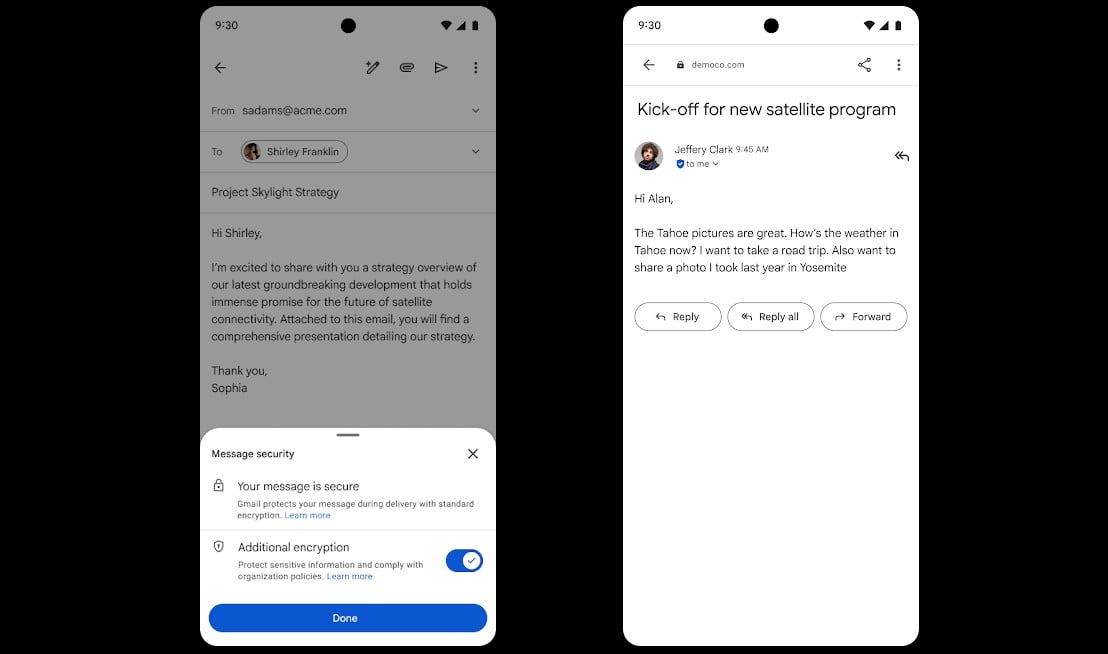
The integration process for mobile is designed to be intuitive. Upon enabling the feature through the Google Workspace Admin Console, administrators can provision the capability for their enterprise users. Once active, a user simply toggles the "Additional encryption" setting by selecting the lock icon within the compose window. The process is seamless, requiring no additional app downloads or complex configuration from the end user.
Perhaps the most significant aspect of this rollout is its versatility regarding the recipient. Historically, secure email often necessitated that both the sender and the recipient operate within the same gated ecosystem. Under this new deployment, Google has ensured interoperability. Recipients who use the Gmail mobile app experience a native, seamless decryption flow. Those operating on different platforms or web-based clients are directed to a secure viewing environment, ensuring that the security chain remains intact regardless of the recipient’s specific email service provider.
Industry Implications and the Security Paradox
This move by Google is not merely a feature update; it is a calculated response to the growing "security paradox" faced by enterprises. As remote and hybrid work models become the standard, the attack surface for sensitive corporate data has expanded exponentially. Mobile devices, often viewed as the "weak link" in corporate security, are now the primary access points for sensitive business communication. By fortifying the mobile mail client, Google is addressing a critical vulnerability in the modern enterprise security posture.
However, the industry implications extend beyond mere convenience. For many Chief Information Security Officers (CISOs), the challenge has always been balancing the "Security vs. Usability" trade-off. Historically, the more secure a system is, the less likely employees are to use it correctly, often leading to "shadow IT" practices where staff might resort to insecure messaging platforms just to get their work done. By making E2EE native to the mobile Gmail experience, Google is effectively removing the incentive for employees to bypass corporate security controls, thereby strengthening the organization’s overall compliance posture.
Navigating Regulatory Landscapes
The timing of this release coincides with an increasingly aggressive regulatory environment regarding data protection. Regulations such as the General Data Protection Regulation (GDPR) in Europe, the Health Insurance Portability and Accountability Act (HIPAA) in the United States, and various regional data sovereignty laws place the burden of proof squarely on the organization.

By utilizing client-side encryption, enterprises can demonstrate to regulators that they have taken every technical precaution to ensure that third parties—including the cloud service provider—cannot access sensitive data. This provides a "zero-trust" framework for email communication, which is increasingly becoming a non-negotiable requirement for high-security environments. Whether it is a law firm sharing case files or a pharmaceutical company discussing clinical trial data, the ability to maintain absolute control over encryption keys is the gold standard for data governance.
Future Trends: The Evolution of Secure Communication
Looking ahead, the expansion of E2EE into mobile environments signals a broader trend in the tech industry: the normalization of "privacy by default." We are entering an era where encryption is no longer an "advanced setting" for the technically savvy but a fundamental expectation of the standard user interface.
As artificial intelligence begins to play a larger role in email management, the protection of data will become even more critical. If organizations are to leverage AI-driven insights to analyze their email traffic, they must first ensure that the underlying data is protected from unauthorized access or accidental exposure. The implementation of E2EE on mobile acts as a necessary prerequisite for this next generation of intelligent, secure business tools.
Furthermore, we should expect to see continued innovation in how these keys are managed. As key management services become more interoperable and decentralized, the friction associated with key rotation and recovery—a common pain point for enterprise administrators—will likely decrease. Google’s current roadmap suggests a future where granular control over data is matched by an increasingly automated and invisible security backend.
Critical Considerations for Administrators
While the benefits of this update are clear, administrators must approach the deployment with caution. Enabling client-side encryption changes the fundamental nature of data management within a Workspace environment. Once a message is encrypted client-side, traditional eDiscovery tools, content filters, and data loss prevention (DLP) scanners that rely on reading message content will be unable to process those emails.
Organizations must therefore conduct a thorough impact assessment before enabling these features. They need to ensure that their regulatory requirements for data retention and archival are met through alternative means, such as the local archival of keys or the use of specific compliant auditing tools that can interface with the encrypted data stream. The convenience of mobile E2EE is a powerful tool, but it is one that requires a robust governance policy to ensure it does not create blind spots in an organization’s internal compliance efforts.
Conclusion: A New Standard for Enterprise Mobility
The introduction of native E2EE on mobile devices for Gmail enterprise users is a landmark event in the evolution of corporate communication. It effectively resolves the long-standing conflict between the need for ironclad security and the necessity of mobile agility. By providing a seamless, native experience, Google has lowered the barrier to entry for high-security communication, enabling a broader range of organizations to adopt the rigorous privacy standards previously reserved for the most sensitive industries.
As digital threats continue to evolve in sophistication, the ability to secure the communication channel from the point of origin to the final recipient is no longer just a luxury—it is a fundamental requirement. This update reinforces the idea that the future of business communication is one where privacy is not an obstacle to productivity, but rather the essential foundation upon which it is built. As organizations continue to navigate the complexities of the digital age, tools that combine high-level cryptographic assurance with intuitive, user-centric design will define the leaders of the new secure-enterprise frontier.
