

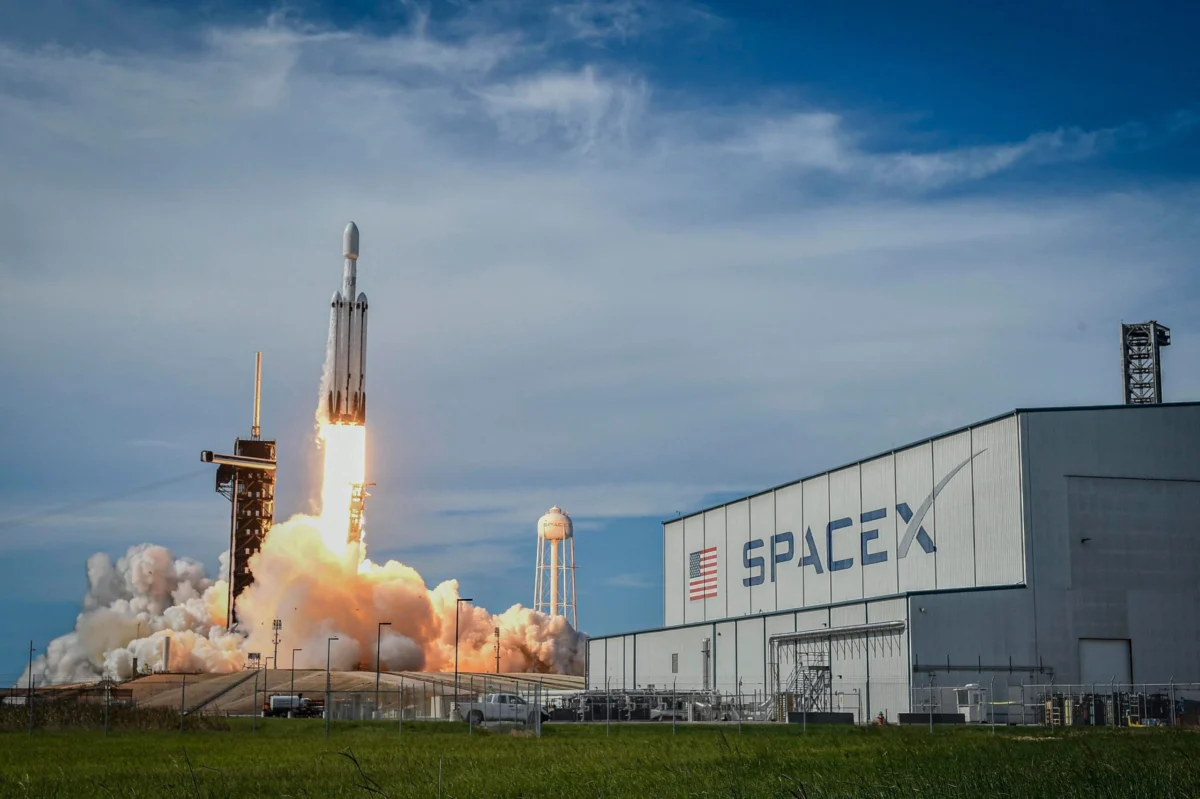
The Florida coastline is once again bracing for the rhythmic thunder of twenty-seven Merlin 1D engines as SpaceX prepares to return its Falcon Heavy launch vehicle to flight. Scheduled to lift off from the historic Launch Complex 39A at NASA’s Kennedy Space Center, this mission marks the first time the triple-core heavy lifter has taken to the skies since the high-profile launch of the Europa Clipper in October 2024. While the Falcon 9 has become a near-daily fixture of the Cape Canaveral skyline, the Falcon Heavy remains a rare and spectacular occurrence, representing a specialized capability in the SpaceX arsenal that bridges the gap between the ubiquitous Falcon 9 and the next-generation Starship system.
The primary objective of this mission is the deployment of a new commercial broadband satellite for ViaSat, a payload that demands the specific high-energy performance that only a multi-core configuration can provide. Originally slated for a Monday departure, the mission was pushed to Wednesday due to unfavorable weather conditions—a common hurdle in the volatile atmospheric environment of the Space Coast. The mission profile is a testament to the complex choreography of modern aerospace engineering: after propelling the massive communications satellite toward a geosynchronous transfer orbit, the two side boosters will perform their signature "ballet" of controlled descent, aiming for precision landings at Cape Canaveral. Meanwhile, the central core, tasked with the most grueling portion of the ascent, will be expended in the Atlantic Ocean, sacrificed to ensure the payload reaches its precise orbital slot.
To understand the significance of this launch, one must look back at the Falcon Heavy’s unique trajectory within the SpaceX ecosystem. When it first debuted in February 2018, it was the most powerful operational rocket in the world by a significant margin. That inaugural flight, which famously sent Elon Musk’s personal cherry-red Tesla Roadster and a spacesuit-clad mannequin dubbed "Starman" into a heliocentric orbit, was more than just a marketing masterstroke; it was a proof of concept for a vehicle that many industry veterans thought was impossible. The engineering challenge of synchronizing three Falcon 9 cores, managing the immense structural loads at the attachment points, and overcoming the "harmonic resonance" of 27 engines firing simultaneously was a hurdle that nearly led to the project’s cancellation multiple times.
Despite its initial fanfare, the Falcon Heavy has remained a niche player compared to its smaller sibling, the Falcon 9. With only 11 successful flights under its belt prior to this week’s mission, it accounts for a tiny fraction of the more than 600 missions completed by the Falcon family. However, its importance is not measured in quantity, but in capability. The Falcon Heavy is the "heavy-duty truck" of the SpaceX fleet, reserved for missions that require massive lift capacity to high-altitude orbits or deep-space trajectories that the Falcon 9 simply cannot achieve without sacrificing its own reusability.
The 100% success rate of the Falcon Heavy is a point of immense pride for the company and a critical metric for its customers. In the aerospace industry, where the margin for error is non-existent, a perfect record across 11 complex launches is an anomaly. This reliability has made the Heavy the preferred choice for high-stakes missions, including the aforementioned Europa Clipper and upcoming components of NASA’s Gateway—a small space station that will orbit the Moon as part of the Artemis program. For commercial clients like ViaSat, the Heavy offers a level of assurance that is vital when launching hardware worth hundreds of millions of dollars.
The current mission arrives at a pivotal moment for SpaceX as a corporate entity. The company is reportedly eyeing an Initial Public Offering (IPO) in the near future, with valuation estimates ranging from $1.5 trillion to $2 trillion. For investors, the Falcon Heavy represents a mature, high-margin segment of the business. While the Starlink satellite internet constellation is the primary engine of SpaceX’s recurring revenue, the launch services division provides the foundational infrastructure and technical credibility that supports the entire enterprise. A successful Falcon Heavy launch reinforces the narrative of SpaceX’s total dominance in the heavy-lift market, particularly as competitors like United Launch Alliance (ULA) and Blue Origin work to ramp up their own heavy-lift alternatives, such as the Vulcan Centaur and New Glenn.

Furthermore, the Falcon Heavy serves as a critical strategic bridge to Starship. Elon Musk has been transparent about the fact that Starship is intended to eventually render both the Falcon 9 and Falcon Heavy obsolete. By creating a fully reusable system with even greater lift capacity, SpaceX hopes to slash the cost of access to space by orders of magnitude. However, Starship is still in its intensive testing phase, characterized by a series of spectacular, high-altitude flight tests that have seen both breakthroughs and setbacks. Until Starship is fully operational and certified for high-value payloads, the Falcon Heavy remains the only proven vehicle capable of meeting the needs of the U.S. Department of Defense and NASA’s deep-space ambitions.
The technical evolution of the Falcon Heavy also reflects broader trends in the aerospace industry toward "flight-proven" hardware. The boosters used in these missions are often refurbished from previous flights, a practice that was once viewed with skepticism but is now the industry standard. This circular economy of rocket components has allowed SpaceX to maintain a launch cadence that was previously unthinkable, while also gathering unprecedented amounts of data on how materials and engines hold up under the extreme stresses of multiple launches and atmospheric re-entries.
The impact of this launch extends beyond the immediate deployment of a broadband satellite. It is a signal to the global telecommunications market that the infrastructure for high-capacity, low-latency satellite internet is continuing to expand. ViaSat and its competitors are in a race to provide global connectivity, a goal that requires a constant influx of more powerful and sophisticated satellites in geostationary orbit. The Falcon Heavy is the primary enabler of this expansion, providing the raw power needed to hoist these massive platforms into the sky.
As the countdown nears zero on Pad 39A, the aerospace community is reminded of the "spectacle of power" that the Falcon Heavy provides. The near-simultaneous landing of the two side boosters remains one of the most visually stunning achievements in modern technology—a feat of software and hardware integration that looks more like science fiction than 21st-century reality. For the "rocket nerds" and industry analysts alike, these landings are more than just a show; they are a demonstration of the precision and control that SpaceX has mastered, providing a glimpse into a future where space travel is as routine and reliable as commercial aviation.
Looking forward, the manifest for Falcon Heavy remains selective but prestigious. Its role in the Artemis missions and various classified national security launches ensures that it will remain a vital component of the U.S. space strategy for years to come. Even as Starship looms on the horizon, the Falcon Heavy has carved out a legacy as the vehicle that proved multi-core liquid-fueled rockets could be both reusable and incredibly reliable.
The launch, scheduled for 10:13 a.m. ET, is not just another mission on the calendar. It is a reaffirmation of a technological milestone. In an era where the space industry is moving faster than ever before, the return of the Falcon Heavy serves as a reminder of the engineering excellence required to push the boundaries of the final frontier. Whether it is carrying a Tesla toward Mars or a broadband satellite to orbit the Earth, the triple-booster giant continues to stand as a testament to the transformative power of private aerospace innovation. As the central core is expended and the side boosters return to their landing zones, SpaceX once again demonstrates that the path to the stars is built on a foundation of proven reliability and ambitious, iterative design.
