

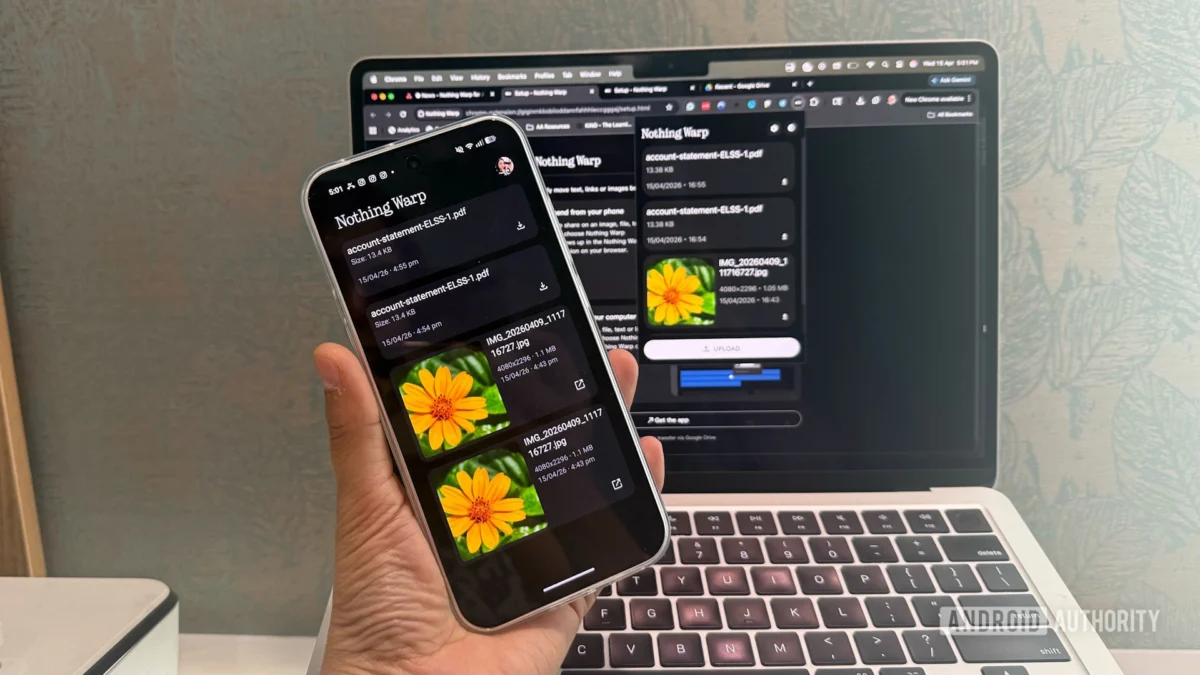
In a move that has left industry analysts and the consumer tech community scrambling for answers, the hardware startup Nothing has executed an abrupt and total recall of its recently unveiled cross-platform utility, Warp. The application, which was positioned as a cornerstone for enhancing the synergy between Android-based smartphones and desktop computing environments, vanished from official distribution channels—including the Google Play Store and the Chrome Web Store—mere hours after its public debut. Compounding the confusion, the company purged all supporting documentation and promotional blog posts related to the service, creating a digital vacuum where a promising new software feature once stood.
The Anatomy of the Warp Ecosystem
Nothing Warp was marketed as a seamless bridge designed to unify the disparate worlds of mobile and desktop computing. By leveraging Google Drive as a foundational, encrypted relay, the application allowed users to transmit files, uniform resource locators (URLs), images, and even clipboard contents across Android, macOS, Windows, and Linux environments. The value proposition was clear: in an era of fragmented hardware, users crave a unified experience that mimics the tight integration found in the "walled gardens" of competitors like Apple.
From a technical standpoint, Warp acted as an abstraction layer. It automated the often tedious process of manually uploading, syncing, and downloading files via cloud storage providers. By abstracting these steps into a single, intuitive interface, Nothing aimed to reduce friction for power users and casual consumers alike. During its brief window of availability, early adopters noted that the utility performed with commendable speed and reliable latency, effectively fulfilling the promise of a "frictionless" transfer experience.
The Question of Permission and Privacy
While the functionality was lauded in initial tests, the architecture of the tool raised immediate questions among security-conscious observers. To operate as advertised, the application requested extensive permissions within the browser environment. These permissions are critical in a software context, as they dictate the extent to which an application can interact with a user’s data, web browsing history, and active tabs.
Industry experts have long noted that any software requiring broad access to browser-level operations carries an inherent risk profile. When a tool essentially automates a manual process—in this case, file management via Google Drive—it introduces a "middleman" layer. If the security protocols surrounding this layer are not sufficiently robust, or if the permissions granted are disproportionate to the functionality provided, it can create a vector for potential data exposure. While there is currently no evidence that Warp suffered a breach or compromised user data, the suddenness of its removal suggests that internal audits may have flagged concerns regarding data handling, permission scopes, or compliance with evolving platform policies.
The "Walled Garden" Dilemma
The abrupt retraction of Warp highlights a broader, systemic struggle within the Android ecosystem. Manufacturers are increasingly desperate to build a cohesive ecosystem that rivals the tight-knit integration of iOS and macOS. Features like Apple’s Handoff or AirDrop are not merely convenient; they are sticky features that keep consumers loyal to the hardware brand. For a company like Nothing, which is attempting to disrupt a market dominated by entrenched incumbents, building a "Nothing Ecosystem" is a strategic imperative.
However, the path to building such an ecosystem is fraught with technical and regulatory hurdles. When a manufacturer attempts to build cross-platform tools that rely on third-party services—such as Google’s infrastructure—they are perpetually at the mercy of shifting API (Application Programming Interface) policies. If a developer builds a tool that "automates" a service in a way that the platform provider (in this case, Google) deems non-compliant with their terms of service, the tool can be summarily removed or throttled. This represents the primary vulnerability of building on top of someone else’s platform; the foundation can change, or be revoked, at any time.
Expert Analysis: Why Pull the Plug?
Why would a company sacrifice its public image by launching a product and deleting it within the same news cycle? There are three primary hypotheses favored by software engineers and industry observers.
First, there is the "Emergency Bug Fix" scenario. If an internal security scan or user report identified a critical vulnerability—such as a failure in token authentication or a flaw in the encryption of transferred files—the only responsible move is to pull the product immediately. In modern software development, "move fast and break things" is increasingly being replaced by a culture of "move fast, but secure everything." The reputational damage of a data leak far outweighs the temporary embarrassment of a product withdrawal.
Second, there is the "Policy Non-Compliance" angle. Google and Apple maintain strict guidelines for apps in their stores. If Nothing’s implementation of the Chrome extension or the Android app violated specific developer agreements—perhaps by obfuscating the underlying data transfer process or using unauthorized API calls—a stern warning from a platform regulator would leave the company with no choice but to retreat while they re-engineer the code to meet compliance standards.
Finally, there is the "Feedback Loop" hypothesis. It is possible that internal telemetry or user feedback indicated that the UX was more confusing than expected, or that the reliance on Google Drive was creating unexpected overhead. If the company realized that the tool didn’t meet their own internal quality bar for the "Nothing" brand, they might have decided to bury it rather than support a subpar experience.
The Future of Cross-Platform Integration
The episode serves as a cautionary tale for the industry at large. As hardware manufacturers push to become software platforms, the complexity of maintaining cross-device functionality grows exponentially. The dream of a universal "Universal Control" feature for Android is still alive, but it requires a level of integration that is difficult to achieve without full control over the operating system, the hardware, and the cloud services.
As we look toward the future, we can expect to see more of these "utility" experiments. Companies are no longer just selling phones; they are selling the spaces between their devices. The failure of Warp does not necessarily mean the death of the concept. It is more likely a temporary setback, a "beta" test that spilled over into the public domain before it was ready for primetime.
For Nothing, the path forward requires transparency. The silence surrounding this takedown is, in many ways, more damaging than the technical failure itself. The tech community thrives on clarity, and the absence of an explanation feeds speculation. To regain the trust of their power-user demographic, the company will eventually need to explain what happened—not just to satisfy curiosity, but to demonstrate that they have the architectural maturity to manage the sensitive data of their users.
Ultimately, the lesson of the Warp incident is that the "ecosystem" is not just a feature set; it is a commitment to security, stability, and reliability. As Nothing continues to evolve its product line, the technical hurdles they encounter today will serve as the crucible for the systems they build tomorrow. For now, users who were hoping for a seamless file transfer bridge will have to return to the manual methods of the past, waiting to see if a more robust, permanent, and transparent solution will emerge from the same design labs. The industry remains watchful, as the attempt to bridge the divide between mobile and desktop is a high-stakes race, and the road to a truly unified experience is clearly more winding than it first appeared.
