

For decades, the field of robotics was defined by a frustrating chasm between aspiration and reality. In the collective imagination of the 20th century, the future was populated by sentient, bipedal assistants capable of navigating the nuances of a human household. Yet, for the engineers tasked with building these machines, the reality was far more modest. While science fiction promised C-3PO, the industry delivered the Roomba and highly specialized robotic arms bolted to the floors of automotive assembly lines. These machines were marvels of precision, but they were fundamentally "dumb"—incapable of handling a single millimeter of deviation from their programmed path.
The central challenge, often referred to as Moravec’s paradox, posits that high-level reasoning requires very little computation, but low-level sensorimotor skills require enormous computational resources. It is easy to make a computer play chess, but incredibly difficult to give it the one-year-old child’s skills of perception and mobility. However, a seismic shift is currently underway. In 2025 alone, investors poured an unprecedented $6.1 billion into humanoid robotics—a fourfold increase over the previous year. This capital flight is not merely a speculative bubble; it is a response to a fundamental revolution in how machines learn to perceive, move through, and manipulate the physical world.

To understand where we are going, we must first examine the rigid architecture of the past. Traditionally, robotics was a craft of explicit instruction. If you wanted a robot to fold a shirt, you had to write a code for every conceivable variable. The programmer would need to define the fabric’s elasticity, identify the exact geometry of a collar, and dictate the precise coordinates for a gripper to move. If the shirt was slightly wrinkled or placed at a different angle, the entire system would collapse. This "rule-based" approach created machines that were reliable in controlled environments but utterly helpless in the chaotic unpredictability of a human home or a dynamic warehouse.
The first crack in this deterministic wall appeared around 2015 with the rise of deep reinforcement learning. Rather than hard-coding rules, researchers began utilizing digital twins—highly accurate virtual simulations where a robot could fail millions of times without consequence. In these digital playgrounds, the software was given a "reward signal" for success and a penalty for failure. This allowed the machine to develop its own "intuition" through trial and error, much like an AI learns to master complex strategy games like Go.
A landmark example of this era was OpenAI’s Dactyl, a robotic hand designed to manipulate objects with human-like dexterity. Training a physical hand to rotate a block or solve a Rubik’s cube is a nightmare of physics; the friction of fingertips and the deformation of rubber are nearly impossible to model perfectly. OpenAI’s solution was "domain randomization." By creating millions of simulated worlds where gravity, lighting, and friction were slightly different in each, the robot developed a robustness that allowed it to transition from the virtual world to the physical one. While Dactyl was a technical triumph, OpenAI eventually shuttered its robotics division in 2021, citing a lack of data. At the time, the "sim-to-real" gap still felt like an insurmountable hurdle for general-purpose applications.

While the mechanical engineers were struggling with dexterity, another branch of robotics was failing at social integration. In 2014, MIT researcher Cynthia Breazeal introduced Jibo, a "social robot" designed to be a companion for families. Jibo was expressive and charming, but its intelligence was an illusion built on scripts. Like the early versions of Siri or Alexa, Jibo relied on a "lookup table" of pre-approved responses. It could dance and tell stories, but it could not truly converse. When the novelty wore off, users were left with a $749 appliance that couldn’t perform the tasks of a basic smartphone. Jibo’s demise in 2019 served as a cautionary tale: a robot that looks alive but acts like a script is destined for the scrap heap.
The turning point arrived in late 2022 with the public debut of ChatGPT and the broader explosion of Large Language Models (LLMs). The industry realized that the "Transformer" architecture—the engine behind modern AI—could do more than just predict the next word in a sentence. It could be adapted to predict the next motor command in a physical sequence. By tokenizing sensor readings, camera frames, and joint positions just as LLMs tokenize text, researchers began building "foundation models" for robotics.
Google DeepMind’s RT-1 and its successor, RT-2 (Robotic Transformer 2), represent this new frontier. Instead of being trained on narrow robotic data, RT-2 was fed vast amounts of internet-scale text and images. This gave the robot a sense of semantic context. Suddenly, a robot didn’t need to be told exactly what a "Coke can" looked like in a specific light; it had "seen" millions of Coke cans in its training data. This allowed for emergent behaviors. When a researcher told an RT-2-powered arm to "place the snack near the picture of the superhero," the robot could identify the snack, identify the picture, and understand the spatial relationship "near"—tasks that would have required thousands of lines of code just years prior.

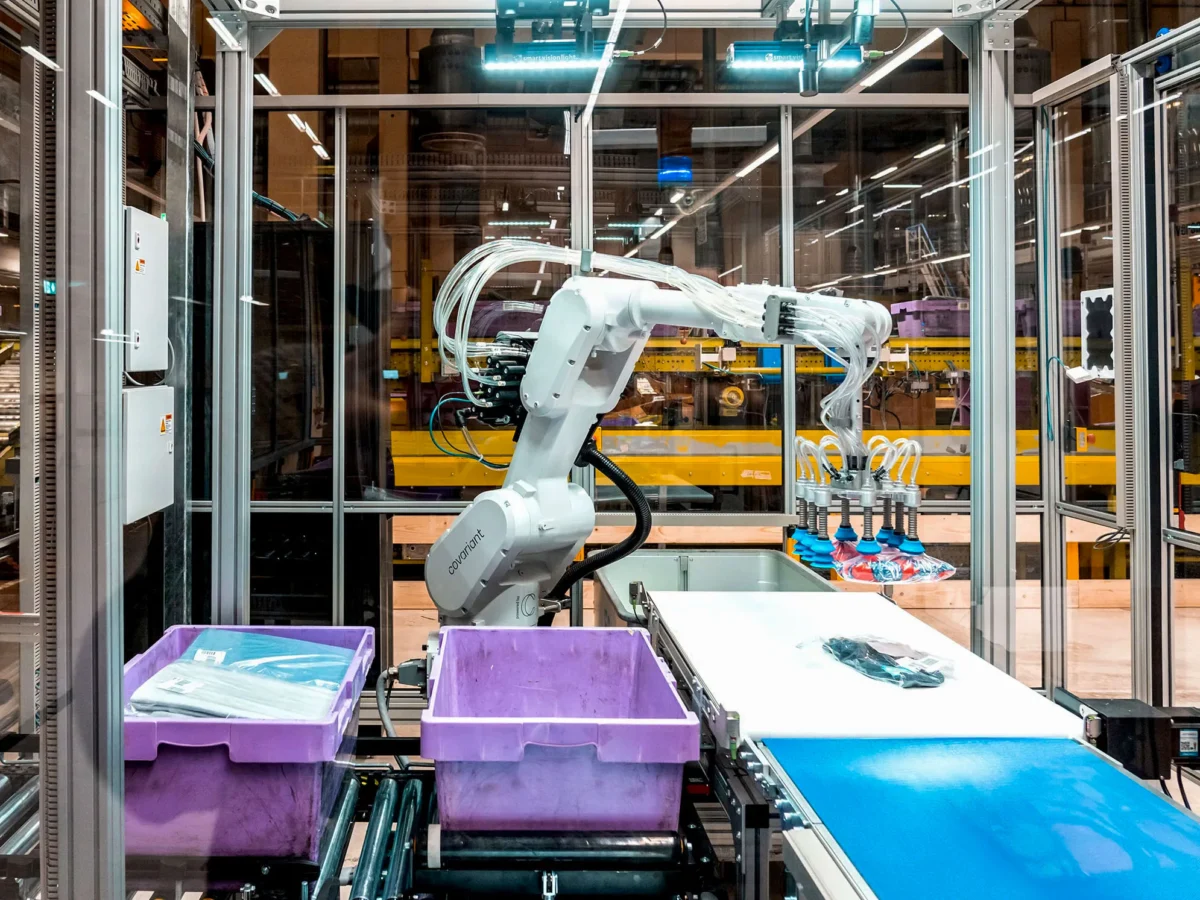
This shift from "learning by doing" (reinforcement learning) to "learning by watching" (imitative foundation models) has fundamentally changed the economic landscape. Companies like Covariant have moved this technology out of the lab and into the warehouse. Their RFM-1 model allows robotic arms to act less like programmed tools and more like coworkers. In a modern fulfillment center, a Covariant arm can encounter an object it has never seen before—a translucent bottle or a fuzzy sweater—and "reason" through the best way to pick it up. If it’s unsure, it can even communicate with a human operator, asking for advice on which suction cup to use, then incorporating that feedback into its permanent knowledge base.
However, the ultimate goal for Silicon Valley remains the general-purpose humanoid. The logic is simple: our world is built for humans. Our stairs, our doorways, and our tools are all designed for a bipedal creature with two arms and ten fingers. If a robot is to be truly helpful, it must fit into our world rather than requiring us to rebuild our world for it.
Agility Robotics’ Digit is perhaps the most prominent example of this philosophy in action. Unlike the glossy, anthropomorphic robots of sci-fi, Digit is a utilitarian machine with "bird-like" legs and a sensor-laden head. It is currently being piloted by giants like Amazon and GXO Logistics to move shipping totes. While its current tasks are repetitive—lifting boxes and placing them on conveyors—the underlying intelligence is evolving. By integrating models like Google’s Gemini, Agility is working toward a version of Digit that can take natural language instructions, such as "Clean up the spill in aisle four," and navigate the environment autonomously.

Despite the optimism, significant bottlenecks remain. The first is the "data desert." While LLMs can be trained on the entire public internet, there is no "internet of robotic movement" yet. Every hour of high-quality robotic data is expensive to collect. The second is the hardware-energy trade-off. To make a humanoid like Digit stronger, you need larger motors and bigger batteries, which increase the weight and decrease the operating time. Finally, there is the issue of safety. A 300-pound humanoid moving at human speeds presents a kinetic risk that a software chatbot does not.
Looking ahead, the next five years will likely see a convergence of these technologies. We are moving toward a world of "Embodied AI," where the brain (the foundation model) and the body (the humanoid frame) are no longer developed in isolation. As these machines begin to work in real-world environments, they will generate a "flywheel" of data—each mistake and each success feeding back into the model to make the next generation of robots more intuitive.
The dream of the 1950s—the helpful household robot—is no longer a matter of "if," but "when." The transition from the rigid, rule-based machines of the past to the intuitive, generative models of today has broken the stalemate. The robots are finally learning not just to move, but to understand. As the capital continues to flow and the models continue to scale, the gap between the Roomba and C-3PO is closing faster than anyone anticipated. We are witnessing the end of the "programmed" era and the beginning of the "autonomous" age, where the machines we build will finally be as adaptable as the people they are designed to serve.
