

Written by: Farid Mustafayev, Cybersecurity Expert at ThreatLocker
Interprocess communication (IPC) serves as the digital nervous system of the modern Windows operating system. Among the various mechanisms available to software architects, named pipes remain an exceptionally popular choice due to their high throughput, native operating system support, and seamless integration across diverse software architectures. From high-privileged background services and Windows system daemons to user-facing desktop applications, system tray utilities, and diagnostic command-line tools, named pipes facilitate rapid data exchange on the local machine.
A standard architectural pattern involves a privileged Windows service operating as a named-pipe server while unprivileged or standard user applications attach as clients. Because both executing components reside on the same physical or virtual workstation, developers frequently labor under the dangerous misconception that this local communication channel is inherently secure, private, and trustworthy.
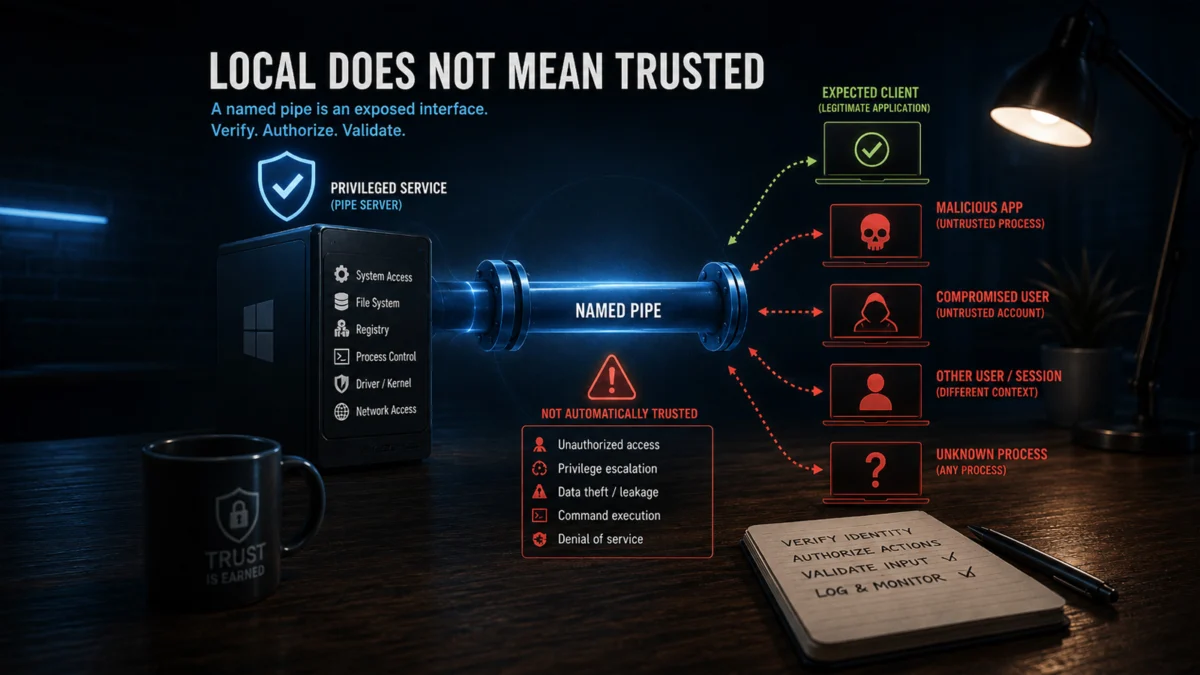
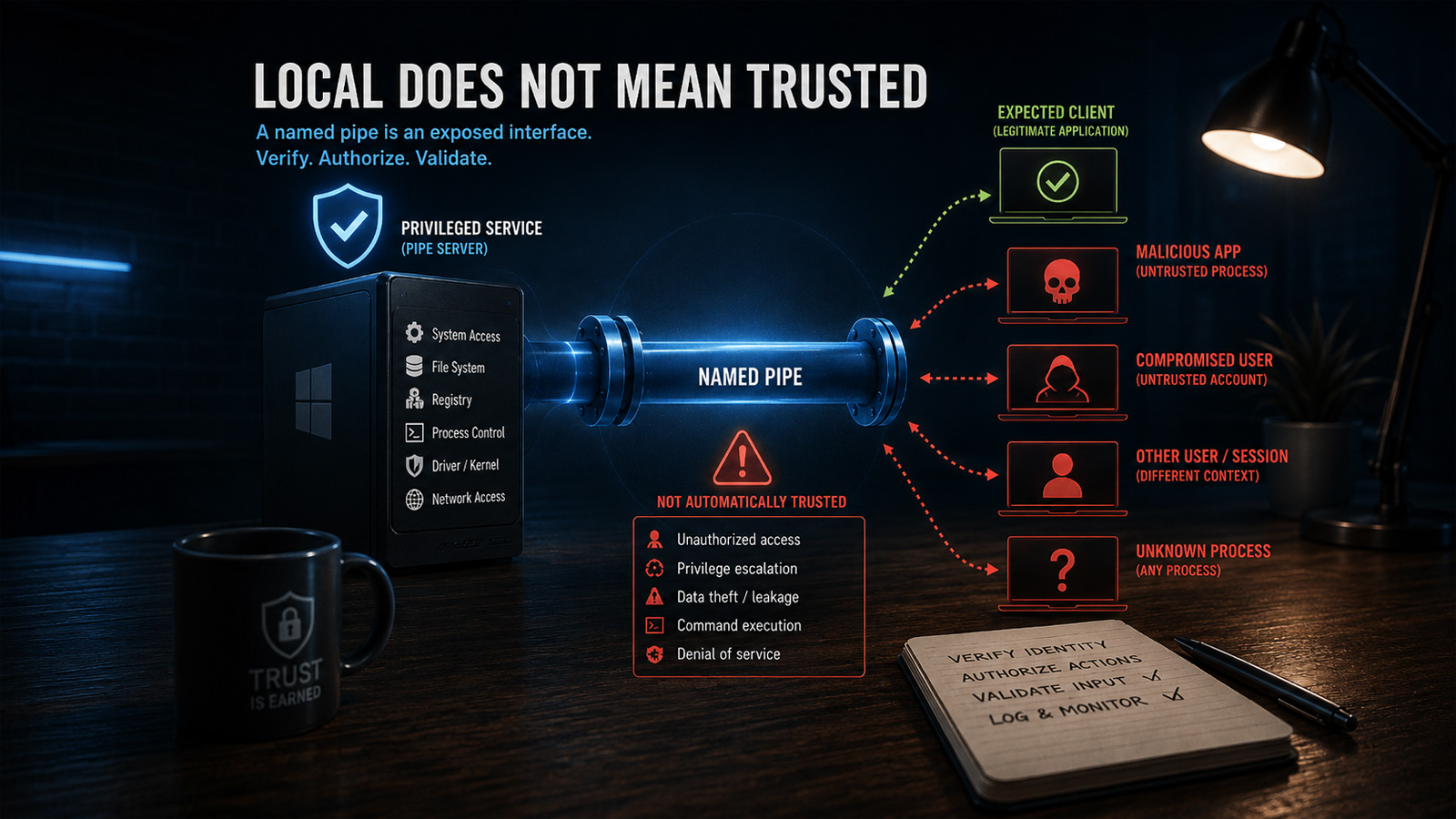
In reality, a Windows workstation is a multi-tenant ecosystem where entirely unrelated processes run concurrently under distinct user accounts, isolated sessions, and widely disparate security contexts. Treating a local named pipe as an internal-only conduit ignores the complex realities of modern operating system security.
The Fallacy of Local Trust
The foundational axiom of modern software security dictates that proximity does not equal trust. When two applications communicate via a named pipe on the same operating system instance, developers often assume that malicious actors cannot intercept or abuse the channel unless they have already achieved complete code execution within the server process itself.
This assumption collapses upon closer inspection of a typical enterprise Windows environment. A modern workstation routinely executes software under the LocalSystem account, high-privileged administrators, standard users, specialized service accounts, and distinct interactive or remote desktop sessions. Furthermore, the environment may harbor third-party applications, untrusted scripts, diagnostic utilities, and active malware operating under compromised user accounts.
Because any local process that successfully discovers the pipe’s predictable identifier and possesses adequate access rights can attempt a connection, the operating system cannot automatically deduce which executable the developer intended to interact with the service. Consequently, a named pipe must be rigorously classified as an exposed local network-style interface. Prior to servicing any incoming request, the server application must explicitly authenticate the client, evaluate whether that specific identity is authorized to execute the requested action, and ensure that all incoming data payloads are meticulously sanitized.
Privilege Boundaries and the Confused Deputy Problem
The architectural risk escalates dramatically when a privileged Windows service establishes a named pipe to interact with standard user-level desktop software. A background service executing with LocalSystem or NT AUTHORITYSYSTEM privileges possesses extensive capabilities: it can modify protected system files, alter critical registry hives, spawn new processes, manipulate global system configurations, access sensitive data belonging to other users, and interface directly with kernel-mode drivers.
When these privileged operations are inadvertently exposed through a poorly secured named pipe, the pipe effectively transforms into an unauthenticated API for the operating system’s most sensitive capabilities. A successful connection to the pipe merely proves that the connecting client process managed to bypass initial access controls; it offers no cryptographic or logical proof that the caller is the legitimate, unmodified frontend application intended by the software vendor.
Without granular authorization checks, services vulnerable to manipulation can fall victim to the classic "confused deputy" vulnerability. In this scenario, an unprivileged attacker supplies malicious instructions through the communication channel, while the high-privileged service executes those instructions using its own sweeping permissions. A seemingly benign request to read a non-sensitive status file can quickly escalate into a system compromise if the server fails to restrict file paths, allowing an attacker to target security-critical system files such as the SAM database or core system binaries.
Comprehensive Access Control and Client Validation
Effective named-pipe hardening begins with the implementation of strict Discretionary Access Control Lists (DACLs). Relying on default operating system descriptors is a frequent source of vulnerability, as default permissions often grant broad access to Everyone or Authenticated Users. Developers must explicitly define security descriptors that restrict pipe connectivity to the absolute minimum set of required Windows identities, such as a specific user SID or a dedicated service account.
However, access to the pipe itself must never be conflated with authorization for individual commands. An application client might legitimately require the ability to query the operational status of a service, yet have zero business logic justification to restart that service, modify system configuration files, or initiate process creation. Authorization logic must therefore be executed independently for every sensitive operational command processed by the server.
To establish robust endpoint verification, modern Windows applications can inspect the process associated with the remote end of a pipe handle. By leveraging native APIs such as GetNamedPipeClientProcessId and QueryFullProcessImageName from kernel32.dll, a server can retrieve the exact Process Identifier (PID) and full executable path of the connecting client.
[DllImport("kernel32.dll", SetLastError = true)]
[return: MarshalAs(UnmanagedType.Bool)]
private static extern bool GetNamedPipeClientProcessId(SafePipeHandle pipe, out uint clientProcessId);

[DllImport("kernel32.dll", SetLastError = true)]
[return: MarshalAs(UnmanagedType.Bool)]
private static extern bool GetNamedPipeServerProcessId(SafePipeHandle pipe, out uint serverProcessId);
While retrieving the client PID and verifying that the executable resides within a write-protected directory provides valuable defense-in-depth, these checks must remain secondary mechanisms rather than primary security gates. Sophisticated threat actors have demonstrated techniques capable of spoofing or abusing named-pipe handle inheritance. Therefore, high-security implementations should pair PID verification with cryptographic validations, such as inspecting the executable’s Authenticode signature using WinVerifyTrust or validating its cryptographic hash against an approved baseline.
Mitigating Risk Through Controlled Impersonation
When a high-privileged Windows service processes requests from a standard user application, performing all operations under the service’s elevated identity introduces severe security risks. Named-pipe impersonation allows the server thread to temporarily adopt the security context of the connected client, ensuring that Windows evaluates file and registry access tokens against the client’s permissions rather than the service account.
In managed environments, the NamedPipeServerStream.RunAsClient method provides a structured approach to executing code under the client’s context:
server.WaitForConnection();

server.RunAsClient(() =>

    string path = @"C:ProgramDataMyApplicationsettings.json";

    // Access permissions are evaluated against the connected client's security token.
    string content = File.ReadAllText(path);

    ProcessClientData(content);
);
Despite its utility, impersonation is not a substitute for explicit command authorization. Impersonation merely alters the security context for resource access checks; it does not validate whether a specific command sequence is business-appropriate. Furthermore, developers must enforce strict scoping. The server must verify that native API calls such as ImpersonateNamedPipeClient succeed and must always wrap operations in a try/finally block to guarantee that RevertToSelf is executed immediately upon completion. Failing to restore the original service identity can lead to catastrophic security failures where subsequent operations inadvertently run within an untrusted user context.
Defending Against Untrusted Data and Denial-of-Service
Even when client identity verification and impersonation are correctly implemented, incoming messages must always be treated as untrusted input. Deserializing raw byte streams directly into object graphs without prior structural and semantic validation opens the door to remote code execution and memory corruption vulnerabilities.
To prevent buffer exhaustion and injection attacks, communication protocols should enforce strict message framing with explicit header definitions, maximum payload bounds, and comprehensive allowlists for all supported commands. Furthermore, named-pipe servers must actively defend against denial-of-service (DoS) vectors. Malicious or malfunctioning local processes can flood a service with continuous connection requests, exhaust available pipe instances, or deliberately stall data transmission to consume thread pool resources and kernel nonpaged pools.
Engineers must implement robust availability controls, including:
- Strict connection limits and concurrent queue boundaries.
- Configurable idle timeouts and read/write cancellation tokens.
- Enforced maximum message sizes before memory allocation occurs.
- Comprehensive rate-limiting mechanisms aligned with user sessions or process identifiers.
Additionally, developers must account for remote exposure risks. Microsoft Windows supports named-pipe communication across network interfaces under specific configurations, particularly when the Windows Server service is active. Local-only IPC mechanisms must explicitly reject network identities such as NT AUTHORITYNETWORK or utilize flags like PIPE_REJECT_REMOTE_CLIENTS to ensure that communication boundaries are strictly enforced at the operating system kernel level.
Architectural Blueprint for Secure Interprocess Communication
Building a resilient Windows service requires a decoupled architecture that clearly separates connection handling, protocol parsing, security authorization, and privileged execution. The named-pipe endpoint should function exclusively as a tightly scoped gateway rather than a general-purpose operating system interface.
+------------------+      +-------------------+      +--------------------+      +----------------------+
|   Client App     | ---> | Named Pipe Gateway| ---> | Authorization Layer| ---> | Privileged Execution |
| (Standard User)  |      | (Input Validation)|      |  (Policy Checking) |      |    (LocalSystem)     |
+------------------+      +-------------------+      +--------------------+      +----------------------+
By enforcing that the server remains authoritative—resolving targets, verifying digital signatures, and validating business logic internally rather than blindly trusting client-supplied arguments—organizations can effectively eliminate entire classes of local privilege escalation vulnerabilities.
Ultimately, securing Windows interprocess communication requires moving away from the assumption of implicit local trust. By combining rigorous access control lists, multi-layered identity verification, strict message parsing, and narrow operational scopes, developers can neutralize modern attack vectors and ensure that high-privileged services remain impenetrable bastions within the enterprise architecture.
Practical Named-Pipe Security Checklist
- Restrict Pipe DACLs: Avoid default security descriptors; explicitly grant access only to required user SIDs or specific service accounts.
- Enforce Local-Only Access: Apply flags such as
PIPE_REJECT_REMOTE_CLIENTSand explicitly deny network service identities to prevent cross-network exposure. - Separate Connection from Authorization: Validate that a client is permitted to connect, then independently authorize every individual command requested.
- Implement Process Verification: Query client PIDs and executable paths as a defense-in-depth measure, verifying binaries against secure directories and cryptographic hashes.
- Bound Resource Consumption: Establish strict limits on message payload sizes, connection concurrency, buffer allocations, and request timeouts to thwart denial-of-service attempts.
- Sanitize All Data Inputs: Treat every incoming message payload as untrusted input, utilizing allowlists, schema validation, and path normalization.
- Isolate Privileged Code: Keep pipe parsing logic separate from high-privileged execution layers to minimize the impact of parser flaws.
To learn more about how ThreatLocker can protect against attacks on named pipes, book a demo.
Author Bio:
Farid Mustafayev is a software developer at ThreatLocker specializing in Microsoft Windows Service development and cybersecurity. With more than 15 years of industry experience, he has deep expertise in .NET technologies, including ASP.NET WebAPI, Windows Services, Windows Forms, WPF, RESTful APIs, and low-level Windows internals. He has led the development and hardening of Windows Services designed to protect systems against malware and ransomware, including work with kernel-level integrations and custom driver enhancements.
Previously, Mustafayev served as a Technical Lead, guiding architecture decisions, mentoring developers, and building scalable, maintainable systems. His experience also includes microservices-based architectures and cloud-native solutions on AWS, with a focus on availability, performance, and security across distributed environments.
Sponsored and written by ThreatLocker.
