

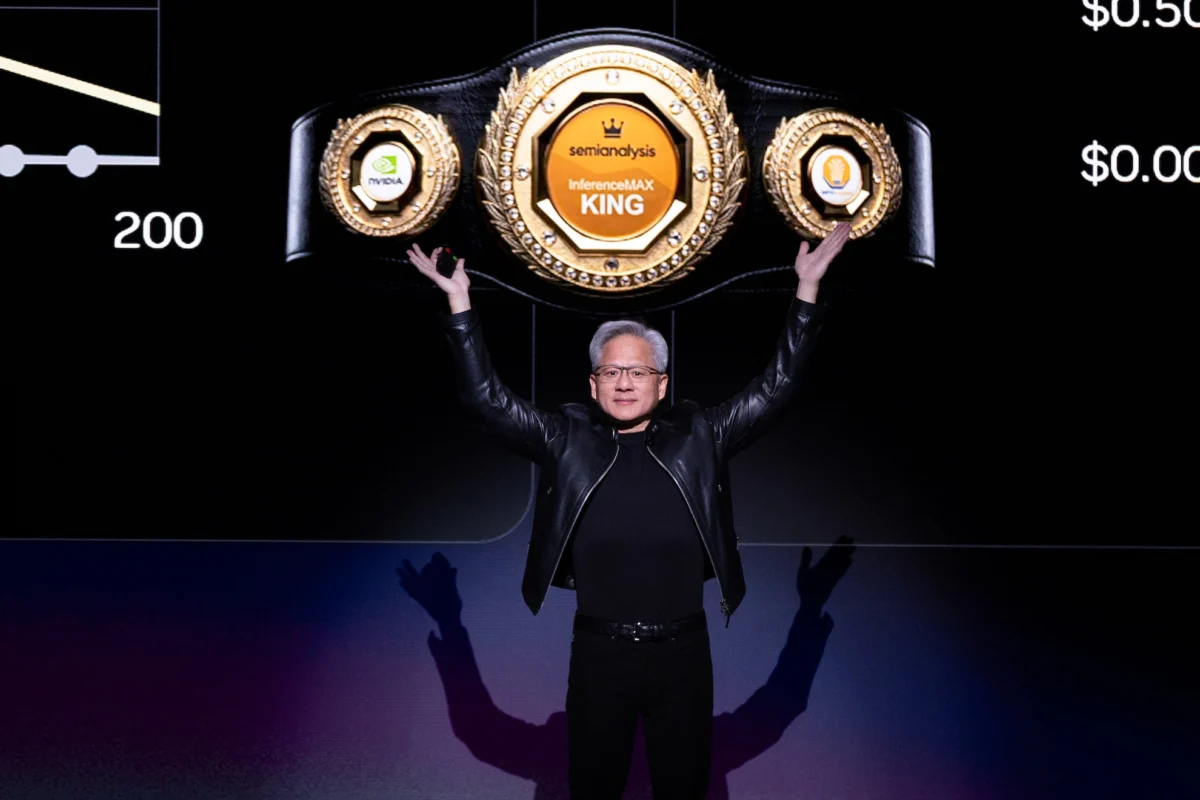
When Jensen Huang, the leather-jacketed architect of the modern silicon age, took the stage for his annual GTC keynote this week, the atmosphere in San Jose was nothing short of electric. For two and a half hours, the Nvidia CEO laid out a vision of a future so saturated with artificial intelligence that it bordered on the science fictional. Yet, as Huang spoke of trillion-dollar chip cycles and tens of trillions in new market opportunities, a curious thing happened on the floor of the New York Stock Exchange: Nvidia’s stock began to slip.
The disconnect highlights a widening chasm in the current technological landscape. On one side stands Silicon Valley, fueled by an almost religious conviction that we are in the early stages of a total civilizational reboot powered by accelerated computing. On the other stands Wall Street, a realm governed by the cold calculus of return on investment (ROI), historical cycles, and an increasing trepidation that the AI "bubble" may be stretching toward its breaking point.
The GTC Marathon: More Than Just Silicon
Huang’s presentation was an exhaustive tour de force, designed to prove that Nvidia is no longer just a chipmaker, but the foundational platform for the next industrial revolution. The technical highlights were formidable. Huang introduced the world to the next generation of architecture, following the Blackwell series with the even more ambitious Vera Rubin system. These are not merely incremental upgrades; they represent a fundamental shift in how data centers are constructed, moving away from general-purpose CPUs toward massive, interconnected GPU clusters designed specifically for the heavy lifting of generative AI.
The innovations extended far beyond hardware. Huang showcased DLSS 5, a leap forward in deep learning super sampling that uses generative AI to create photorealistic environments in video games. However, the ambitions for DLSS 5 clearly reach beyond the living room; this technology is slated to power the "digital twins" of entire factories and cities, allowing for perfect simulations before a single brick is laid or a robot is deployed.
Perhaps most significant was the announcement of a partnership with Groq to accelerate AI inference within the Vera Rubin ecosystem. As the industry shifts from training large language models (LLMs) to deploying them at scale—a process known as inference—speed and efficiency become the primary currencies. By integrating specialized inference capabilities, Nvidia is signaling its intent to own the entire lifecycle of an AI model.
The Numbers That Failed to Move the Market
During the keynote, Huang threw out figures that would have seemed absurd five years ago. He described the burgeoning ecosystem of "AI agents"—autonomous software entities capable of performing complex tasks—as a potential $35 trillion market. He further characterized the "physical AI" and robotics sector as a $50 trillion opportunity. To put that in perspective, the entire global GDP is estimated to be around $100 trillion. In Huang’s view, Nvidia is positioning itself to be the toll collector for nearly half of the world’s economic activity.
Furthermore, Huang projected that by the end of 2027, the company expects to see a staggering $1 trillion in purchase orders for its Blackwell and Vera Rubin chips alone. This projection was bolstered by the news that Amazon Web Services (AWS) has already committed to purchasing 1 million GPUs as part of a massive infrastructure overhaul.
Under normal market conditions, such a bullish forecast from a $4-trillion-dollar titan would send shares into the stratosphere. Instead, the market reacted with a shrug, followed by a sell-off. The reason, according to seasoned market analysts, is a "great new uncertainty" that has begun to overshadow even the most impressive earnings reports.
The Anatomy of Investor Anxiety
The primary friction point for Wall Street is not a lack of belief in the technology, but a lack of clarity regarding its timeline and societal impact. As Futurum CEO Daniel Neuman noted, the sheer speed of innovation has outpaced the market’s ability to model its consequences. We are witnessing a transformation so rapid that the traditional "societal constructs"—the way we work, value labor, and structure enterprises—are being called into question.
Markets thrive on predictability, and AI is the ultimate disruptor of predictability. There is a growing concern that while the "picks and shovels" (Nvidia’s chips) are selling at record rates, the "gold miners" (the enterprises buying the chips) have yet to show how they will turn a profit on their massive investments. This has led to a narrative of low enterprise adoption, a sentiment that Neuman argues is based on lagging data.
"Enterprise AI adoption is going to hit inflection and scale very quickly," Neuman suggests. He posits that the perceived lack of ROI is a byproduct of the time it takes to aggregate enterprise data. Most reports citing slow adoption are based on six-month-old surveys, which in "AI time" is an eternity. Nevertheless, until the "receipts" are visible on the balance sheets of Fortune 500 companies, Wall Street remains in a "show me" mode.
Nvidia as the Economic Sun
Despite the stock’s short-term fluctuations, there is an undeniable reality that Kevin Cook, a senior equity strategist at Zacks Investment Research, pointed out: the modern economy is increasingly orbiting around Nvidia. The company has moved beyond being a vendor to becoming the "rails" upon which the rest of the market runs.
This is evidenced by the diversifying portfolio of Nvidia’s partners. It isn’t just Microsoft, Google, and Meta anymore. Industrial giants like Caterpillar are now being categorized under "physical AI." By utilizing Nvidia’s Omniverse and robotics platforms, companies in heavy industry are automating logistics, predictive maintenance, and autonomous excavation. When a 100-year-old machinery company becomes a "physical AI" firm, it suggests that Nvidia’s influence has permeated the bedrock of the global economy.
This systemic importance creates a unique paradox. If Nvidia is indeed the infrastructure for the entire $100 trillion global industry, as Huang suggested, then the company is "too big to fail" in a way that exceeds even the largest banks of 2008. If the AI boom is a bubble, its bursting would not just affect tech stocks; it would derail the modernization efforts of almost every sector, from healthcare and automotive to retail and defense.
The Road Ahead: 2027 and Beyond
As we look toward the 2027 horizon that Huang frequently cited, several key trends will determine whether Wall Street eventually aligns with Silicon Valley’s optimism.
First is the transition from "Boutique AI" to "Industrial AI." Currently, many companies are experimenting with AI in isolated silos. For the trillion-dollar projections to hold, AI must move into the core operational flow of global business. This requires not just faster chips, but a massive build-out of networking infrastructure—a division Nvidia is aggressively expanding to rival its own chip business.
Second is the geopolitical and regulatory landscape. As AI becomes a matter of national security and economic sovereignty, Nvidia faces the dual challenge of navigating export controls and the potential for "sovereign AI" movements, where nations seek to build their own independent computing stacks.
Finally, there is the question of competition. While Nvidia currently enjoys a near-monopoly on high-end AI silicon, the "uncertainty" the market feels is partly due to the inevitable rise of challengers. From custom silicon developed in-house by Big Tech firms to nimble startups like Groq, the moat around Nvidia’s $4 trillion valuation will be tested.
Conclusion: A Visionary’s Burden
The tepid reaction to the GTC keynote serves as a reminder that being a visionary is a lonely business. Jensen Huang is effectively asking the world to price in a future that hasn’t arrived yet—a future where software writes itself, robots manage our supply chains, and every company is, at its heart, an AI company.
Wall Street’s nervousness isn’t necessarily a vote of no confidence in Nvidia; rather, it is a reflection of the sheer scale of the unknown. The company is barreling full steam ahead, dragging the global economy into a new era of accelerated computing. Whether the market follows suit tomorrow or a year from now, the momentum Nvidia has generated appears, for the moment, to be an unstoppable force of nature. The "uncertainty" that investors fear may simply be the sound of the old world being rewritten in real-time.
