

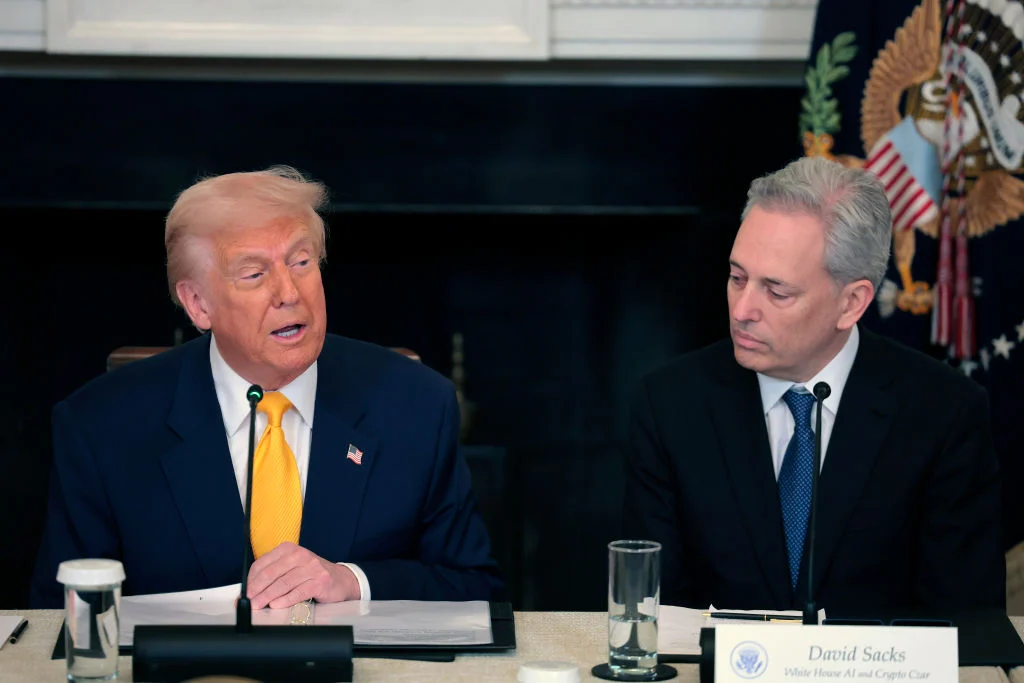
The initial phase of the second Trump administration’s technological overhaul has reached a significant milestone with the conclusion of David Sacks’ tenure as the nation’s "AI and Crypto Czar." Sacks, a veteran Silicon Valley entrepreneur, venture capitalist, and prominent podcaster, has officially completed his 130-day stint as a special government employee. While the departure marks the end of his direct, singular influence over federal artificial intelligence and digital asset policy, it does not signal a retreat from the halls of power. Instead, Sacks is transitioning into a broader, albeit more traditional, role as the co-chair of the President’s Council of Advisors on Science and Technology (PCAST).
In a recent interview, Sacks confirmed the conclusion of his non-consecutive service as a special government employee, a legal designation that allowed him to navigate the boundary between private sector interests and public service. He will now lead PCAST alongside Michael Kratsios, the senior White House technology adviser who previously served as the Chief Technology Officer of the United States. This move shifts Sacks from a role defined by executive proximity and rapid policy formulation to one centered on long-term strategy and multi-industry coordination.
The transition raises critical questions about the trajectory of American technology policy. As the "AI Czar," Sacks enjoyed a direct line to the Oval Office, wielding a mandate to dismantle existing regulatory hurdles and accelerate the deployment of domestic AI capabilities. In his new capacity at PCAST, his influence becomes institutionalized. While PCAST is historically an advisory body—studying complex issues and issuing recommendations rather than enacting law—the composition of the current council suggests it may function with more weight than its predecessors.
The current iteration of PCAST represents a departure from the academic focus of previous administrations. Historically, the council has been populated by Nobel laureates, theoretical physicists, and university presidents. Sacks himself noted that this version possesses the most "star power" of any such group ever assembled. The roster reads like a Who’s Who of the trillion-dollar club: Nvidia’s Jensen Huang, Meta’s Mark Zuckerberg, Oracle’s Larry Ellison, Google co-founder Sergey Brin, AMD’s Lisa Su, Michael Dell, and Marc Andreessen are among the initial 15 members.
This concentration of corporate power at the advisory level signals a paradigm shift. The administration is essentially outsourcing its strategic technological roadmap to the very individuals who own the infrastructure of the digital age. For supporters, this represents a pragmatic "Team USA" approach, aligning the interests of the state with the capabilities of its most successful companies to maintain a competitive edge over global rivals, particularly China. For critics, it raises the specter of regulatory capture, where the boundaries between the regulators and the regulated become dangerously porous.
Sacks has outlined an ambitious agenda for the council that extends far beyond the "czar" mandate of AI and cryptocurrency. The group is set to tackle a quartet of pillars critical to 21st-century sovereignty: advanced semiconductors, quantum computing, nuclear power, and, of course, artificial intelligence. The inclusion of nuclear power is particularly telling; as AI models grow in complexity, the energy demands of the data centers that house them have become a primary bottleneck. By bringing energy policy into the tech fold, Sacks and his colleagues are acknowledging that the race for AI supremacy is as much about the power grid as it is about the software code.
A primary near-term objective for PCAST will be the promotion and implementation of the national AI framework released by the White House earlier this month. Sacks has been vocal about the "patchwork" of state-level regulations—most notably California’s aggressive attempts to legislate AI safety—which he argues creates an untenable environment for innovators. The administration’s goal is to establish a unified federal standard that preempts state laws, providing a clear, pro-growth runway for domestic tech firms. Sacks views the current regulatory environment as a fragmented mess of 50 different sets of rules, a situation he believes hampers the speed required to win the global technology race.
However, the timing of Sacks’ transition has not escaped scrutiny. The move comes shortly after a public moment of friction regarding foreign policy. On a recent episode of the "All In" podcast, which Sacks co-hosts, he took a firm stance against the U.S.-backed conflict with Iran, outlining catastrophic scenarios involving oil infrastructure and desalination plants. His public call for an "exit ramp" prompted a swift response from the President, who told reporters that Sacks had not discussed these views with him directly.
When questioned about whether this disagreement precipitated his move away from the "czar" role, Sacks maintained a posture of professional distance, noting that he was never part of the formal national security or foreign policy teams. He characterized his podcast commentary as personal opinion, distinct from his official duties. Nevertheless, the incident highlights the unique challenges of the "podcaster-statesman" era, where private discourse and public policy often collide in real-time.
The historical context of PCAST provides a lens through which to view Sacks’ potential impact. During the Obama administration, the council was prolific, producing 36 reports that led to tangible outcomes, such as the deregulation of over-the-counter hearing aids. Conversely, during Trump’s first term, the council was slow to form and struggled to find its footing. The Biden administration’s council returned to an academic focus, producing steady but less industry-disruptive research.
The Sacks-Kratsios PCAST is a different animal entirely. It is a council of operators rather than observers. By bringing together the CEOs of Nvidia and AMD, or the founders of Google and Meta, the administration is creating a forum where the people who control the "compute" and the "data" can coordinate on national priorities. This could lead to unprecedented efficiency in addressing supply chain vulnerabilities in the semiconductor industry or accelerating the commercialization of quantum sensors.
Yet, the shadow of ethics and conflict of interest remains a persistent theme. Sacks remains a partner at Craft Ventures, the firm he co-founded, which holds significant stakes in numerous AI and crypto startups. While Sacks obtained ethics waivers to serve in his previous role—an arrangement that drew sharp rebukes from transparency advocates—his move to an advisory council may change the legal optics but does little to quiet the fundamental concern: can an investor truly provide neutral advice to the government on the very sectors where his personal wealth is concentrated?
As Sacks moves forward, the tech industry will be watching closely to see if PCAST becomes a meaningful engine of policy or merely a high-profile "photo op" for the Silicon Valley elite. If Sacks can successfully bridge the gap between the administration’s populist-nationalist goals and the profit-driven motives of Big Tech, he may become one of the most influential unelected figures in Washington.
The broader industry implications are vast. A corporate-led PCAST suggests a future where federal policy is designed to "scale" rather than "restrict." We can expect a push for massive deregulation in the energy sector to facilitate AI data centers, a more aggressive stance on chip export controls to maintain a lead over China, and a federal "light-touch" approach to crypto that could see digital assets integrated more deeply into the traditional financial system.
In the end, David Sacks’ departure from the "AI Czar" role is less an exit and more a promotion to a different theater of influence. He is no longer just the man in charge of a specific policy vertical; he is now the conductor of a choir of billionaires tasked with composing the future of American science and technology. Whether this grand experiment in corporate-government synergy yields a new era of American innovation or a consolidated monopoly of influence remains the defining question of his new tenure.
