


The modern digital marketplace operates on a complex, interconnected web of shared libraries, third-party analytics scripts, and modular e-commerce frameworks. While this modular ecosystem accelerates development and enhances user insights, it simultaneously expands the digital attack surface in ways that traditional security models struggle to defend. A stark illustration of this architectural vulnerability recently emerged in Latin America’s digital commerce sector, where a sophisticated credit card skimming syndicate successfully infiltrated the checkout infrastructure of Convertr, a prominent Brazilian e-commerce engine. By weaponizing an internal analytics script, the malicious actors converted a standard visitor-tracking mechanism into a precision financial surveillance tool, compromising sensitive customer data across numerous high-profile retail brands.
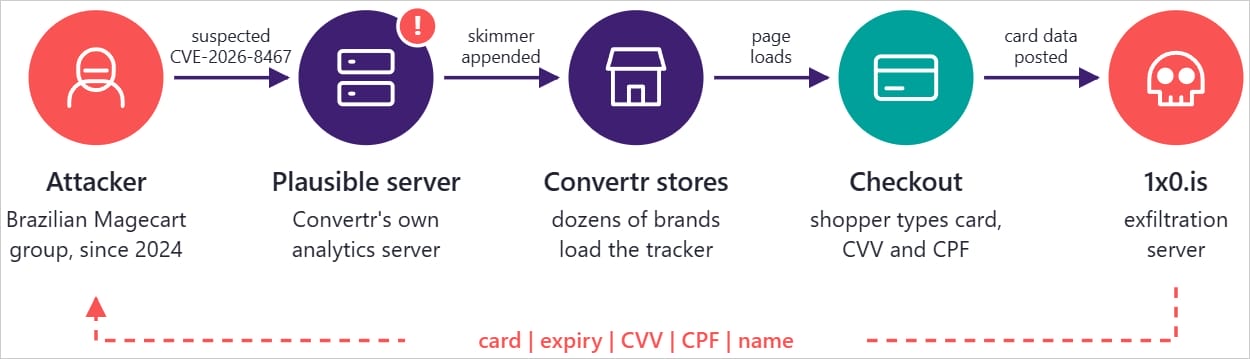
The incident, initially uncovered by e-commerce cybersecurity specialists on October 24, highlights a sophisticated evolution in digital skimming tactics. Rather than targeting individual merchant websites one by one—a time-consuming and noisy endeavor—the threat actors executed a classic software supply chain attack. They targeted the centralized infrastructure of a platform provider, granting them leveraged access to dozens of online storefronts simultaneously. Investigators have provisionally linked this campaign to an active Brazilian cybercriminal collective that has maintained operations since at least mid-2024. Historically, this group focused its efforts on injecting malicious payloads into popular open-source e-commerce frameworks such as Magento, OpenCart, and WooCommerce. However, the Convertr incident represents a strategic pivot toward centralized platform vectors, maximizing their return on investment by exploiting unified infrastructure.
To understand the gravity of the breach, one must examine Convertr’s market footprint. The platform serves as the technological backbone for numerous major fashion and retail brands across Brazil, processing an estimated R$2 billion ($370 million USD) in annual transactions. Because Convertr manages the checkout pipelines and backend transaction processing for these commercial entities, any compromise at the platform level cascades immediately down to individual merchant sites. When digital security researchers analyzed the vector of entry, they discovered that the attackers had successfully manipulated a Plausible tracker file. Plausible is widely deployed as a privacy-focused, open-source alternative to conventional telemetry tools like Google Analytics. In this deployment, the tracker was hosted on a self-managed, self-hosted server environment directly controlled and maintained by Convertr, rather than residing on a third-party managed cloud service.

Initial technical assessments point toward a severe unauthenticated remote code execution flaw, cataloged as CVE-2026-8467, which reportedly afflicted Convertr’s deployment of the Plausible Community Edition. Security analysts believe the threat actors exploited this unpatched vulnerability to achieve initial ingress into the internal corporate network. Although this specific exploitation vector remains officially unconfirmed pending comprehensive forensic audits, the mechanics of the subsequent intrusion are exceptionally clear. Once the actors secured administrative or execution privileges on the self-hosted server, they bypassed perimeter defenses and injected malicious JavaScript directly into the legitimate analytics tracker file. Because this particular tracker script is hardcoded to load asynchronously on the checkout pages of every single merchant operating within the Convertr ecosystem, the malicious payload was silently delivered to the browsers of unsuspecting shoppers the moment they initiated a transaction.
The evolution of the injected malicious payload reveals a high degree of technical competence and iterative refinement. According to threat intelligence reports, the initial iterations of the digital skimmer deployed by the group relied on generic, heuristic pattern matching to scrape form fields. These early scripts attempted to harvest any input field bearing resemblance to traditional credit card nomenclature—such as card numbers, expiration dates, and CVV codes. However, as the attack progressed, the cybercriminals pushed a significantly more targeted iteration. By October 26, the script had been updated to recognize and extract data utilizing Convertr’s exact proprietary payment API field names. This custom tailoring ensured that the stolen financial data was clean, structured, and instantly actionable upon exfiltration, minimizing data corruption and reducing the likelihood of operational errors during extraction.
The consequences of this supply chain compromise extend far beyond immediate financial losses, triggering complex regulatory and reputational liabilities for both the platform provider and its merchant network. When malicious scripts execute within the context of a trusted browser session, they operate outside the visibility of traditional web application firewalls. Because the injected code piggybacks on a legitimate, whitelisted analytics script, security monitoring solutions often fail to flag the outbound data transmission as anomalous. The script quietly captures sensitive consumer data fields during the final, most critical stage of the buyer journey—the payment confirmation phase—before the data is even encrypted and transmitted to legitimate payment gateways. Consequently, consumers who completed transactions on any affected Brazilian storefront featuring the telltale checkout address string since the inception of the campaign found their financial credentials harvested in real time.
Response and remediation efforts orchestrated in the wake of the discovery underscored the friction inherent in modern incident response workflows. Upon receiving actionable intelligence from security researchers, Convertr initiated containment protocols, purging the malicious code modifications from the compromised Plausible instance and upgrading the underlying software framework to a securely patched version. Concurrently, the platform provider began issuing mandatory notifications to impacted merchant clients and associated payment processing partners. Despite these remediation measures, security researchers issued critical warnings regarding secondary persistence mechanisms—specifically, browser-side caching. Because web browsers aggressively cache static assets like JavaScript tracker files to optimize loading speeds, the malicious script could theoretically continue to execute in consumer browsers for up to 24 hours after server-side eradication. Experts strongly urged affected shoppers to purge their local browser caches before attempting future transactions and advised anyone who engaged in card-based commerce on impacted platforms to immediately freeze their payment cards and request replacements.
This incident serves as a sobering reminder of the systemic risks associated with third-party digital dependencies. In contemporary web development, applications are routinely assembled from dozens of external scripts, tracking pixels, and analytics libraries, many of which execute with high privileges within the consumer’s browser environment. Each external dependency represents a potential vector for supply chain exploitation. If an attacker compromises a single shared asset—be it a content delivery network, an open-source analytics package, or a vendor-managed hosting server—they effectively achieve mass distribution for their payload. This architectural reality challenges the foundational tenets of modern cybersecurity, emphasizing that an enterprise’s security posture is only as robust as its weakest third-party integration.
Looking toward the future, the cybersecurity landscape surrounding e-commerce infrastructure is bound to experience profound shifts in regulatory enforcement, architectural design, and defensive technology. Financial regulators and data protection authorities are increasingly holding platform operators strictly accountable for downstream security failures, meaning that third-party software supply chain negligence can no longer be insulated by corporate disclaimers or distributed vendor responsibilities. In response, platform engineering teams are accelerating the adoption of advanced runtime application self-protection (RASP) tools, rigorous automated dependency scanning, and strict Content Security Policies (CSP). By implementing aggressive CSP directives that limit where scripts can load from and where they can transmit data, organizations can neutralize unauthorized data exfiltration attempts even if an upstream script is successfully compromised.
Simultaneously, consumer-facing defensive strategies are evolving to mitigate the risks inherent in an increasingly hostile internet. The growing adoption of disposable virtual payment cards—which feature dynamic card numbers, strict transaction limits, and immediate post-purchase expiration—represents a vital line of defense for end users. By abstracting the consumer’s primary financial accounts away from the direct point of sale, virtual cards ensure that even a successful digital skimming attack yields transient, unusable data tokens rather than permanent access to revolving credit lines. Ultimately, as cybercriminal syndicates continue to refine their supply chain infiltration techniques, the digital commerce ecosystem must transition from a reactive posture of post-breach cleanup to an architecture of absolute zero trust, where every script, tracker, and third-party dependency is continuously verified, monitored, and restricted by default.
