

The landscape of enterprise artificial intelligence is undergoing a profound structural evolution, marked by a strategic shift away from raw parameter scale toward operational velocity, cost efficiency, and agentic precision. In a significant industry development, OpenAI has officially announced the rollout of GPT-6.1 Terra. This advanced model is engineered specifically to master complex computer use, nuanced visual reasoning, advanced coding workflows, and day-to-day administrative burdens. By marrying high-performance task execution with a radically diminished economic footprint, the release of Terra signals a new chapter in how organizations deploy artificial intelligence for routine knowledge work and automated desktop orchestration.
As modern enterprises increasingly demand automation tools that transcend simple text generation, the introduction of GPT-6.1 Terra addresses a critical bottleneck in the market. Historically, deploying large language models capable of executing multi-step desktop procedures or interpreting intricate technical blueprints involved prohibitive computational costs and latency issues. Organizations were forced to choose between the blinding speed of smaller, less capable models and the exorbitant API expenses of flagship heavyweights. GPT-6.1 Terra bridges this gap, offering an agile, highly specialized alternative designed to shoulder the cognitive and operational heavy lifting of the modern corporate workspace without straining enterprise IT budgets.
At its core, GPT-6.1 Terra is architected to thrive in environments that require active interaction with graphical user interfaces, software applications, and dynamic data streams. Unlike traditional models that operate primarily in text-based isolation, Terra is optimized for computer use—the ability to interpret screen layouts, interact with software controls, complete structured web and desktop forms, and orchestrate cross-application workflows. Furthermore, its enhanced visual reasoning capabilities allow it to parse dense architectural layouts, engineering schematics, and rich multimedia assets such as video editing timelines.
According to technical documentation released by OpenAI, Terra represents a generational leap over its predecessor, the GPT-5.6 Terra. The organization emphasized that the model excels at the multifaceted communication and computer-based routines that consume the average professional workday. Whether an enterprise user needs to draft comprehensive project proposals, synthesize multi-page technical drawings, execute bulk form submissions, or coordinate preliminary video editing milestones, Terra provides a frictionless, natural writing and execution layer that minimizes human intervention.
One of the most disruptive aspects of the GPT-6.1 Terra release is its aggressive pricing strategy. OpenAI has structured the API costs for the new model to be 50 percent lower than both the preceding GPT-5.6 Terra and the concurrent GPT-6.1 Sol architectures. Specifically, developers and enterprise clients can access the model via the gpt-6.1-terra endpoint at a rate of $1 per million input tokens and $5 per million output tokens. This aggressive downward pricing pressure reflects a broader industry trend where foundational model providers are competing fiercely on unit economics to capture high-volume enterprise integration pipelines.
This dramatic reduction in cost does not come at the expense of capability. Benchmark evaluations reveal striking performance gains across standardized testing frameworks. On the rigorous "Agents’ Last Exam" benchmark, GPT-6.1 Terra achieved a score 15 percentage points higher than GPT-5.6 Terra when operating at a medium reasoning effort level, all while consuming approximately one-third of the operational expenditure. More remarkably, comparative analysis indicates that Terra delivers performance parity with OpenAI’s flagship GPT-6 Astra model, yet costs a mere one-tenth of Astra’s price per token.
Beyond cost and accuracy, velocity remains a defining characteristic of the new release. In operational throughput tests, GPT-6.1 Terra completed designated workflows over three times faster than both GPT-6 Astra and GPT-6.1 Sol. This velocity multiplier is particularly critical for autonomous AI agents, where latency compounds across multi-step task chains. By accelerating execution speed threefold, Terra enables real-time responsiveness in interactive desktop agents, transforming user experiences from asynchronous batch processing to immediate, conversational task completion.
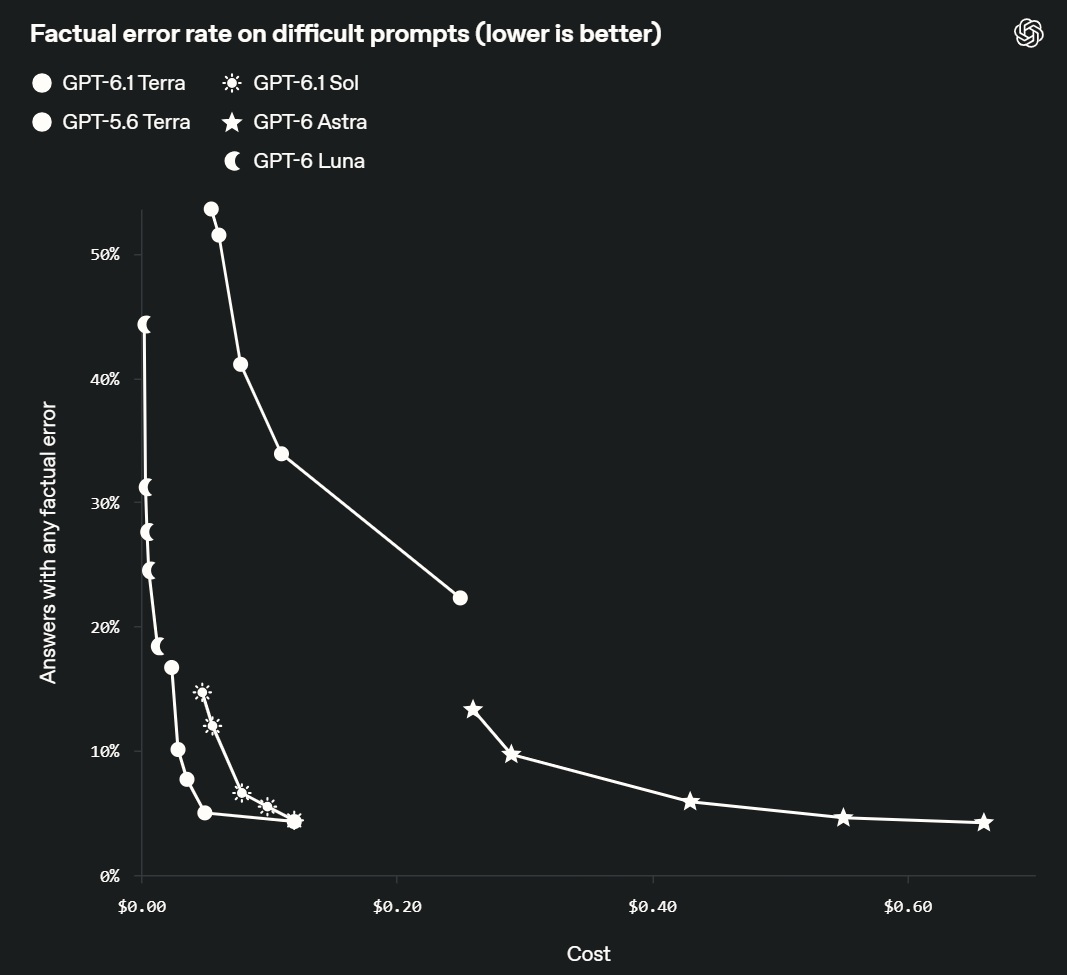
A persistent challenge in the deployment of generative artificial intelligence for mission-critical enterprise workflows has been the propensity for models to hallucinate—generating plausible-sounding but factually incorrect outputs or executing erroneous tool calls. GPT-6.1 Terra introduces substantial architectural refinements designed to drastically curtail error rates.
Internal benchmark metrics provided by OpenAI illustrate a dramatic improvement in reliability. When operating at low reasoning effort, the error rate plummeted from 53.6 percent in the previous GPT-5.6 Terra iteration down to 16.7 percent in GPT-6.1 Terra. When pushed to maximum reasoning effort, the error rate dropped an additional 18 percentage points, landing at a remarkably stable 4.3 percent. This places Terra’s reliability profile on par with much larger systems like GPT-6 Astra and GPT-6.1 Sol, giving systems architects greater confidence when embedding the model into automated loops where human oversight is minimal.
Software engineering workflows have also experienced a major upgrade. On Terminal-Bench 4.0, evaluated at maximum reasoning effort, GPT-6.1 Terra secured a score of 50.3 percent. This performance metric represents more than a doubling of the capability demonstrated by GPT-5.6 Terra, which stalled out at 21.5 percent. While OpenAI continues to recommend specialized architectures such as GPT-6.1 Sol or GPT-6 Astra for hyper-complex, multi-file software engineering endeavors and deep algorithmic development, Terra proves more than capable of handling routine scripting, debugging, and terminal automation tasks.
The broader market implications of GPT-6.1 Terra extend far beyond individual productivity enhancements. As enterprises transition from passive chat interfaces to active, autonomous agent ecosystems, the demand for models that can reliably execute computer-use tasks has skyrocketed. Industry analysts note that the race for enterprise automation is no longer won solely by raw parameter counts, but by the ability to deliver deterministic execution, low latency, and predictable unit economics.
By undercutting legacy pricing structures while simultaneously delivering a threefold speed advantage and a sharply reduced error rate, OpenAI is aggressively positioning Terra as the default engine for enterprise process automation. This strategy threatens to disrupt traditional robotic process automation (RPA) vendors, whose legacy rule-based bots often struggle with unstructured visual data, dynamic web interfaces, and contextual natural language interpretation. An autonomous agent powered by GPT-6.1 Terra can adapt to layout changes in software applications, interpret unstructured documentation on the fly, and execute complex administrative handoffs without requiring fragile, hard-coded integration scripts.
Furthermore, the integration path for organizations has been streamlined. GPT-6.1 Terra is rolling out immediately across multiple tiers of the OpenAI ecosystem. It is now accessible to Plus, Pro, Enterprise, and Edu subscribers directly within ChatGPT Work and Codex environments. For custom software developers and enterprise engineering teams, the model is fully operational via the API using the standardized gpt-6.1-terra identifier. This immediate availability ensures that the developer community can begin stress-testing the model’s agentic capabilities and recalculating their application unit economics without delay.
Looking toward the future, the introduction of models like GPT-6.1 Terra heralds a fundamental shift in human-computer interaction paradigms. As AI agents become faster, cheaper, and structurally more reliable, the locus of digital work is shifting from direct manual execution to high-level supervisory management. Workers will increasingly act as directors of fleets of specialized autonomous agents, delegating complex multi-application workflows—ranging from financial reconciliation and compliance auditing to dynamic content production and software deployment—to fast, cost-effective models operating quietly in the background.
In this emerging paradigm, the innovations embedded within GPT-6.1 Terra—balancing speed, economic viability, visual reasoning, and minimized hallucination rates—serve as a blueprint for the next generation of enterprise software architecture. As organizations worldwide race to capture efficiency gains through automation, models that successfully democratize high-end reasoning while collapsing operational overhead will undoubtedly dictate the competitive winners of the digital economy.
