

The global transition toward renewable energy is currently unfolding at an unprecedented pace. Across every continent, utility companies, private developers, and governments are engaged in a high-stakes race to deploy solar arrays and battery storage systems. The drivers are clear: achieving energy security, reducing dependence on volatile fossil fuel markets, and meeting aggressive decarbonization targets to mitigate the worst effects of climate change. Yet, as capital pours into the clean energy sector, the transition is hitting a formidable and unexpected barrier: a severe and systemic shortage of skilled labor.
Building a utility-scale solar farm is a grueling, labor-intensive endeavor. It requires thousands of workers to operate in remote, harsh environments, manually unloading, carrying, and installing millions of heavy, fragile glass panels. As the demand for these projects skyrockets, the construction industry is struggling to recruit and retain the workforce necessary to keep pace with project pipelines. While automation has long been proposed as a solution to industrial labor shortages, traditional robotics have historically failed when taken out of the controlled, highly predictable environments of factory floors.
However, a fundamental shift is underway. The convergence of advanced computer vision, spatial computing, and next-generation artificial intelligence is enabling machines to operate effectively in chaotic, unstructured outdoor environments. Capitalizing on this technological leap, Gritt, a robotics startup founded by Carnegie Mellon University-trained roboticists, has emerged from stealth with $34 million in total funding. The company’s mission is to leverage "physical AI" to automate the most labor-intensive aspects of heavy infrastructure development, beginning with utility-scale solar installations.
The Capital Influx and the Stealth Exit
Gritt’s official emergence from stealth is backed by a $26 million Series A funding round led by Obvious Ventures, with participation from Union Square Ventures and Active Impact Investment. This latest injection of capital brings the startup’s total funding to $34 million, following an earlier seed round supported by a coalition of prominent deep-tech and climate-focused venture capital firms, including First Round Capital, Climactic, Congruent Ventures, and VSC Ventures.
The startup was co-founded by CEO Puneet Puri and CTO Vishal Dugar, both alumni of Carnegie Mellon University’s prestigious robotics program. Their shared vision is to develop an intelligent software platform capable of orchestrating heavy machinery on dynamic, unpredictable construction sites. Rather than designing specialized, proprietary hardware, Gritt is focusing its resources on the cognitive layer of robotics—creating the "brain" that allows standard industrial equipment to perceive, navigate, and manipulate objects in the real world.
The investment reflects a growing appetite among venture capitalists for practical, software-driven solutions to physical-world bottlenecks. While the tech industry has spent the last decade funding software-as-a-service (SaaS) and digital AI models, the limits of purely digital productivity are driving capital back toward the physical economy. Infrastructure, logistics, and agriculture are increasingly viewed as the next frontiers for AI-driven transformation.
The Paradox of Outdoor Automation
To appreciate the significance of Gritt’s approach, one must understand why automation has historically stopped at the factory gate. In an automotive assembly plant, every variable is controlled. The lighting is consistent, the floor is perfectly flat, and the components arrive in precise, predictable orientations. Under these conditions, robots can execute pre-programmed trajectories with high speed and repeatability.
A solar construction site is the exact opposite. It is an unstructured, chaotic environment characterized by uneven terrain, dust, shifting wind, variable lighting, and unpredictable human activity. Traditional robotic programming, which relies on deterministic, step-by-step instructions, completely breaks down in these conditions. If a solar panel is slightly misaligned in a delivery crate, or if a gust of wind moves a robotic arm by a fraction of an inch, a traditional robot cannot adapt, often resulting in damaged equipment or system halts.
Gritt’s core thesis is that solving this problem requires generalizable intelligence rather than highly specialized hardware. The company’s software platform integrates advanced machine learning models with real-time sensor data, allowing off-the-shelf industrial machines to perceive their surroundings, make real-time adjustments, and perform complex manipulation tasks with sub-millimeter precision.
A Software-First, Hardware-Agnostic Strategy
One of the most critical strategic decisions made by Gritt’s founders is the rejection of custom hardware development. Building proprietary physical robots is a capital-intensive, high-risk path that has led to the demise of numerous robotics startups. Hardware development cycles are slow, manufacturing supply chains are complex, and maintenance in remote field locations is incredibly difficult.
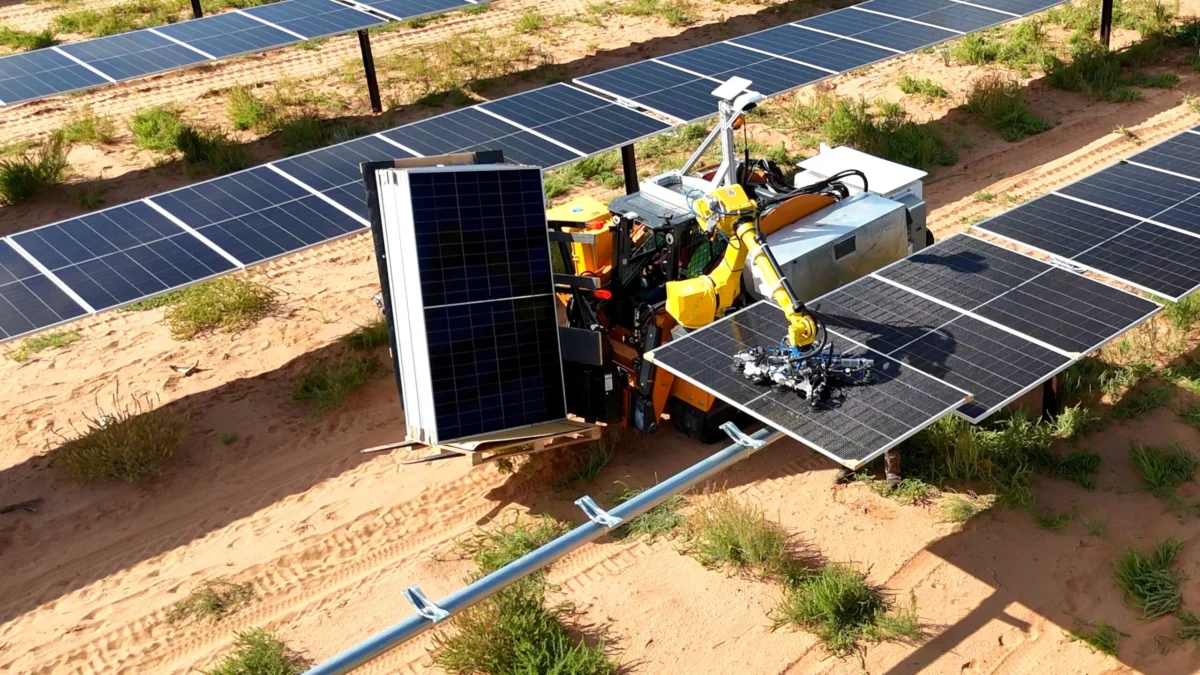
Instead, Gritt utilizes existing, widely available hardware. In its current field deployments, the company rents standard industrial skidders and integrates them with off-the-shelf robotic arms manufactured by established industrial giants like Kawasaki. By overlaying its proprietary AI models onto proven, ruggedized machinery, Gritt bypasses the hardware manufacturing bottleneck.
This hardware-agnostic strategy offers several distinct advantages:
- Capital Efficiency: Gritt does not need to build factories to manufacture robots. It can scale its operations by purchasing or leasing existing machinery, keeping its capital expenditures low and its balance sheet lean.
- Maintenance and Support: Standard construction machinery is built to withstand harsh environments and is supported by global dealer networks. If a skidder breaks down on a remote site, local technicians can service it, minimizing project downtime.
- Regulatory and Safety Compliance: Utilizing heavy machinery that has already undergone decades of safety testing and regulatory certification simplifies the path to deployment on active, highly regulated construction sites.
This approach sets Gritt apart from several competitors in the emerging solar-robotics space, such as Luminous Robotics, Cosmic, and China-based Trinabot, which are developing integrated, proprietary hardware platforms. While custom hardware can offer tight integration and optimized performance for specific tasks, Gritt’s software-first model is designed for rapid scaling and adaptability.
Redefining Site Economics and Worker Safety
The first operational task tackled by Gritt’s intelligent systems is the handling and positioning of utility-scale solar panels. These panels are large, heavy sheets of glass and silicon, often weighing up to 100 pounds. Manually unloading these panels from shipping crates, transporting them across uneven ground, and lifting them overhead to align them with metal racking systems is exhausting, repetitive, and physically hazardous work.
Gritt’s system automates this entire sequence. Operating on a mobile platform, the robot unloads the panels, carries them to the designated installation frames, and positions them with sub-millimeter accuracy. Human workers are then responsible for the final, low-strain task of securing the fasteners.
The productivity gains of this collaborative human-robot workflow are profound. On a typical utility-scale project, an eight-person crew of manual laborers can install roughly 800 panels per day. When that same eight-person crew works alongside Gritt’s automated systems, daily installation rates jump to between 3,000 and 4,000 panels. This represents a four- to five-fold increase in labor productivity.
Beyond the raw speed of installation, the technology addresses a critical safety and labor retention issue. Construction companies struggle to staff remote projects, where workers must endure extreme heat and perform heavy lifting for weeks on end. Musculoskeletal injuries are common, leading to high turnover and increased workers’ compensation costs. By delegating the heavy lifting to machines, construction firms can create safer, more appealing working environments, making it easier to recruit and retain workers for supervisory and technical roles.
Commercial Traction and the Scaling Pipeline
The market demand for this technology is already evident in Gritt’s commercial pipeline. Upon exiting stealth, the company revealed that it has secured contracts to assist in the installation of 2.8 gigawatts (GW) of solar capacity over the next 18 months. To put this in perspective, 2.8 GW is equivalent to the capacity of several large nuclear power plants and represents a significant fraction of the annual solar deployment in the United States.
Gritt’s customer base already includes three of the top ten power construction companies in the U.S. To meet this demand, the company plans to scale its active field deployments rapidly, aiming to have 48 of its intelligent systems operating on commercial sites within the next six months.
For construction contractors, the value proposition extends beyond labor savings. Utility-scale solar projects operate on tight margins and strict timelines, with severe financial penalties for project delays. By introducing a highly predictable, high-speed automated installation process, contractors can de-risk their project schedules, avoid costly delays, and bid more competitively on future projects.
The Power of Generalization in Physical AI
The rapid development of Gritt’s technology is a direct result of the recent breakthroughs in foundational AI models. Historically, training a robot to perform a new task—such as moving from stacking blocks to tying rebar—required years of custom software engineering, hardcoded math, and extensive physical testing.
Modern AI, however, excels at generalization. By utilizing neural networks trained on vast amounts of spatial and visual data, Gritt’s underlying software pipeline can adapt to new tasks with minimal retraining. According to CEO Puneet Puri, while training the system to stack cinder blocks initially took weeks of development, transitioning the same software pipeline to perform a highly complex rebar-tying demo took just a single day.
This capacity for rapid generalization is central to Gritt’s long-term product roadmap. While the company is starting with solar panel installation, it plans to quickly expand the capabilities of its systems to encompass other labor-intensive, sequential construction tasks. These include:
- Racking and Post Drilling: Automating the initial steps of solar farm construction, including driving steel piles into the ground and assembling the metal racking systems that hold the panels.
- Rebar Tying: A notoriously grueling and repetitive task in concrete construction, where workers must bend over for hours to tie steel reinforcement bars together with wire before concrete is poured.
- Material Handling and Logistics: Moving diverse building materials across complex construction sites dynamically, adapting to changing layouts and obstacles.
The Autonomous Construction Site of the Future
As Gritt’s systems deploy across more construction sites, they will collect massive amounts of real-time spatial and operational data. This data feedback loop will not only improve the performance of individual robotic tasks but also enable the systems to act as an intelligent management layer for the entire job site.
On a traditional construction site, project managers often struggle with a lack of real-time visibility. Missing inventory, delayed sub-contractors, and unexpected weather events can disrupt schedules without warning. A fleet of robots equipped with advanced cameras, LiDAR, and edge-computing capabilities can serve as continuous, mobile data collectors.
The founders of Gritt envision a future where their systems do more than perform physical labor; they will actively assist in site decision-making. For example, a Gritt platform navigating a site might detect an open, uncompleted trench. Recognizing an approaching storm via localized weather data, the system could automatically alert project managers to cover the trench before rain damages underground electrical components. Similarly, the system could continuously track inventory, flagging missing or misplaced materials before they cause a work stoppage.
This integration of physical manipulation and high-level site intelligence represents the true potential of "physical AI." It transforms robots from single-purpose tools into collaborative, intelligent agents capable of optimizing the entire construction ecosystem.
Industry Implications and the Broader Construction Crisis
The rise of companies like Gritt comes at a critical juncture for the global construction industry. For decades, construction has suffered from a stagnation in productivity. While manufacturing, agriculture, and retail have experienced massive productivity gains through automation and digitization, construction productivity has actually declined in some regions.
This productivity deficit is compounded by demographic shifts. The average age of construction workers is rising, and younger generations are increasingly pursuing careers in the digital economy rather than the physical trades. At the same time, the global demand for new infrastructure—not just clean energy, but also housing, transportation, and grid modernization—is at an all-time high.
The transition to a sustainable economy cannot happen in the abstract; it requires the physical deployment of millions of tons of steel, glass, and concrete. If the labor supply cannot meet this demand, the clean energy transition will stall, with severe consequences for global climate goals.
By proving that AI-driven robotics can operate successfully in the chaotic, real-world environments of construction sites, Gritt is demonstrating a viable path forward. The successful automation of utility-scale solar construction is likely just the first chapter in a broader revolution that will redefine how humanity builds its physical world. As physical AI matures, the division between digital intelligence and physical labor will dissolve, paving the way for a more productive, safer, and rapidly scalable approach to building global infrastructure.
