


The contemporary digital landscape is defined by an ongoing struggle between systemic data harvesting and the individual’s right to digital anonymity. For decades, the foundational mechanics of the internet have treated personal identifiers—most notably the electronic mail address—as persistent, immutable tokens. Web platforms, marketing conglomerates, and threat actors rely on this permanence to track users across disparate domains, build comprehensive behavioral profiles, and execute targeted exploitation campaigns following corporate data breaches. In response to this expanding attack surface, browser developers are increasingly moving beyond traditional perimeter defenses to address foundational vulnerabilities in how digital identities are structured.
With the release of version 1.94, the privacy-focused Brave browser has introduced a significant architectural expansion aimed at dismantling one of the most resilient tracking mechanisms on the web: the persistent email address. Entitled "Email Aliases," this new capability allows users to instantly provision disposable, unique forwarding addresses when registering for external services, effectively shielding their primary inboxes from direct exposure. While this feature represents an intuitive tool for everyday consumers, its underlying engineering reflects a broader paradigm shift in how privacy software vendors are attempting to eliminate residual data liabilities that standard browsing protections fail to cover.

To understand the strategic significance of this release, one must examine the limitations of modern browser-level privacy controls. For years, browsers have deployed sophisticated countermeasures—ranging from automated cookie blocking and cache partitioning to advanced fingerprinting mitigation—to prevent third-party trackers from correlating a user’s activity across multiple sites. However, these mechanisms traditionally halt at the application boundary. When a user voluntarily submits their primary email address to create a web account, that identifier is committed to a third-party database. Once ingested by corporate servers, the email address becomes a persistent cross-site identifier, capable of being shared with data brokers, cross-referenced in data cooperatives, or weaponized in subsequent security incidents.
The security implications of this reliance on a single, permanent email address are severe. When a service provider suffers a security breach, user credentials and profile metadata frequently circulate within underground forums and commercial data-broker networks. Because individuals reuse credentials or rely on their primary email across dozens of critical and non-critical platforms, a single compromised low-security forum can expose an individual to targeted phishing campaigns, credential stuffing assaults, and social engineering vectors that persist for years. Brave’s introduction of automated email aliasing directly addresses this systemic risk by enforcing compartmentalization. By ensuring that every web service interacts with a distinct, cryptographically isolated placeholder rather than the user’s actual inbox, the browser neutralizes the connective tissue that data brokers use to unify disparate behavioral histories.
Implementing this functionality required a careful balancing act between seamless usability and zero-knowledge architecture. To utilize the new alias system, users must first establish a complimentary Brave Account and register their primary email address. This foundational registration serves exclusively as the routing endpoint for inbound message delivery. Significantly, the architecture behind these accounts relies on OPAQUE, a password-authenticated key exchange standardized as RFC 9807. This cryptographic protocol allows users to authenticate with cloud services without ever transmitting their raw passwords—or even traditional password hashes—to Brave’s servers. By decoupling authentication from credential exposure, the system mitigates risks associated with server-side memory scraping, bulk database cracking, and credential logging attacks, ensuring that even if infrastructure is compromised, the master keys to user accounts remain shielded.

The mechanics of the email aliasing service are structured with data minimization as a primary design principle. To preserve absolute confidentiality during the message transit lifecycle, both the user’s primary address and all generated aliases are maintained in an encrypted state within the infrastructure. When inbound messages arrive from third-party services, they undergo automated, non-invasive spam and malware filtering before being immediately routed to the destination inbox. Crucially, in a deliberate nod to ephemeral data retention policies, these messages are purged from Brave’s handling servers within seconds of successful delivery. Metadata such as custom user notes associated with individual aliases remain stored locally on the user’s device or are end-to-end encrypted via Brave Sync if propagated across multiple trusted client installations.
From a commercial and deployment standpoint, Brave has structured the rollout to balance accessibility with long-term ecosystem sustainability. The baseline tier of the feature allows free users to generate and manage up to five active email aliases without financial commitment. Concurrently, the organization has indicated plans to introduce an advanced, paid Premium tier in the near future, which will remove these volumetric restrictions for power users requiring extensive compartmentalization across dozens of online registrations.
Despite the robust engineering protecting the feature, early adopters must navigate certain transitional realities inherent to deploying a proprietary mail routing framework. Because Brave is actively establishing its infrastructure’s reputation as an independent mail transfer agent, automated security filters on major legacy email providers may initially misclassify forwarded messages, routing them to spam or junk folders during the initial trust-building phase. Users testing the feature are advised to monitor their filtering directories closely while the system’s sending reputation stabilizes across the broader email ecosystem.
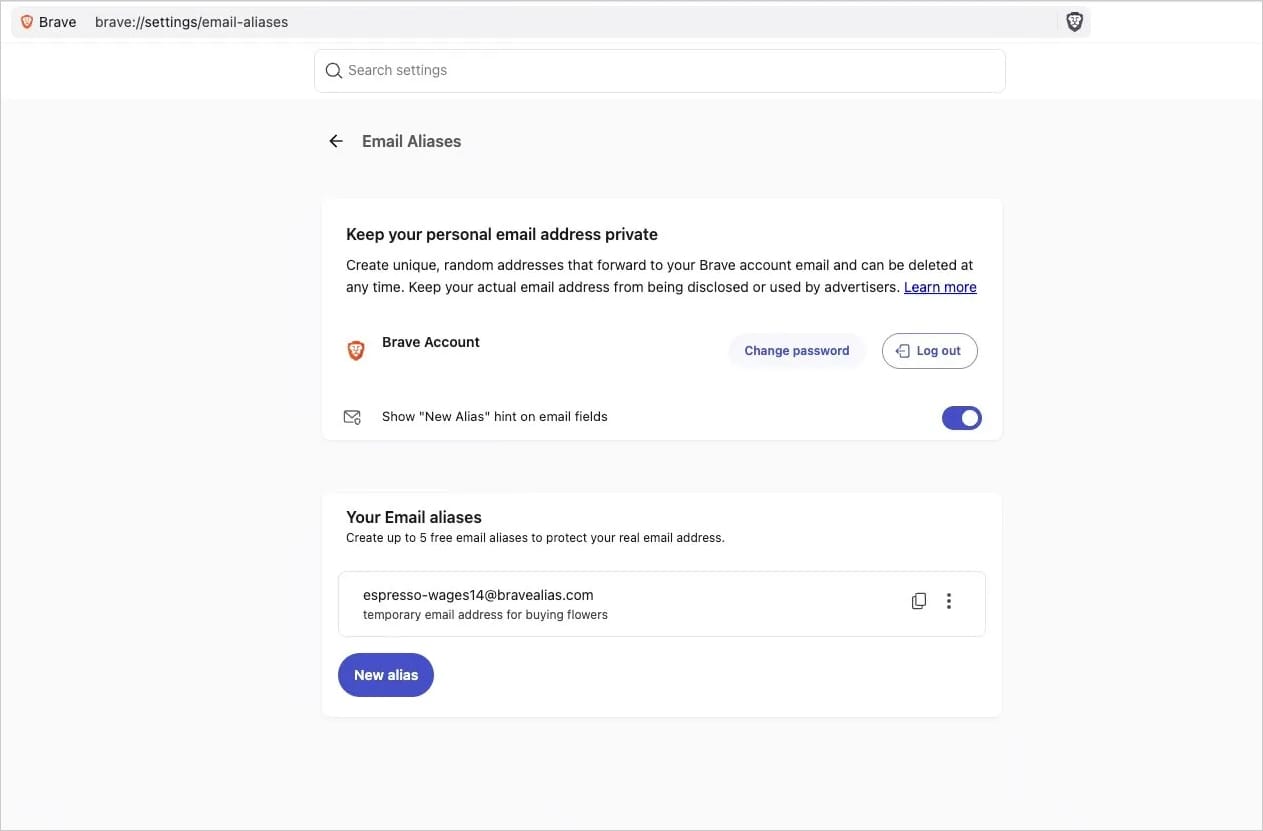
The introduction of native email aliasing within a mainstream browser signals a maturation in the consumer privacy sector. For a long time, achieving this level of operational security required technical literacy—forcing users to configure independent domain names, manage self-hosted mail servers, or rely on third-party privacy services that lacked tight integration with the browsing environment. By embedding identity obfuscation directly into the browser workflow, tools like Brave are lowering the barrier to entry for robust digital hygiene.
As regulatory scrutiny intensifies and automated surveillance technologies become more sophisticated, the boundary between browser security and identity protection will continue to blur. Threat actors and data aggregators increasingly rely on persistent application-layer identifiers to bypass network-level tracking protections. Features that decouple a user’s true identity from their digital footprint are no longer merely convenient utilities; they are becoming essential defensive infrastructure. By neutralizing cross-site identity matching at the point of registration, developments of this nature represent a crucial step forward in returning control of personal data to the individual, shifting the balance of power away from centralized data harvesters and back to the end user.
