

In the high-stakes arena of transplant surgery, time is an unforgiving adversary. From the moment a vital organ is severed from its vascular supply during donor retrieval, a relentless biological clock begins to tick. Deprived of oxygenated blood, cellular metabolism breaks down, triggering rapid adenosine triphosphate (ATP) depletion, cellular swelling, inflammatory cascades, and progressive tissue decay. For decades, the global medical community has relied on static cold storage—submerging donated organs in specialized preservation solutions packed on wet ice at approximately 4°C (39°F)—to slough off metabolic demand and slow down degradation.
Yet, conventional hypothermic preservation remains a strictly limited palliative measure for organ decay. At 4°C, metabolic activity drops to roughly 10 percent of normal levels, buying clinicians a precarious window of roughly 18 to 24 hours to transport a donor kidney to a compatible recipient. Beyond this threshold, the risk of delayed graft function (DGF), tissue necrosis, and long-term graft failure rises exponentially. This narrow temporal constraint generates a logistical bottleneck that costs thousands of lives every year.
Now, a pioneering advancement in thermodynamic engineering and bio-preservation is poised to dismantle this operational constraint. Researchers led by thermodynamicist Matthew Powell Palm at Texas A&M University have developed a specialized pressure-controlled system capable of supercooling solid organs to -4°C (25°F) without forming damaging ice crystals or requiring toxic chemical additives. In groundbreaking preclinical animal trials, the team successfully preserved porcine kidneys at sub-zero temperatures for up to 72 hours—triple the standard clinical timeframe—before transplanting them into animal recipients with remarkable functional recovery and long-term graft viability.
The Staggering Reality of the Organ Allocation Crisis
To understand the magnitude of this technological leap, one must examine the systemic vulnerabilities of the modern organ procurement and transplantation infrastructure. In the United States alone, the waiting list for kidney transplants exceeds 104,000 candidates. The supply-demand disparity is severe, resulting in an average of 17 patients dying each day while waiting for a viable organ.
Critically, the crisis is exacerbated not only by a shortage of registered donors, but also by the catastrophic loss of viable organs during transit. National transplant registries indicate that in certain years, up to one-third of all recovered donor kidneys are discarded prior to implantation. The vast majority of these organs are rendered clinically unusable because cold ischemic time—the duration an organ spends between donor cross-clamping and recipient revascularization—exceeds safe limits.
CURRENT CLINICAL STANDARD vs. SUPERCOOLING ADVANCEMENT
┌───────────────────────────┬───────────────────────────┬───────────────────────────┐
│ Preservation Method       │ Standard Temperature      │ Viable Storage Window     │
├───────────────────────────┼───────────────────────────┼───────────────────────────┤
│ Static Cold Storage (Ice) │ ~4°C (39°F)               │ 18 – 24 Hours             │
│ Normothermic Perfusion    │ ~37°C (98.6°F)            │ 12 – 24 Hours             │
│ Isobaric Supercooling     │ -4°C (25°F)               │ 72 – 120 Hours            │
└───────────────────────────┴───────────────────────────┴───────────────────────────┘
While advanced ex vivo normothermic machine perfusion systems have emerged to pump oxygenated, nutrient-rich fluids through organs at body temperature, these platforms are technically complex, prohibitively expensive, and typically extend preservation by only a few additional hours. As a result, transplant centers remain constrained by rigid geographical radii, forced to race against time using private charter flights and rapid ground transit to deliver organs before ischemia permanently damages the graft tissue.
Devising an Ice-Free Sub-Zero Environment
The fundamental challenge of cooling biological tissue below the freezing point of water (0°C) lies in phase change dynamics. When liquid water transitions to solid ice, extracellular ice crystals form sharp, needle-like structures that puncture cellular membranes, disrupt microvascular networks, and cause severe osmotic shock. While cryobiologists have long achieved sub-zero cryopreservation for single cells and simple structures—such as sperm, oocytes, and early-stage embryos—large, dense vascularized organs present a vastly more complex physical hurdle.
To prevent ice formation during deep freezing, scientists historically experimented with high concentrations of cryoprotectant agents (CPAs)—chemical compounds that essentially act as biological antifreeze. However, CPAs introduce profound clinical drawbacks: they are inherently cytotoxic at high concentrations, induce systemic inflammation, cause cellular dehydration, and require long, complex washing protocols to remove prior to transplantation. Furthermore, introducing novel chemical compounds into human organs creates formidable regulatory hurdles, delaying clinical translation by years or decades.
Approaching the problem through the lens of pure thermodynamics, Powell Palm and his team circumvented the need for chemical antifreeze altogether. The team capitalized on the physical phenomenon of supercooling, wherein a liquid is cooled below its standard freezing temperature without turning into a solid, provided there are no nucleation sites to trigger ice crystal formation.
The team engineered a compact, hermetically sealed preservation chamber designed to maintain an organ submerged in fluid under strict, constant pressure—an approach known as isobaric supercooling. By controlling the thermodynamic state of the chamber and eliminating mechanical vibrations, air bubbles, and thermal fluctuations that typically seed ice nucleation, the system allows the preservation liquid and embedded organ tissue to remain entirely liquid at -4°C.
The device itself represents an elegant convergence of sophisticated physics and practical clinical engineering. Dubbed by its creators as "low-tech high science," the chamber features a transparent lid for visual monitoring and a sensor array embedded at its base to continuously track ambient temperature, pressure, and acoustic signals indicative of microscopic ice formation. Rather than utilizing experimental chemicals, organs are submerged in a standard, commercially available preservation fluid—such as University of Wisconsin (UW) solution—which is already universally approved for clinical organ transport.
Preclinical Validation: Porcine Models and Long-Term Recovery
To validate the safety and efficacy of the isobaric supercooling platform, the researchers conducted a rigorous series of autotransplantation trials using swine, whose renal anatomy, physiology, and vascular architecture closely mirror those of humans.
In the experimental protocol, individual kidneys were surgically harvested from porcine donors and flushed with standard preservation solution to clear residual blood. The organs were divided into control groups and experimental cohorts:
- Control Group A: Preserved via standard static cold storage on ice (4°C) for 2 hours.
- Control Group B: Preserved via standard static cold storage on ice (4°C) for 24 hours.
- Supercooled Cohorts: Placed within the pressure-controlled chamber at -4°C for 24, 48, or 72 hours.
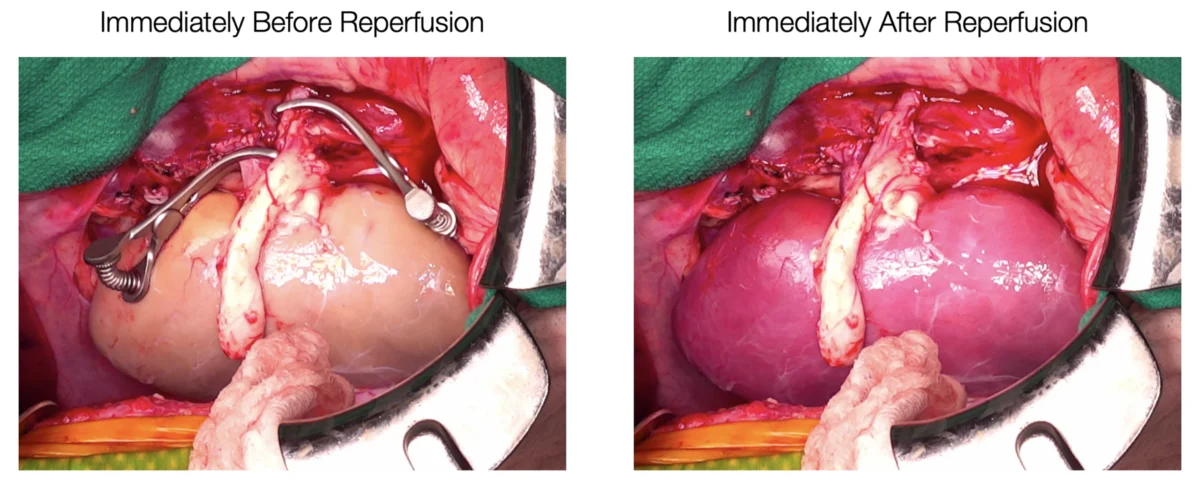
Following the designated storage intervals, the organs were rewarmed and transplanted back into the original donor animals. During the same operative procedure, each animal’s remaining native kidney was removed. This unilateral nephrectomy model ensured that the survival and physiological recovery of the animal depended entirely on the performance of the single, previously preserved graft.
The empirical results surpassed clinical expectations. Kidneys supercooled for 24 hours demonstrated immediate function upon revascularization, producing urine on the operating table within minutes of vascular unclamping—a primary clinical biomarker of cellular health and microvascular integrity. Serum creatinine and blood urea nitrogen (BUN) levels, which measure renal filtration capacity, returned to baseline healthy levels within 10 days post-surgery. Notably, organs supercooled for 24 hours cleared metabolic toxins markedly faster than control kidneys stored on standard ice for the same duration.
Even more striking was the performance of grafts preserved at sub-zero temperatures for 48 and 72 hours. These organs, kept suspended in time for up to three days—triple the maximum standard for human clinical care—exhibited rapid physiological recovery. Rather than suffering from severe ischemic necrosis or primary non-function, the 72-hour supercooled kidneys restored baseline renal filtration within two weeks.

To evaluate long-term graft durability, the research team monitored the transplanted animals over extended survival windows. Over a 30-day post-operative period, the juvenile swine experienced normal developmental growth, increasing their total body mass by approximately 30 percent. Histological and imaging analyses revealed that the supercooled kidneys adapted seamlessly, undergoing compensatory renal hypertrophy—nearly doubling in volume to assume the full metabolic workload previously shared by two kidneys.
In one longitudinal subject tracked for 200 days post-transplant, subsequent tissue biopsy and functional analysis confirmed sustained, healthy renal architecture with no evidence of interstitial fibrosis, chronic vascular rejection, or delayed tissue degeneration. The findings were formally presented at the American Transplant Congress in Boston, drawing widespread acclaim from transplant surgeons and cryobiologists worldwide.
Comparative Analysis: Isobaric Supercooling vs. Alternative Technologies
The success of Powell Palm’s chemical-free isobaric supercooling model marks a distinct shift in the competitive landscape of organ preservation research. Earlier attempts by rival institutions to break the sub-zero barrier required complex chemical cocktails or high-pressure vitrification schemes.
Preservation Paradigm Comparison:

Isobaric Supercooling (Powell Palm Lab):
  • Temperature: -4°C (25°F)
  • Chemical Additives: None (Uses standard UW Solution)
  • Max Tested Preservation: 72–120 Hours
  • Regulatory Obstacle: Low (Device classification, no new drugs)
  • Long-term Survival: Proven (30 to 200+ Days)

Chemical Cryoprotectant Protocols (Alternative Approaches):
  • Temperature: Below 0°C to -10°C
  • Chemical Additives: High concentrations of CPAs (e.g., DMSO, Trehalose)
  • Max Tested Preservation: 48 Hours
  • Regulatory Obstacle: High (Complex drug-device combination approval)
  • Long-term Survival: Limited (1 to 7 Days in preclinical models)
By eliminating CPAs, isobaric supercooling eliminates the toxic side effects that plagued prior sub-zero trials. In contrast to studies where organs required extensive, time-consuming flushing to extract chemical antifreeze before implantation, supercooled organs coming out of an isobaric chamber can be immediately flushed and anastomosed into the recipient using standard surgical workflows.
Industry Implications and the Transformation of Transplant Logistics
The capacity to safely store solid organs for 72 hours—and potentially up to 120 hours based on preliminary bench top data—holds transformative implications for global healthcare delivery, health economics, and logistics.
1. Transition from Emergency Responds to Elective Scheduling
Under current time constraints, organ transplantation operates as an unpredictable, midnight emergency operation. Surgical teams, operating rooms, and support staff must be assembled at a moment’s notice, driving up operational costs and contributing to surgeon fatigue. Extending graft viability to three days transforms transplant surgery into a scheduled, semi-elective procedure. Hospitals can optimize operating room utilization, manage staffing more effectively, and prepare recipients thoroughly prior to surgery.
2. Radical Expansion of Geographic Matching Radii
A 72-hour preservation window effectively eliminates geographic boundaries for organ allocation. Today, a donor kidney harvested in Western Europe or East Asia cannot be transported to a matched recipient in North America due to strict cold ischemia limitations. Isobaric supercooling enables cross-continental organ sharing, creating a global donor-recipient matching network that can dramatically increase the likelihood of finding precise tissue matches for highly sensitized or hard-to-match patients.
3. Deep Histocompatibility and Crossmatching
Modern transplant success relies on matching Human Leukocyte Antigen (HLA) markers to minimize host-versus-graft rejection. However, comprehensive genomic sequencing, cell-based crossmatching, and recipient desensitization protocols take time. By granting clinical laboratories a multi-day buffer, medical teams can perform exhaustive immunological profiling, reducing the incidence of acute rejection and decreasing a patient’s reliance on lifelong, high-dose immunosuppressive therapies.
4. Financial Optimization and Discard Elimination
The financial burden of end-stage renal disease (ESRD) on global healthcare systems is massive, driven primarily by the ongoing costs of chronic hemodialysis. In the United States, Medicare spends tens of billions annually supporting dialysis patients. By dramatically reducing the 33 percent discard rate of donated kidneys and expanding the usable donor pool, isobaric supercooling could transition thousands of patients from chronic dialysis to long-term renal health, saving healthcare systems billions of dollars annually.
Furthermore, the technology eliminates the absolute reliance on high-cost emergency charter aircraft. The physical preservation chamber developed by Powell Palm’s team is compact, portable, and energy-efficient. Demonstrating its real-world durability, researchers successfully transported supercooled kidneys across state lines in the back of a standard crossover SUV (a Kia Sorento), proving that the system can withstand the mechanical vibrations and bumps of routine ground transport without triggering premature ice nucleation.
The Clinical Road Ahead: Regulatory Strategy and Commercialization
With compelling preclinical proof-of-concept data established, the path toward human clinical trials is accelerating. Because the isobaric supercooling platform functions entirely as a mechanical and thermodynamic containment system—without introducing new pharmacologic agents or unapproved synthetic compounds—it qualifies for a streamlined regulatory pathway through the U.S. Food and Drug Administration (FDA).
The device is likely to be evaluated under medical device classification frameworks rather than as a complex drug-device combination product. This distinction significantly reduces the timeline and capital requirements for human clinical testing.
To bring the technology to market, Powell Palm has partnered with biotechnology entrepreneur Sebastian Giwa to launch a specialized spinoff enterprise dedicated to commercializing the sub-zero preservation chamber. The company’s mandate extends beyond renal preservation; researchers are actively adapting the isobaric chamber to accommodate other vital solid organs, including livers, hearts, and lungs. Each organ type possesses unique structural, cellular, and metabolic characteristics, requiring tailored pressure profiles and thermal cooling rates.
Preliminary bench trials suggest that the thermodynamic principles governing isobaric supercooling are universal across soft mammalian tissue. If applied successfully to cardiac and pulmonary preservation—where current clinical time limits are notoriously restrictive at just 4 to 6 hours—the technology could revolutionize thoracic transplantation, saving thousands of patients with end-stage heart and lung failure who currently die on waitlists due to distance constraints.
A New Horizon in Bio-Preservation Science
The development of chemical-free isobaric supercooling represents a pivotal moment in the history of regenerative medicine and surgical biology. For over half a century, the ability to extend the biological viability of harvested tissue was halted by the physics of phase changes and ice formation. By overcoming this thermodynamic obstacle, scientists have unlocked a mechanism to effectively pause biological decay without causing structural or cellular harm.
As human clinical trials approach, the implications of this breakthrough extend far beyond logistics and economics. By turning back the biological clock on donor tissue, isobaric supercooling offers a definitive solution to the global organ shortage, bringing the scientific community closer to a future where no usable organ is discarded and no patient dies waiting for a transplant.
