


The landscape of mobile malware has undergone a fundamental paradigm shift with the identification of RatHat, a sophisticated Android Trojan that integrates large language models to automate device navigation. Traditional mobile malware families have long relied on rigid scripting languages, hardcoded coordinate-based clicking mechanisms, and predictable execution workflows to siphon user credentials and execute fraudulent transactions. However, RatHat transcends these conventional limitations by leveraging an integrated, artificial intelligence-powered subsystem. This technical leap allows the malware to interpret dynamic graphical user interface layouts in real time, transforming how threat actors execute remote fraud operations on compromised mobile handsets.
Security analysts first uncovered the campaign after performing deep forensic reverse-engineering of the malicious packages. Telemetry indicates that the operation is orchestrated by Chinese-speaking threat actors, a conclusion reinforced by the discovery of internal LLM prompt engineering scripts written entirely in Mandarin. The delivery vectors deployed in this campaign reflect standard contemporary distribution strategies, including aggressive malvertising networks, SMS smishing campaigns, and meticulously crafted phishing portals. These landing pages deceive victims into side-loading Android Package Kit (APK) files directly from external web domains, completely bypassing the security guardrails enforced by official software distribution repositories.

At the core of RatHat’s architectural design is the systematic exploitation of the Android Accessibility framework. While leveraging accessibility APIs is a common hallmark among contemporary banking Trojans and remote access tools, RatHat elevates this abuse to an unprecedented level of system integration. Upon securing accessibility privileges, the malware initiates a sequence of highly privileged operations, most notably enabling the device’s native Developer Options and activating Wireless Debugging functionalities. By configuring the operating system in this manner, the malware achieves a local shell-level execution context entirely independent of an external physical workstation. This procedural methodology mirrors advanced tactics previously documented in high-profile mobile malware families such as ToxicPanda and RedHook, signifying a broader industry trend toward self-contained mobile execution environments.
Once local shell execution is secured via Android Debug Bridge (ADB) capabilities, RatHat deploys a specialized, Go-based secondary agent designated as liblocal-service.so. This background component operates with full ADB shell privileges, enabling it to systematically disable system battery optimizations, manipulate background execution limits, and institute persistent hooks within the operating system. Resilience is a defining characteristic of this architecture; the Go-based agent maintains a bidirectional recovery loop with the primary malware binary. If the main application package is terminated or uninstalled by basic administrative commands, the background agent automatically restores it. Conversely, if security software or user intervention neutralizes the agent, the primary malware payload immediately reinstates the missing component. This mutual redundancy guarantees that the malicious foothold remains stable across device reboots and forced application shutdowns.
Further expanding the operational capabilities of the malware is a secondary modular component, libmedia_codec.so, which functions as a Fast Reverse Proxy (FRP) client. This binary establishes an encrypted, persistent network tunnel directly back to infrastructure controlled by the threat actors. Through this continuous communication pipeline, operators maintain stable, low-latency access to the infected handset, even when it rests behind complex network address translation (NAT) boundaries or strict corporate firewalls.
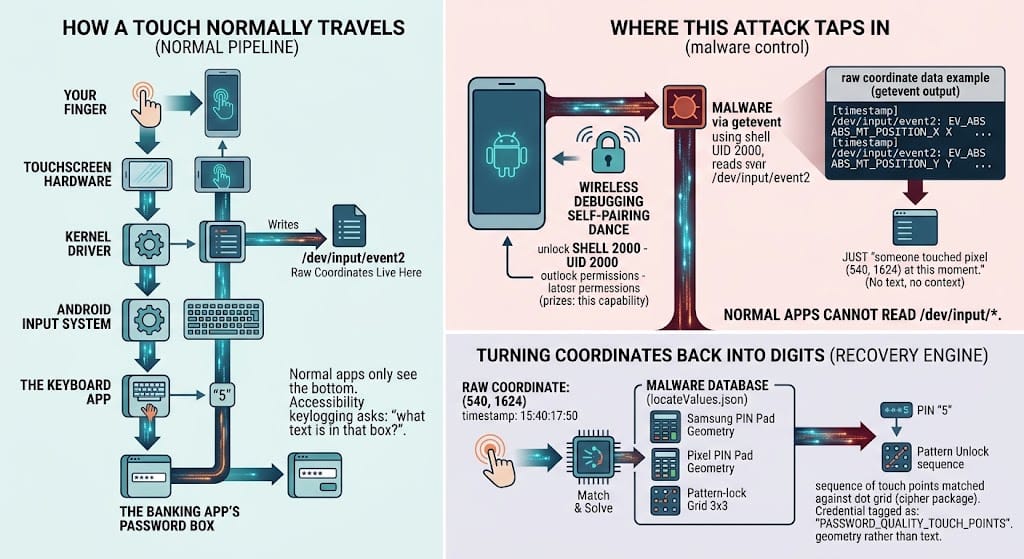
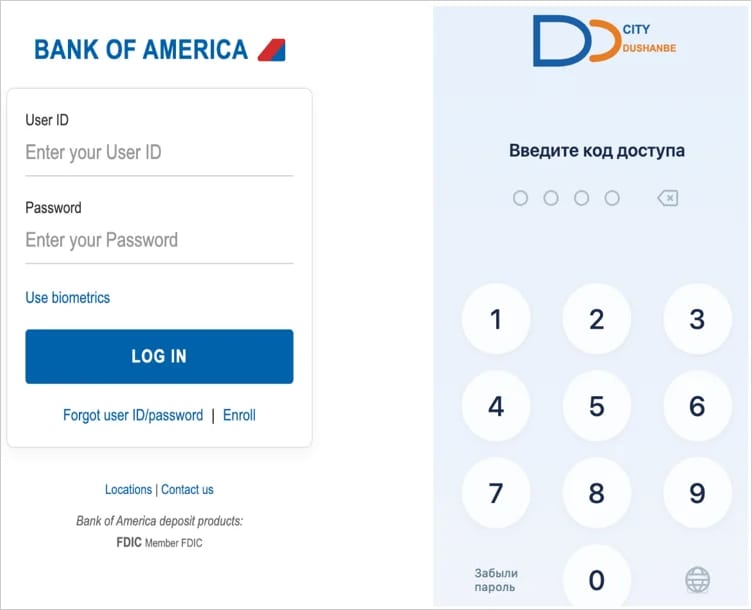
With unfettered access to the device interior, RatHat deploys dynamic HTML overlays designed to mimic the login interfaces of prominent financial institutions and cryptocurrency asset management platforms. These overlays render precisely over legitimate applications when launched by the user, harvesting login credentials, multi-factor authentication codes, and recovery keys in real time. Beyond credential harvesting, the malware’s monitoring suite is comprehensive. It intercepts inbound SMS text messages, captures push notifications containing one-time passwords (OTPs), records granular text-change events across input fields, extracts precise uniform resource locators from active browser address bars, and logs lock-screen personal identification numbers, passwords, and graphical unlock patterns.
The most groundbreaking evolution introduced by RatHat, however, is its artificial intelligence-guided navigation engine. Traditional mobile Trojans require human operators to manually tap through unfamiliar application updates, localized menus, or updated banking interfaces. If a banking application alters its layout during a routine update, scripted automation routines frequently break, stalling the fraudulent transaction. RatHat solves this operational bottleneck by capturing the live Android Accessibility node tree, serializing the hierarchical structural data into standardized XML formats, and transmitting this structural map to a cloud-based AI assistant.
The integrated AI model processes the XML layout instantly, identifying input fields, confirm buttons, and navigation menus regardless of localized language changes or minor interface updates. The AI tool then formulates precise coordinate or node-action instructions, which the malware executes locally to complete complex financial transfers, approve unauthorized loans, or alter account settings without requiring active human oversight from the remote attacker. This intelligent UI automation renders the threat significantly more adaptable, allowing campaigns to scale efficiently across diverse device models, screen resolutions, and localized software environments while leaving minimal behavioral signatures for traditional heuristic detection engines to flag.
Mitigating removal attempts is another area where RatHat demonstrates exceptional engineering maturity. When a user attempts to manually revoke permissions or uninstall the malicious package through system settings, the malware detects the intent via accessibility hooks, intercepts the uninstallation confirmation dialog, cancels the procedure programmatically, and superimposes a convincing, full-screen fake Google Play overlay displaying a fraudulent system error message. This psychological trapping prevents victims from successfully purging the infection through standard user interfaces.
Furthermore, the malware incorporates an array of sophisticated anti-analysis countermeasures designed to frustrate security researchers and automated sandbox environments. These obfuscation techniques include deliberate APK container tampering, an artificially bloated Android manifest file exceeding 61 megabytes in size to crash poorly optimized static parsers, and invalid Dalvik Executable (DEX) pseudo-instructions injected specifically to break disassemblers and reverse-engineering frameworks.
The emergence of AI-driven mobile malware marks a critical inflection point for the cybersecurity industry. As threat actors increasingly incorporate machine intelligence into their operational tooling, the velocity and adaptability of cyberattacks will outpace human-driven defense models. Security analysts warn that organizations and individuals must adopt a proactive posture against machine-speed threats. End users are strongly advised to exercise extreme caution regarding side-loaded applications, strictly avoid granting accessibility permissions to unverified utilities, and maintain active device monitoring through trusted endpoint protection solutions. Ultimately, the discovery of RatHat underscores the urgent need for mobile operating system developers to harden accessibility frameworks and build native cryptographic barriers against local ADB abuse, ensuring that artificial intelligence remains a tool for defense rather than a force multiplier for mobile cybercrime.
