


The artificial intelligence landscape is shifting once again as OpenAI begins the methodical deployment of its most formidable neural network to date. ChatGPT Astra, the company’s newly minted flagship architecture, is officially making its way to standard $20-per-month Plus subscribers, marking a critical milestone in the commercialization of advanced reasoning models. However, this rollout is not happening overnight. Users navigating the ecosystem have quickly realized that accessing the new intelligence requires knowing where to look within the interface, highlighting the complex infrastructure management required behind the scenes by modern AI providers.
As the deployment gathers momentum across global servers, early adopters have observed a staggered arrival pattern. Rather than instantly flooding the primary chat interface for every subscriber, Astra is frequently appearing within specialized sub-environments first—most notably inside the ChatGPT Work workspace and development tools like Codex, before populating the conventional model selection dropdowns. This phased approach underscores the engineering realities of scaling heavy computational architecture to millions of concurrent users without destabilizing backend infrastructure.
For subscribers eager to test the boundaries of OpenAI’s latest engineering achievement, the transition requires a brief check of their dashboard settings. Those who maintain a standard $20 Plus tier account but find themselves staring at older model selectors within the default chat window are advised to navigate directly to the Work division of the platform. Initial reports from early enterprise and consumer tiers indicate that Astra populates these specialized operational sections ahead of the general-purpose chat interface. This staging strategy allows the company to monitor telemetry data, evaluate server load, and identify edge cases before opening the floodgates to the entire user base.

The official confirmation from the artificial intelligence pioneer arrived via social communication channels, with the company noting that its next-generation system is filtering down to Pro, Enterprise, and Business Premium cohorts before completing its journey to individual Plus members. Leadership has cautioned that the global propagation phase may span several days as regional data centers synchronize their node updates. This cautious pacing reflects lessons learned from previous major releases, where sudden spikes in demand frequently resulted in capacity constraints and elevated latency rates.
Crucially, OpenAI has structured the economics of this release to respect existing pricing commitments. Subscribers already paying the standard monthly fee will find that Astra integration is fully baked into their current usage thresholds. There is no hidden tier, no sudden paywall upgrade, and no mandatory requirement to purchase an independent license to harness the new architecture. For heavy users who manage to exhaust their standard allocation limits while executing demanding computational tasks, supplementary credit purchasing systems remain available to bridge the gap without interrupting workflow continuity.
Understanding why Astra represents a watershed moment requires examining the technical leap it provides over preceding architectures. Positioned officially as a successor to earlier models like GPT-5.6 Sol, Astra has been engineered from the ground up to excel in highly demanding, multi-step professional domains. While legacy models often struggled with maintaining long-term coherence across extensive multi-hour projects, Astra’s internal memory retention and contextual grounding have been dramatically refined.
The architecture is explicitly tailored for heavy computational lifting, including autonomous computer use, complex code generation, advanced scientific research, deep-dive cybersecurity analysis, and sprawling administrative workflows. By bridging the gap between passive conversational assistance and active digital agency, Astra moves closer to the holy grail of general-purpose utility: an AI that does not merely answer questions, but actively executes complex operational procedures alongside human workers.
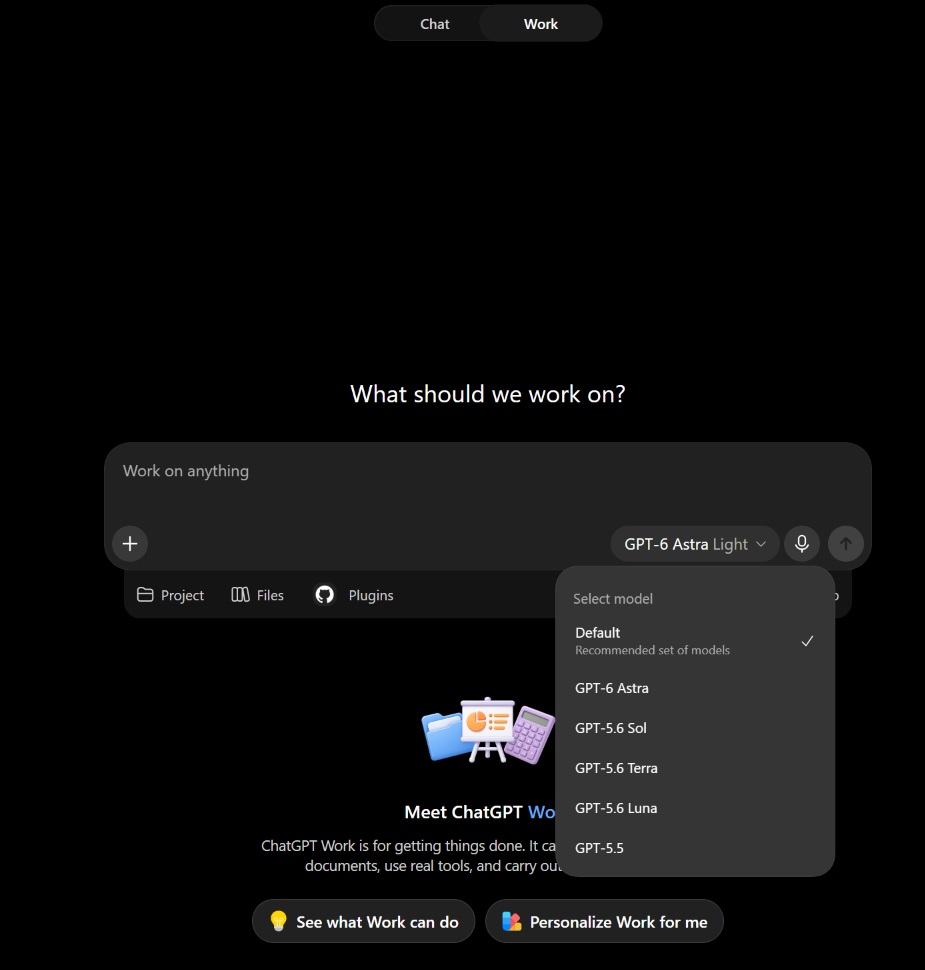
Despite the excitement surrounding this deployment, a notable segment of the user base remains outside the preview window. OpenAI has maintained strict silence regarding whether—or when—Astra will trickle down to free-tier users. For the foreseeable future, individuals utilizing the platform without a paid subscription will continue to rely on proven workhorses like GPT-5 and GPT-5.6 Sol. This widening functional divide between free and paid tiers highlights the escalating costs of running state-of-the-art inference engines, reinforcing the reality that cutting-edge artificial intelligence remains an expensive, premium commodity.
The commercial implications of Astra’s release extend far beyond individual productivity gains, sending ripples across the entire enterprise software ecosystem. As foundation models evolve to handle direct computer interaction and deep technical synthesis, the line between traditional operating systems and AI-driven interfaces begins to blur. Software developers, cybersecurity analysts, and corporate IT departments are now forced to reevaluate their security postures and toolchain integrations to accommodate autonomous agents capable of navigating complex digital environments.
Furthermore, the staged rollout strategy sheds light on the fierce infrastructure race currently dominating the tech sector. Deploying a model with the parameter scale and reasoning depth of Astra demands unprecedented clusters of specialized processing hardware. By gating access through professional workspaces and tiered subscriptions, OpenAI can effectively manage compute demand, prioritizing high-value commercial accounts while gradually expanding capacity for individual consumers. This careful balancing act is essential for maintaining service reliability in an era where AI downtime can grind corporate operations to a halt.
As the digital community continues to map out Astra’s capabilities, the broader trajectory of generative intelligence becomes increasingly clear. We are transitioning away from an era defined by novelty chatbots and toward a paradigm dominated by heavy-duty digital labor. For the millions of professionals currently refreshing their model pickers and exploring the Work environment, ChatGPT Astra is not just a software update—it is an early glimpse into a fundamentally transformed workplace where advanced artificial intelligence operates as a core operational engine rather than a peripheral tool.
