

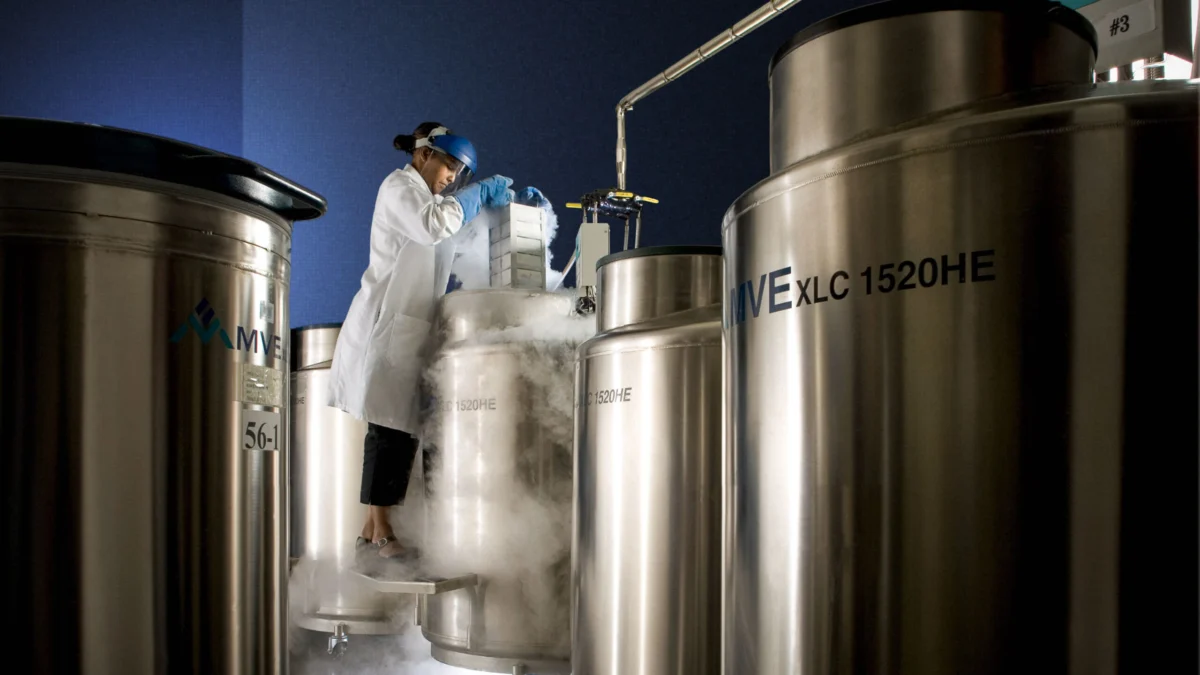
In a high-security facility in Scottsdale, Arizona, the brain of L. Stephen Coles rests in a stainless-steel dewar, submerged in liquid nitrogen at a temperature of −146 degrees Celsius. To the casual observer, the organ appears as a frosted relic of a bygone life. To those who maintain the facility, however, it is a biological time capsule—a high-stakes bet placed against the finality of death. Coles, a renowned gerontologist who spent his career decoding the mechanisms of human longevity before succumbing to pancreatic cancer in 2014, was not merely a scientist; he was a pioneer in the controversial and often misunderstood field of cryonics.
Before his passing, Coles arranged for his brain to be preserved, driven by a mixture of scientific curiosity and a refusal to accept the biological expiration date inherent to the human condition. He even tasked his close friend, the distinguished cryobiologist Greg Fahy, with analyzing samples of his preserved neural tissue. Fahy’s subsequent findings—that the brain remained "astonishingly well preserved"—have provided a rare glimmer of empirical data in a field more often characterized by philosophical speculation and science-fiction tropes. Yet, even Fahy’s optimism comes with a caveat: preservation is not the same as potential reanimation.
The journey of Coles’ brain represents the modern face of a movement that began in 1967 with James Hiram Bedford, a retired psychology professor. Bedford, the first human to be cryonically suspended, was "quick-frozen" by the Cryonics Society of California under circumstances that would be considered primitive by today’s standards. His preservation was overseen by a team led by a television repairman who possessed more charisma than medical credentials. Despite the amateurish beginnings of the industry, Bedford remains in storage at Alcor Life Extension Foundation today, his body a silent witness to over five decades of technological and social evolution.
The Philosophy of Vitalism and the War on Aging
The motivation behind choosing cryopreservation often transcends simple fear of the unknown. It is frequently rooted in a burgeoning ideological movement known as "vitalism," which posits that life is an inherent good and that death is not a natural necessity, but rather a technical problem awaiting a scientific solution. At recent gatherings of longevity enthusiasts, such as the Vitalist Bay summit, the sentiment is clear: aging is a disease to be "obviated," and cryonics serves as the ultimate "Plan B" for those who do not live long enough to see the cure for mortality.
Emil Kendziorra, CEO of the European-based cryonics firm Tomorrow.Bio, notes that while the field remains a niche endeavor—with only 5,000 to 6,000 individuals signed up globally—the demographics are shifting. Recent surveys of internet users suggest that men are significantly more likely than women to express interest in indefinite life extension. Approximately one-third of male respondents in one study expressed a desire to live forever, viewing cryonics as a rational insurance policy against the current limitations of medical science.
This optimism is fueled by the historical trajectory of medicine. Proponents point to the precipitous decline in cancer mortality rates since the 1990s as evidence that "terminal" is a temporary label. For Coles and Bedford, both of whom died of cancers that were untreatable in their respective eras, the gamble was simple: if the future holds the cure, the only way to reach it is to stop the clock.
The Economics and Logistics of the Deep Freeze
Cryonics is not an inexpensive pursuit, and its financial structure is designed to ensure stability over centuries. Organizations like Alcor and Tomorrow.Bio charge substantial fees—typically ranging from $80,000 for "neuropreservation" (the brain only) to upwards of $220,000 for "whole-body" preservation. These costs cover the immediate medical intervention required at the moment of legal death, the transportation of the remains, and the long-term maintenance of the storage dewars.
To make this accessible to the non-wealthy, the industry has largely pivoted to a life insurance model. Members name the cryonics organization as the beneficiary of a policy, ensuring that the necessary funds are available precisely when the biological clock stops. A portion of these fees is typically diverted into a "Patient Care Trust," an investment fund designed to generate enough returns to pay for liquid nitrogen and facility security indefinitely.
The choice between preserving the brain or the entire body is both a financial and a philosophical one. Neuropreservationists argue that the brain contains the entirety of the self—memories, personality, and consciousness. They believe that a future society capable of reanimating a brain would also possess the technology to grow a new body or provide a synthetic interface. Whole-body proponents, conversely, prefer the "backup" of the original biological architecture, despite the increased complexity and cost of preserving larger volumes of tissue without damage.
The Scientific Barrier: From Preservation to Reanimation
Despite the professionalization of the industry, the scientific community remains deeply divided over the feasibility of reanimation. The primary technical challenge is not the freezing itself, but the damage caused by the process. When biological tissue is frozen, water inside cells expands into ice crystals, which act like microscopic daggers, shredding cellular membranes.
To combat this, modern cryonics uses a process called vitrification. By replacing blood and bodily fluids with proprietary "cryoprotectant" cocktails—essentially medical-grade antifreeze—scientists can transition the body into a glass-like state without the formation of ice. While Fahy’s research on Coles’ brain suggests that vitrification can maintain the structural integrity of the "connectome" (the map of neural connections), it does not address the toxicity of the cryoprotectants themselves or the underlying cause of death.
Critics, including many mainstream cryobiologists, argue that the probability of reversing this process is "vanishingly small." The damage at the molecular level, combined with the original pathology that killed the patient, presents a repair task of staggering proportions. Bringing back a cryopreserved patient would likely require advanced nanotechnology capable of repairing trillions of cells simultaneously, or perhaps the ability to "scan" the preserved brain and upload the consciousness into a digital substrate.
Industry Implications and the Path to Legitimacy
While cryonics is often sidelined as a fringe science, the research generated by the field has significant implications for mainstream medicine. The quest to preserve human organs for indefinite periods is the "holy grail" of transplant surgery. Currently, hearts and lungs can only survive for hours outside the body, leading to a massive waste of viable organs due to logistical constraints.
If the vitrification techniques pioneered by cryonicists could be perfected for organ banking, the global organ shortage could be solved virtually overnight. This "dual-use" nature of cryopreservation research is beginning to attract interest from biotech investors and academic institutions. Organizations like the Organ Preservation Alliance are working on the same fundamental problems as Alcor—how to cool and re-warm complex biological tissues without triggering cellular collapse—albeit with a focus on saving the living rather than reviving the dead.
Ethical and Societal Quandaries
Beyond the technical hurdles lie a host of philosophical and legal questions that remain unanswered. Shannon Tessier, a cryobiologist at Massachusetts General Hospital, highlights the "social isolation" dilemma. If an individual is revived 200 years in the future, they will emerge into a world where their family is long dead, their skills are obsolete, and the culture may be unrecognizable.
"Do I want to be revived hundreds of years later when my family is gone and life is different?" Tessier asks. This sentiment points to the profound legal complications of reanimation. Would a "reanimated" person retain their original identity and property rights? Would they be considered a new legal entity? The societal impact of a population that refuses to "make room" for future generations also poses a significant ethical challenge to the vitalist ideology.
Furthermore, there is the risk of "dystopian" outcomes. Some critics argue that cryonics could become a tool for the ultra-wealthy to hoard power and resources across centuries, creating a class of "immortals" that stifles social progress. Others simply view it as a predatory industry that sells false hope to the grieving and the terminally ill.
The Future of the Gamble
As we look toward the mid-21st century, the field of cryonics sits at a crossroads. The integration of artificial intelligence and high-resolution brain mapping is providing new tools for those who hope to decode the "frozen" data of the human mind. Some futurists suggest that we may never need to "thaw" the brain at all; instead, we might use AI to reconstruct the personality and memories stored in the vitrified neural architecture, achieving a form of digital immortality.
For now, the thousands of people signed up for cryopreservation are living in a state of calculated hope. They acknowledge the odds are stacked against them, but as Nick Llewellyn, Alcor’s director of research and development, puts it: the chance is above zero. In a universe governed by entropy, that "above zero" probability is a powerful motivator.
The story of L. Stephen Coles’ brain is not just a story about a gerontologist who couldn’t stop his own aging; it is a reflection of the human desire to transcend biological limits. Whether these frozen pioneers will ever wake to see the future they so craved remains a mystery. For the time being, they exist in a state of suspended animation—quietly waiting in their silver dewars for a morning that science has yet to invent.
