

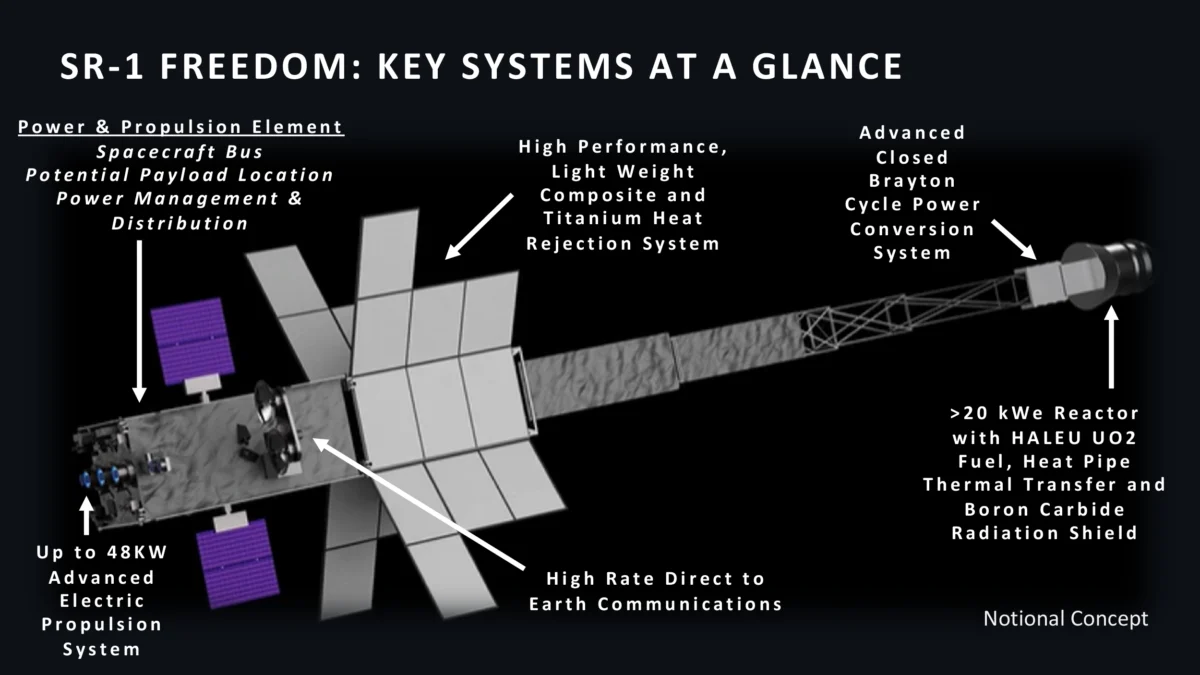
The landscape of American space exploration shifted dramatically in the halls of NASA’s Washington, D.C. headquarters recently, as Administrator Jared Isaacman unveiled a roadmap that extends far beyond the lunar horizon. While the aerospace community was already bracing for updates on the Artemis program and the establishment of a permanent presence at the lunar south pole, Isaacman introduced a variable that few expected to see on such an accelerated timeline: the Space Reactor-1 Freedom (SR-1). This ambitious project aims to launch the first-ever nuclear reactor-powered interplanetary spacecraft toward Mars by the end of 2028, signaling a definitive end to decades of theoretical study and the beginning of a new, atomic-powered era in deep-space transit.
For over half a century, the propulsion systems used to escape Earth’s gravity and navigate the solar system have relied almost exclusively on chemical reactions. By mixing liquefied hydrogen and oxygen and igniting the mixture, rockets generate the massive, short-lived thrust necessary to break orbit. However, once a craft is in the vacuum of space, chemical propulsion becomes a liability of weight and diminishing returns. To reach the outer planets or to make Mars a viable destination for human crews, the physics of the journey must change. NASA’s pivot to nuclear power represents a fundamental acknowledgment that the "chemical era" of spaceflight has reached its ceiling.
The SR-1 Freedom is not merely a conceptual exercise; it is a strategic necessity born of a burgeoning second space race. As China and Russia solidify plans for their own nuclear-powered lunar infrastructure by 2035, the United States is seeking to regain the technological high ground. By deploying a functional fission reactor on an interplanetary trajectory within the next four years, NASA is attempting to leapfrog its geopolitical rivals and solve the two most pressing problems of deep-space travel: speed and power availability.
The Physics of the Atomic Engine
To understand why nuclear propulsion is considered the "holy grail" of aerospace engineering, one must look at energy density. Traditional chemical fuels are heavy and inefficient over long distances. In contrast, nuclear fuel offers what experts describe as "more bang per kilogram" by several orders of magnitude. In the vacuum of space, efficiency is measured by specific impulse—essentially the "fuel mileage" of a rocket. Nuclear systems can provide double or triple the efficiency of the best chemical engines, allowing for faster transit times and larger payloads.
There are two primary ways to harness a nuclear reactor for propulsion: Nuclear Thermal Propulsion (NTP) and Nuclear Electric Propulsion (NEP). In an NTP system, a nuclear reactor heats a propellant, such as liquid hydrogen, to extreme temperatures (roughly 5,000 degrees Fahrenheit), causing it to expand and blast out of a nozzle. While powerful, NTP systems are notoriously difficult to manage due to the corrosive nature of hot hydrogen and the complexity of the plumbing required.
For the SR-1 Freedom, NASA has opted for the more elegant, albeit lower-thrust, Nuclear Electric Propulsion (NEP) model. In this configuration, the fission reactor acts as a power plant. The heat generated by splitting uranium atoms is converted into electricity, which is then used to power high-efficiency electric thrusters, such as Hall effect thrusters or ion engines. These engines accelerate charged gas particles to incredible speeds. While they don’t provide the "kick" needed to lift off from a launchpad, they can run continuously for months or years, slowly but surely accelerating a spacecraft to velocities that chemical rockets could never sustain.
Engineering the "Arrow of Freedom"
The design of the SR-1 Freedom, as revealed in preliminary NASA briefings, resembles a colossal, high-tech arrow. This shape is not aesthetic; it is a requirement of thermal management and radiation safety. At the very tip of the craft sits the 20-kilowatt uranium-filled reactor. This reactor is significantly smaller than terrestrial power plants—which often produce gigawatts of energy—but it is designed for ruggedness and longevity in the harsh environment of space.
Separating the reactor from the rest of the spacecraft is a robust radiation shield, likely composed of boron carbide, to protect sensitive electronics and potential future crew modules from neutron and gamma radiation. The middle of the craft is dominated by what engineers call "fletches"—massive, wing-like radiators. Because there is no air in space to carry away excess heat through convection, the spacecraft must rely on radiation to cool itself. Without these composite and titanium heat-rejection systems, the heat generated by the fission process would eventually melt the spacecraft’s internal structure.

At the rear of the craft lies the power-and-propulsion element. Interestingly, NASA is not building this from scratch. The agency is repurposing technology originally intended for the "Gateway," a lunar-orbiting space station that was recently canceled. By integrating the Gateway’s advanced electric propulsion systems with a custom-built space reactor, NASA is practicing a form of "agile" engineering—saving time and billions of dollars by recycling proven components for a more ambitious mission.
A Legacy of False Starts
The path to the SR-1 Freedom is littered with the ghosts of previous nuclear programs. In 1965, the United States launched SNAP-10A, the first and only American nuclear reactor to operate in orbit. It functioned for 43 days before a system failure unrelated to the reactor shut it down. During the Cold War, the Soviet Union was far more prolific, launching over 30 small reactors to power their RORSAT spy satellites, though several of these missions ended in radioactive debris re-entering the atmosphere.
In more recent years, projects like DRACO (Demonstration Rocket for Agile Cislunar Operations), a joint venture between NASA and DARPA, were touted as the future of nuclear spaceflight before being shuttered due to budget constraints and the high cost of ground testing. The cancelation of DRACO in 2025 left a void that the SR-1 project is now rushing to fill. The difference this time, according to industry analysts, is the sense of urgency. The "Artemis era" has brought a level of political and financial momentum to NASA that hasn’t been seen since the 1960s.
Safety and the "Minutes of Hell"
The prospect of launching a nuclear reactor atop a pillar of fire is understandably a source of public concern. To mitigate the risk of a launch-pad explosion spreading radioactive material, the SR-1’s reactor will be launched "cold." Uranium-235, in its un-reacted state, is relatively stable and emits very little radiation. The fission process will only be initiated once the spacecraft is in a "nuclear-safe" orbit, roughly two days after liftoff. This ensures that if the rocket fails during the "shaken, rattled, and rolled" phase of ascent, the environmental impact would be negligible.
Once in deep space, the challenges shift to the mechanics of zero gravity. Earth-based reactors rely on gravity for certain fluid movements and cooling cycles. The SR-1 uses a "Closed Brayton Cycle" power conversion system, which utilizes gas to transfer heat and spin turbines, a method that is less dependent on gravity and highly efficient in a vacuum.
Geopolitical Stakes and the Future of the Species
The 2028 deadline for SR-1 is what experts call "aggressive," but it is a timeline dictated by the shifting tides of international power. China’s "International Lunar Research Station" (ILRS), a partnership with Russia, is explicitly designed to use nuclear power for its surface operations. For the United States, being the first to demonstrate a functional, interplanetary nuclear engine is about more than just scientific prestige; it is about establishing the rules of the road for the "High Frontier."
Beyond the geopolitics, the success of SR-1 could solve the single greatest hurdle to human Mars exploration: cosmic radiation. Astronauts traveling to Mars using current chemical technology face a nine-month journey each way, exposing them to lethal doses of solar and galactic radiation. A nuclear-powered craft could potentially cut that travel time in half, significantly reducing the health risks to the crew and making the "Red Planet" a much closer neighbor.
If the SR-1 Freedom arrives at Mars in 2029 as planned, it will mark a turning point in human history. It will prove that we are no longer tethered to the "explosion-in-a-tube" logic of 20th-century rocketry. Instead, we will have mastered a form of propulsion that can carry us to the moons of Jupiter, the rings of Saturn, and eventually, perhaps, to the stars beyond. As Simon Middleburgh of the Nuclear Futures Institute noted, these are the engineering marvels that define an era. For the scientists and engineers currently working on the SR-1, the mission is not just about reaching another planet—it is about ensuring that humanity has the power to stay there.
