


The landscape of Windows security has shifted dramatically following the public disclosure and subsequent weaponization of three critical vulnerabilities. These flaws, which enable local privilege escalation (LPE) and the crippling of defensive security measures, have moved rapidly from theoretical research to active, hands-on-keyboard exploitation. The situation is exacerbated by a contentious disclosure process, where a researcher known as "Nightmare-Eclipse" opted to release proof-of-concept (PoC) code directly to the public in an act of protest against the perceived bureaucratic inertia of the Microsoft Security Response Center (MSRC).
The Anatomy of the Triple Threat
The trio of vulnerabilities—identified by the researcher as BlueHammer, RedSun, and UnDefend—targets the core components of the Windows security stack, specifically Microsoft Defender.
BlueHammer and RedSun represent severe LPE flaws. In the context of modern cybersecurity, LPE is the "holy grail" for attackers who have already established an initial foothold on a network. By transitioning from a standard user account to SYSTEM or administrative-level privileges, threat actors can bypass access controls, install persistent backdoors, deploy ransomware, or exfiltrate sensitive data with virtually no restrictions.
The third vulnerability, UnDefend, presents a different but equally dangerous challenge. It allows an attacker to manipulate the update mechanism of Microsoft Defender. By effectively blocking security definition updates, the exploit renders the operating system blind to newer threats, creating a "frozen" security posture that keeps the machine susceptible to known exploits that the antivirus would otherwise have caught.

From Research to Real-World Exploitation
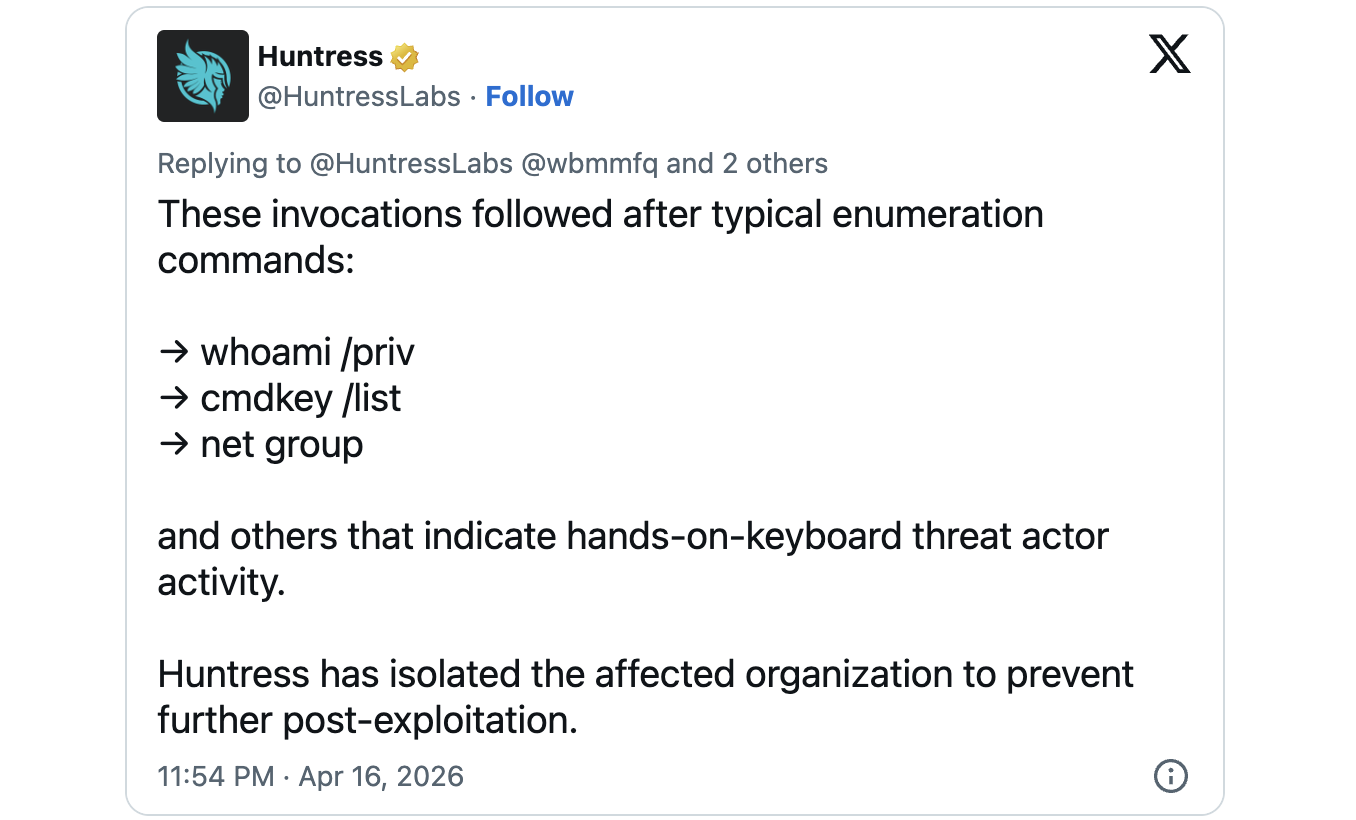
The transition from academic vulnerability research to active exploitation is rarely as compressed as it has been in this instance. Security telemetry from Huntress Labs confirms that these exploits are no longer theoretical; they are being integrated into the operational toolkits of malicious actors.
The most alarming aspect of this development is the evidence of "hands-on-keyboard" activity. This terminology indicates that the attacks are not merely automated scripts running indiscriminately; they involve human operators who are actively navigating compromised networks, moving laterally, and tailoring their techniques to the specific environment they have breached. Reports indicate that these exploits have been identified on systems initially compromised through secondary vectors, such as vulnerable SSLVPN gateways. This suggests a multi-stage attack methodology: first, gain an initial foothold via a perimeter device, and second, leverage these local Windows vulnerabilities to achieve total system dominance.
The Breakdown of Coordinated Disclosure
The decision by Nightmare-Eclipse to release these exploits underscores a growing friction between independent security researchers and major platform vendors. Coordinated vulnerability disclosure (CVD) is the industry-standard mechanism intended to provide vendors with a "grace period" to develop, test, and deploy patches before details of a flaw are made public.
When researchers feel that this process is being abused—either through excessive delays, poor communication, or a lack of transparency—the temptation to "go rogue" increases. By releasing the PoC code, the researcher has effectively removed the window of safety that typically protects users. While this forces the vendor’s hand, it also provides a ready-made weapon for threat actors who lack the sophistication to discover such vulnerabilities on their own but are perfectly capable of downloading and weaponizing published code.

Analysis: Why Defender Is at the Center of the Storm
The focus on Microsoft Defender in these specific exploits is highly strategic. As the primary, native security layer for the vast majority of Windows environments, Defender is the most ubiquitous target. RedSun, in particular, highlights a profound logic flaw: the interaction between cloud-based reputation services and local file system operations.
According to the researcher’s technical breakdown, the exploit leverages the way Defender handles files flagged by its cloud-based protection mechanisms. In an effort to "remediate" or "clean" a file that it identifies as potentially malicious, the antivirus engine can be coerced into performing operations that overwrite legitimate system files. Essentially, the security software is tricked into becoming an agent of the attacker, using its elevated SYSTEM privileges to overwrite critical OS components, thereby granting the attacker administrative control. This "circular" logic—where the defender’s own remediation routine is the vector for the compromise—is notoriously difficult to patch because it involves fundamental changes to how the security engine interacts with the file system.
Industry Implications and the "Patch Gap"
The current reality presents a significant challenge for enterprise security teams. While Microsoft has addressed the BlueHammer vulnerability (tracked as CVE-2026-33825) in the April 2026 patch cycle, the other two flaws remain in a state of limbo. This creates a dangerous "patch gap," where organizations are partially protected but remain vulnerable to secondary and tertiary exploits.
For the security industry, this event serves as a stark reminder of the limitations of relying solely on signature-based or even heuristic-based antivirus solutions. When the security software itself can be manipulated, the underlying assumption of "protection" is invalidated. This has led to an increased focus on "autonomous validation" and context-aware security platforms. Modern defense strategies must move beyond traditional static analysis and toward systems that can detect the behavior of an attack—such as the unauthorized modification of system files—rather than just looking for known malicious payloads.
Future Trends: The Age of Weaponized Research
We are entering a period where the barrier to entry for high-impact cyberattacks is dropping. The availability of high-quality, researcher-grade exploit code on public platforms means that the "time-to-exploit"—the duration between a vulnerability disclosure and the first instance of widespread attack—is shrinking toward zero.
Future trends will likely see:
- Accelerated Exploitation: Automated bots will be programmed to scan for and immediately leverage any new PoC code published on platforms like GitHub, forcing security teams to act in hours rather than weeks.
- Increased Scrutiny on OS Architecture: The reliance on monolithic, highly privileged security services like Defender will continue to be a focal point for researchers and attackers alike. This may drive a shift toward more sandboxed, micro-kernel architectures where security services are isolated from the core OS processes.
- The Erosion of Trust in Vendor Disclosure: If major vendors cannot keep pace with the influx of reported vulnerabilities, the cycle of public "protest leaks" will likely continue, creating a more hostile and unpredictable threat environment.
Conclusion: Defensive Posture in a Post-Disclosure World
For IT administrators and security practitioners, the immediate priority must be a "defense-in-depth" approach. Relying on the assumption that a fully patched system is secure is no longer sufficient. Organizations should implement strict application control, reduce local administrator rights, and leverage behavioral monitoring to detect the specific patterns associated with these LPE exploits.
The incident involving BlueHammer, RedSun, and UnDefend is a microcosm of the modern cybersecurity struggle. It highlights the power of independent research, the risks of flawed disclosure processes, and the ingenuity of attackers who can turn a vendor’s own security mechanisms against the user. As we move forward, the ability to rapidly identify, validate, and isolate vulnerable components before they are weaponized will become the primary metric of a successful security organization. Until the remaining vulnerabilities are fully addressed by the vendor, the onus remains on the end user to exercise extreme caution and maintain a rigorous, proactive security posture in the face of evolving, weaponized research.
