


The continuous arms race between corporate cybersecurity defenses and threat actor ingenuity has entered a deeply microscopic dimension. As email security gateways grow increasingly sophisticated—leveraging natural language processing, contextual awareness, and comprehensive blocklists—cybercriminals are constantly forced to find friction points in how digital systems parse human language. The latest evolution in this persistent cat-and-mouse game involves the exploitation of foundational text rendering standards, transforming benign-looking typography into stealthy cloaking devices designed to bypass automated filters entirely.
Security researchers have documented a massive, sustained cyberattack campaign leveraging an advanced evasion vector known as ASCII smuggling. By embedding invisible, non-printing Unicode characters directly inside common lexicon strings, malicious operators have managed to slip millions of fraudulent emails past traditional perimeter defenses. What makes this methodology particularly concerning is its conceptual migration from artificial intelligence prompt injection vectors directly into traditional inbox infiltration, signaling a broader convergence of text-obfuscation techniques across disparate attack surfaces.
Deconstructing the Mechanics of ASCII Smuggling
To understand how ASCII smuggling defeats modern email security platforms, one must examine the underlying mechanics of how text is handled by computers versus how it is interpreted by humans. Text encoding standards like Unicode contain thousands of code points that do not correspond to visible glyphs. Among these are formatting controls, directional markers, and specialized blocks like the Unicode Tags block, which ranges from U+E0000 to U+E007F. Originally designated for obsolete linguistic or metadata tagging functions, these characters are routinely ignored by text-rendering engines, meaning they render as absolute nothingness on a victim’s screen.

However, automated security filters—specifically those relying on legacy signature matching, regular expressions (regex), and keyword blacklists—process raw string data before it is ever normalized or rendered for human consumption. If an automated filter maintains a strict keyword prohibition against high-risk financial terminology like "funding," "loan," or "credit," a simple text analysis scanner will look for contiguous strings of characters matching those parameters.
Attackers exploit this blind spot by weaving invisible code points directly into the interior of these trigger words. A term like "funding" is effectively shattered into a fragmented string such as "fun[invisible_character]ding." To a human reader examining the final rendered email in an inbox, the word appears completely normal, processed fluidly by cognitive reading patterns. But to a rudimentary keyword filter that lacks pre-processing normalization, the string fails to match the prohibited list. The filter perceives an innocuous jumble of letters rather than a malicious financial lure, allowing the message to sail unimpeded past the initial line of defense.
The Scale and Scope of the Threat Landscape
Telemetry data captured by corporate threat intelligence analysts reveals the true industrial scale at which this technique has been operationalized. Following a distinct surge that began in early February, malicious infrastructure orchestrated a high-volume campaign that peaked at an astonishing 2.37 million daily delivered messages. This intensive phase maintained its momentum for roughly three months, before experiencing a sharp operational contraction.
The campaign relied heavily on a clustered network of roughly 148 distinct sender domains specifically curated around financial themes. These domains were systematically weaponized to promote fraudulent business funding opportunities, rapid commercial loans, unsecured credit lines, and cash advances. By distributing these messages through the legitimate infrastructure of mainstream email-marketing platforms—such as ActiveCampaign—the threat actors added an extra layer of structural legitimacy. Because the delivery pipeline utilized legitimate bulk-email services with established IP reputations, standard reputation-based filtering checks were heavily neutralized, leaving the content itself as the primary target for evasion.
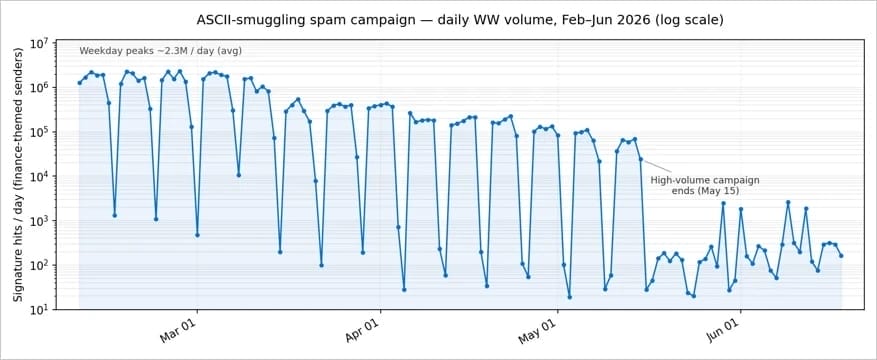
Despite the sheer volume of the operation, enterprise defensive arrays were not entirely blind. Advanced threat-hunting logic specifically tuned to detect anomalies within Unicode tag blocks successfully flagged the underlying signatures. Security analysts noted that while the obfuscation technique allowed the messages to bypass naive keyword filters, holistic defense-in-depth platforms still intercepted the vast majority of the incoming stream based on secondary contextual telemetry, including anomalous sender behavioral profiles, domain age history, and auxiliary infrastructure reputation checks. Yet, the fact that millions of iterations managed to penetrate deep into corporate environments underscores the persistent fragility of signature-based text analysis.
Industry Implications and the Broader Threat Ecosystem
The transition of ASCII smuggling from AI prompt-injection scenarios into conventional phishing highlights a troubling trend: the modular reusability of modern evasion techniques. Previously, researchers observed similar Unicode manipulation tactics being deployed against large language models and generative AI chatbots. In those instances, malicious instructions were encoded using invisible tags to trick AI assistants into executing unauthorized code or bypassing safety filters without alerting the end user reviewing the dialogue.
The successful cross-over into email vectors demonstrates that cybercrime syndicates are increasingly modularizing their offensive toolkits. When a bypass technique proves effective against one type of text-parsing parser—whether it is a neural network processing natural language or a security gateway parsing SMTP data—it is rapidly adapted for other text-dependent systems.
This convergence forces a fundamental reassessment of how software handles text ingestion. Email security gateways, content moderation engines, and conversational AI interfaces all share a common vulnerability: trusting raw input data without performing aggressive sanitization and normalization. If software systems evaluate text payloads in their native, unnormalized state, they will perpetually remain susceptible to typographic steganography and invisible-character injection.
.jpg)
Remediation Strategies and Defensive Evolution
Mitigating the risks posed by ASCII smuggling requires a fundamental shift in defensive architecture. Cybersecurity engineers and platform architects can no longer treat incoming text streams as clean, trustworthy strings ready for immediate evaluation. Instead, enterprise security posture must mandate rigorous text normalization protocols at the earliest possible stage of data ingestion.
To effectively neutralize invisible character manipulation, defenders should implement normalization pipelines that systematically strip, filter, or neutralize all non-printing Unicode tag blocks, zero-width spaces, and anomalous formatting characters before any keyword matching, regular expression evaluation, or signature analysis is executed. Furthermore, security monitoring systems should treat the unexpected presence of Unicode Tag characters not merely as a formatting anomaly, but as a high-fidelity indicator of potential evasion tactics.
Cloud service providers and email-marketing platforms are also facing increased pressure to tighten their abuse-detection algorithms. Major marketing automation vendors have iterated their moderation systems to recognize that excessive or abnormal concentrations of invisible Unicode characters are rarely legitimate. By treating heavy use of non-printing code points as an inherent policy violation, service providers can severely disrupt the delivery infrastructure that threat actors rely upon.
Ultimately, the emergence of invisible Unicode phishing serves as a stark reminder that the frontier of cyber defense extends far beyond traditional malware analysis and binary reverse engineering. As attackers continue to weaponize the very building blocks of digital communication—the letters and spaces that construct our daily administrative reality—the cybersecurity industry must build smarter, more resilient parsing engines capable of seeing through the invisible.
