

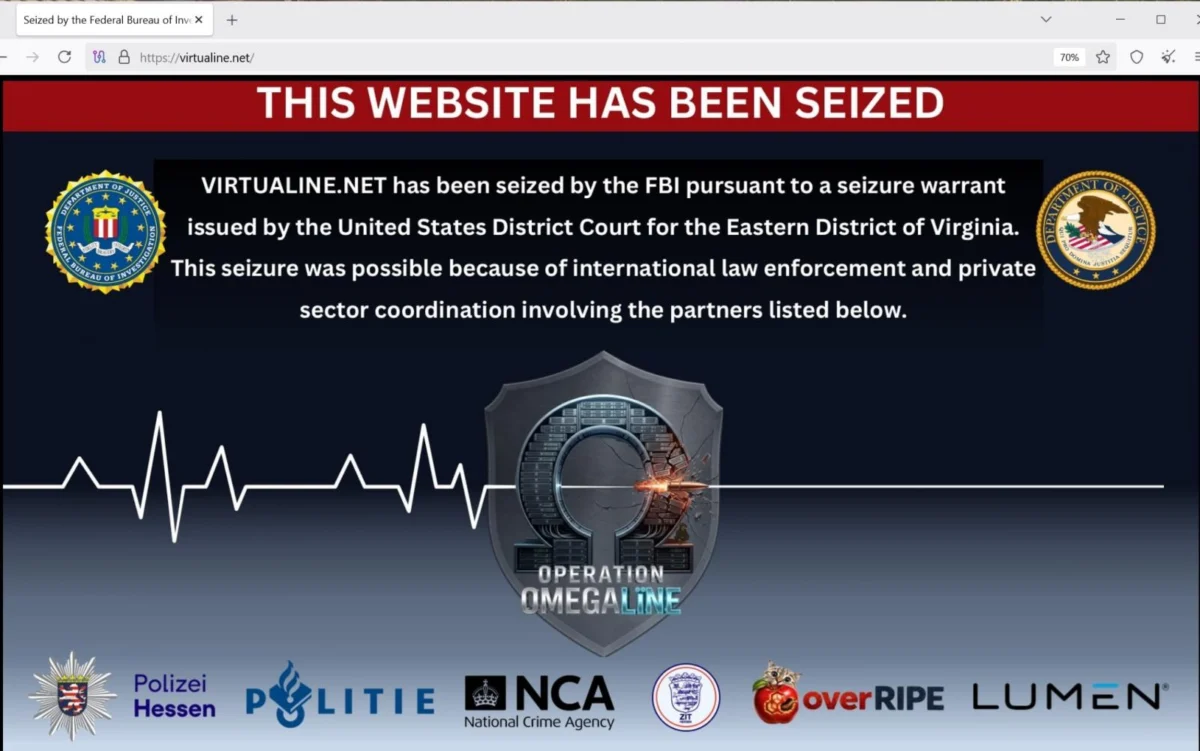
The complex ecosystem of global cybercrime has suffered a severe logistical blow following a coordinated international law enforcement sweep targeting Virtualine, a prominent bulletproof hosting provider long believed to be untouchable. Operating under a rotating rotation of corporate facades—including Secury, Massgod, Spamhouse, Lanedo, and Omegatech—the entity systematically positioned itself as an offshore safe haven for malicious actors. By deliberately ignoring legal processes, subpoenas, and abuse complaints, Virtualine enabled an array of high-impact digital threats, ranging from sophisticated ransomware deployments and information stealers to large-scale phishing campaigns and illicit market operations.
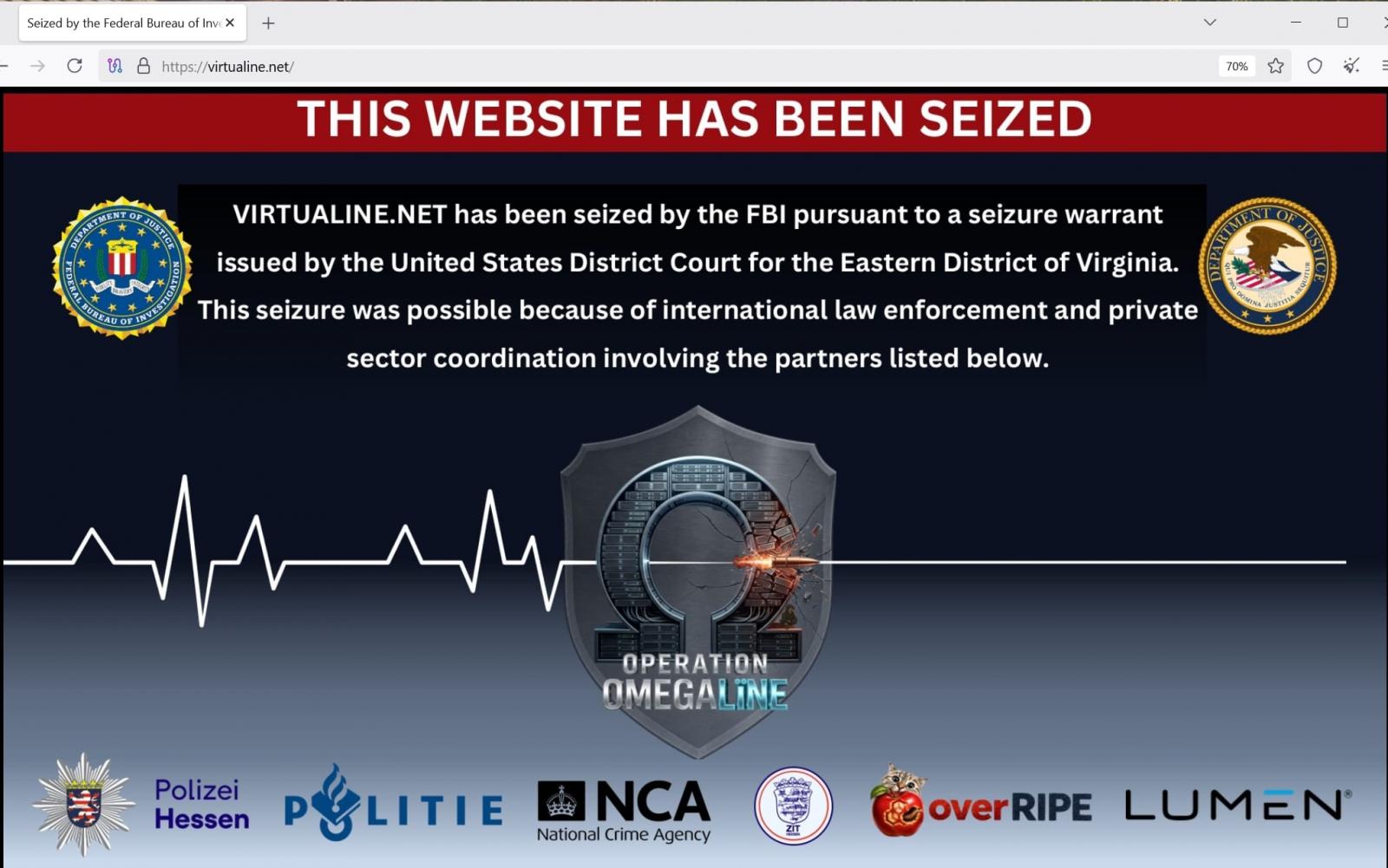
The successful takedown of the primary infrastructure, highlighted by the seizure of the virtualine[.net] domain by the United States Federal Bureau of Investigation (FBI), represents the culmination of a protracted cross-border investigation. This multi-jurisdictional effort required the synchronization of law enforcement bodies across continents, bringing together Germany’s Polizei Hessen, the Netherlands’ Politie Midden-Nederland, and the United Kingdom’s National Crime Agency (NCA). Furthermore, the operation relied heavily on technical intelligence and analytical support from private-sector cybersecurity partners, including Lumen, OverRIPE, and specialized blockchain analytics firms, illustrating the modern necessity of public-private synergy in neutralizing modern digital threats.
Anatomy of an Underground Infrastructure
To understand the gravity of Virtualine’s disruption, one must examine the critical role that bulletproof hosting providers play within the modern cybercrime economy. Traditional hosting providers maintain strict compliance policies, promptly terminating accounts that engage in malicious network scanning, malware distribution, or credential harvesting. In contrast, bulletproof hosters purposefully ignore or reject abuse notifications, providing malicious actors with the stability and immunity required to sustain long-term operations. Virtualine optimized this model, marketing its services openly on dark web forums and underground Russian-language communities as explicitly tailored for "illegal and black hat activities."

Operating since at least 2022, the syndicate provided the foundational architecture for numerous threat groups, shielding them from the reach of domestic and international authorities. The tactical reach of Virtualine’s network extended across multiple verticals of the cybercrime underground. Ransomware syndicates relied on its infrastructure to command and control compromised corporate networks, while botnet operators utilized its high-bandwidth virtual private servers (VPS) to execute distributed denial-of-service (DDoS) attacks and credential-stuffing sweeps.
However, the enterprise’s willingness to shield virtually any illicit operation eventually drew intense scrutiny regarding content deemed crossing ethical boundaries. According to court filings and statements issued by the U.S. Department of Justice (DOJ), Virtualine’s operators knowingly hosted an online forum dedicated to the dissemination of child abuse material. Despite repeated warnings and formal notices dispatched by law enforcement agencies, the National Center for Missing and Exploited Children (NCMEC), and victim legal representatives, the hosting provider allegedly assisted the forum administrators in migrating to new infrastructure when legal pressure mounted. While the service’s administrative leadership later published an open letter vehemently denying complicity in sexual exploitation—proclaiming it to be a crime against humanity—the physical and digital evidence gathered by investigators told a starkly different story.
Financial Entanglements and Cryptocurrency Laundering
Beyond raw server provisioning, Virtualine functioned as an active participant in illicit financial circulation. Blockchain intelligence firms Chainalysis and TRM Labs released detailed telemetry following the operation, uncovering the intricate web of cryptocurrency transactions that fueled the hosting provider’s expansion. Unlike legitimate enterprise hosts that utilize regulated payment processors and financial institutions, Virtualine accepted direct Bitcoin transfers via unhosted wallet addresses. This deliberate design choice allowed cybercriminal clients to bypass the standard compliance and know-your-customer (KYC) protocols enforced by centralized cryptocurrency exchanges.
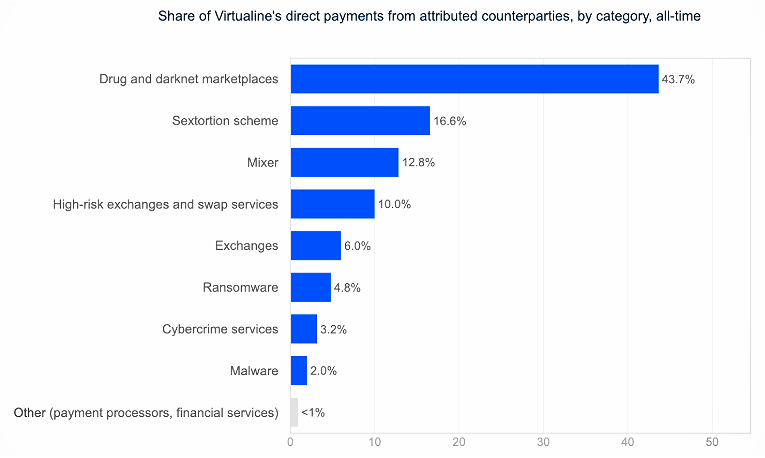
The financial breakdown of Virtualine’s inflows provides a revealing snapshot of contemporary cybercrime economics. TRM Labs reported that roughly 44 percent of the provider’s financial inflows stemmed directly from a prominent Russian-language drug marketplace. Meanwhile, ransomware operators accounted for approximately 5 percent of the total transaction volume, with the remainder distributed across large-scale sextortion schemes, cryptocurrency mixers, and illicit underground shops. Furthermore, on-chain analytics identified continuous financial ties between Virtualine and operators of the StealC infostealer, pointing to a symbiotic relationship wherein stolen credentials were systematically monetized and reinvested into secure infrastructure.
By accepting unhosted crypto payments and subsequently cycling those funds through various obfuscation techniques, Virtualine effectively acted as an unlicensed money laundering hub. This dual capability—providing both computational infrastructure and financial laundering pathways—made the entity an indispensable asset for elite threat groups seeking to operationalize and liquidate stolen capital without leaving a clear forensic trail.
The Ground Operation and Seizure Realities
The technical takedown transcended a mere domain seizure, evolving into a massive physical and digital disarmament operation. In the Netherlands, tactical teams from Politie executed coordinated raids in Limburg, seizing dozens of physical servers and immediately knocking hundreds of virtual servers offline. Dutch investigators reported successfully extracting forensic data associated with more than 3,000 distinct Virtualine customers. This data harvest has catalyzed a wave of follow-up investigative actions, targeting individual clients who leveraged the provider’s infrastructure to execute cyberattacks.
Cybersecurity researchers monitoring the aftermath noted that while parts of Virtualine’s web presence attempted to remain reachable via alternative domain extensions—such as virtualine[.org]—the underlying network infrastructure suffered catastrophic routing degradation. Network prefix visibility plummeted to near zero, indicating that upstream internet service providers and peering partners had severed connections to the syndicate’s autonomous system numbers (ASNs). This infrastructural isolation effectively neutralizes the immediate operational capabilities of the hosting provider, forcing displaced cybercriminals to scramble for alternative, less stable refuges.
Industry Implications and Future Outlook
The dismantlement of Virtualine underscores a vital shift in international law enforcement strategy. Rather than merely reacting to individual ransomware infections or phishing campaigns, global agencies are increasingly targeting the foundational enablers of the cybercrime ecosystem. Bulletproof hosters represent the central connective tissue of the underground economy; cutting off these choke points introduces friction, increases operational overhead for threat groups, and forces malicious actors to constantly re-engineer their technical stacks.
Nevertheless, the eradication of bulletproof hosting remains an uphill battle. The decentralized nature of the global internet, coupled with lax regulatory enforcement in select geopolitical jurisdictions, ensures that new illicit providers will likely emerge to fill the void left by Virtualine. Yet, the sheer volume of actionable intelligence recovered from the thousands of seized client accounts signals a new paradigm in accountability. As blockchain analytics, cross-border intelligence sharing, and physical infrastructure seizures become more synchronized, the lifespan of bulletproof empires is shrinking rapidly, signaling to cybercriminals that absolute anonymity and operational impunity are increasingly difficult to maintain.
