


Google has initiated a worldwide deployment of security patches for its Google Chrome browser to remediate a high-severity, actively targeted zero-day security flaw residing within its V8 core execution environment. Cataloged under the identifier CVE-2026-85046, this vulnerability represents an urgent security risk for billions of internet users globally, given that malicious actors are already leveraging functional exploit payloads against targeted targets in real-world scenarios. The discovery of this vulnerability emphasizes the relentless cat-and-mouse game played between modern software vendors and advanced threat groups who continuously scour complex browser architectures for subtle memory management anomalies.
The critical security defect was brought to the attention of Google’s security engineers by external vulnerability researcher Salvatore Gulizia, widely recognized within the digital security community by the online alias “Serotav.” Prompted by this disclosure, Google’s engineering teams mobilized quickly to design, test, and release a comprehensive patch set. The resulting stable channel updates advance the browser versions to 152.0.7977.82 and 152.0.7977.83 for enterprise and consumer systems running Microsoft Windows and Apple macOS, while Linux distributions receive version 152.0.7977.82. In accordance with standard industry disclosure protocols aimed at minimizing the risk of copycat attacks, Google has intentionally withheld granular technical specifics regarding the exploitation vectors and operational mechanisms of CVE-2026-85046, affording users, system administrators, and downstream software projects a vital window of opportunity to secure their systems before weaponized exploits become commoditized.
At its technical core, CVE-2026-85046 is classified as a type confusion vulnerability. This class of software defect occurs when a programming language or runtime environment initializes an object using one specific data structure or type, but subsequently accesses, casts, or manipulates that same object as though it belonged to an entirely different type. In the context of modern web browsers, which execute complex, untrusted logic on a minute-by-minute basis, type confusion anomalies frequently lead to unpredictable memory corruption states. Attackers who successfully trigger these states can manipulate pointers, bypass vital security boundaries, and ultimately achieve arbitrary memory read and write capabilities within the hosting application’s memory space.

The specific battleground for this vulnerability is the V8 engine, Chrome’s high-performance, open-source JavaScript and WebAssembly runtime environment. V8 is tasked with compiling raw, untrusted web code directly into efficient machine instructions that can be executed natively by the host processor. Because modern web applications rely heavily on rich, dynamic JavaScript frameworks, the V8 engine must continuously balance blazing-fast execution speeds with stringent security sandboxing. When a flaw like CVE-2026-85046 manifests within V8, it opens a dangerous pathway. A malicious actor can construct a bespoke, deceptive HTML document embedded with carefully engineered JavaScript code. When an unsuspecting user navigates to the compromised web page, the malicious script interacts with the vulnerable runtime engine, triggering the type confusion condition and potentially facilitating remote code execution within the confines of Chrome’s tightly constrained sandboxed renderer process.
While the zero-day exploit targeting the V8 engine has naturally dominated industry headlines, Google’s latest security bulletin addresses a far broader array of underlying architectural risks. The comprehensive update package incorporates fixes for nine additional high-severity security vulnerabilities. These supplementary patches remediate a diverse mix of complex memory corruption bugs, including classic use-after-free conditions and out-of-bounds memory read and write anomalies dispersed across critical internal subsystems. Affected components in this patch cycle include Crash Reporting, Network services, Compositing engines, WebGL graphics pipelines, CacheStorage managers, Developer Tools (DevTools), the Skia graphics library, as well as a hazardous race condition isolated within the V8 engine itself. The sheer breadth of these vulnerabilities underscores the immense difficulty of maintaining software security in massive, multi-threaded codebases that process millions of lines of untrusted external input daily.
With the inclusion of CVE-2026-85046, this incident marks the sixth actively exploited zero-day vulnerability that Google has been forced to patch within the Chrome ecosystem since the commencement of the calendar year. This recurring pattern highlights an alarming trend in the cyber threat landscape: web browsers have firmly cemented their position as the primary attack surface for both state-sponsored espionage syndicates and financially motivated cybercrime syndicates. Because browsers sit natively between the user and the vast, unverified expanse of the public internet, they represent a high-value, high-reward target. A successful browser compromise allows attackers to bypass traditional network defenses, neutralizing enterprise firewalls and intrusion detection systems by operating entirely within authorized web traffic streams.
The commercial implications of these frequent zero-day discoveries extend far beyond individual consumer annoyance. In modern enterprise environments, the corporate web browser has effectively replaced the traditional desktop operating system as the primary workspace interface. Employees spend the vast majority of their working hours interacting with cloud-based software-as-a-service (SaaS) applications, enterprise resource planning dashboards, and web-mail portals directly inside the browser. Consequently, a vulnerability that compromises the browser runtime jeopardizes enterprise-wide data integrity. Recent industry telemetry, such as insights highlighted in major cybersecurity landscape reports, demonstrates that once sophisticated threat actors secure initial access—often via credential theft or browser-based exploits—traditional preventative security controls struggle to contain lateral movement, emphasizing the vital importance of hardening the browser boundary as the first line of defense.
Furthermore, the impact of Google’s rapid security response ripples across the wider software development ecosystem. Because Google Chrome’s underlying rendering and execution engine—historically known as Chromium—serves as the foundational architecture for a vast array of alternative web browsers, millions of users relying on downstream applications are indirectly affected. Popular web platforms such as Microsoft Edge, Brave, Opera, and Vivaldi all inherit the core V8 and Skia components patched by Google. Consequently, when a critical zero-day is mitigated in Chrome, developers of these derivative browsers must scramble to integrate the upstream source code patches into their own proprietary release pipelines. This technical dependency typically introduces a operational lag of several days, leaving users of alternative browsers in a temporarily vulnerable state while they await localized software updates from their respective vendors.
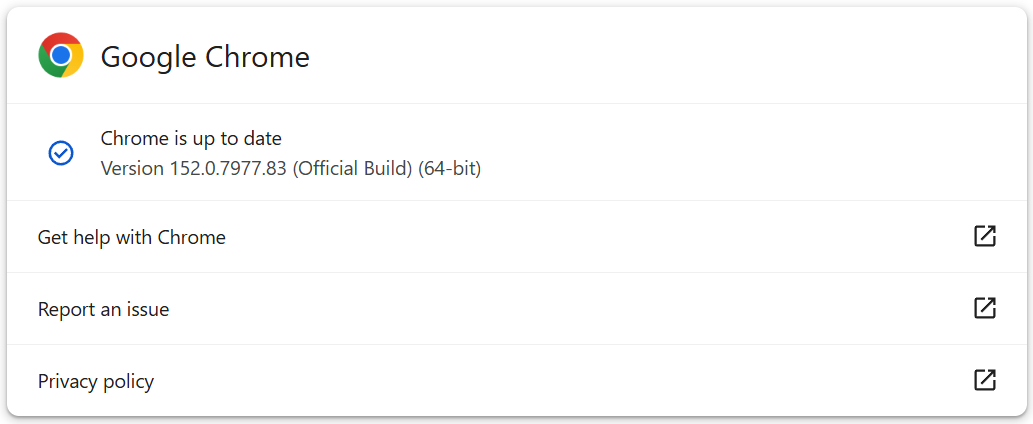
To mitigate the immediate risks posed by CVE-2026-85046, cybersecurity professionals and system administrators strongly advise all users to verify their browser update status immediately. Google delivers these updates through a phased global rollout, meaning the patch may take some time to propagate to every installation worldwide. Users can manually accelerate this process by navigating to the browser menu, selecting Help, and clicking on "About Google Chrome." This action forces the application to poll Google’s update servers, initiating the download and installation of the latest stable build. Crucially, industry experts emphasize that the installation process is incomplete until the browser is fully restarted, which flushes the old runtime binaries from active memory and loads the newly patched V8 execution environment.
Looking toward the future, the persistent discovery of sophisticated memory corruption flaws in foundational web infrastructure points to an urgent, industry-wide imperative: the systematic transition toward memory-safe programming paradigms. For decades, high-performance engines like V8 have been written in languages such as C and C++, which offer developers absolute control over hardware resources and memory allocation at the cost of exposing the software to human error. Mistakes in manual memory management invariably lead to the exact classes of vulnerabilities—such as type confusions, use-after-free bugs, and out-of-bounds errors—that continue to plague modern applications.
Although rewriting massive, highly optimized legacy engines from scratch presents monumental engineering challenges, software vendors are increasingly exploring the integration of memory-safe languages and advanced automated fuzzing techniques to intercept these defects before they reach production environments. Until that architectural transformation is fully realized across the technology sector, the digital security community will remain locked in a reactive posture, relying on rapid patch management, advanced behavioral monitoring, and vigilant user awareness to fend off the relentless wave of zero-day exploitation targeting our daily digital gateways.
