

The landscape of cybersecurity is undergoing a profound structural shift, driven largely by the relentless integration of generative artificial intelligence and advanced machine learning into software testing, code analysis, and threat research. Security practitioners have long awaited tools capable of uncovering latent flaws with superhuman speed and precision. Today, that future has arrived, but it has brought with it an unprecedented operational crisis. As artificial intelligence automates and massively accelerates the discovery of software weaknesses, the traditional ecosystem responsible for cataloging, enriching, and remediating those flaws is buckling under the weight.
When the volume of newly identified flaws breaks through the structural ceilings of legacy evaluation models, enterprise defenders find themselves caught in a dangerous crossfire. The core challenge facing modern cybersecurity is no longer about finding vulnerabilities; it is about surviving an avalanche of data that institutional repositories can no longer process in a timely fashion.
The Breaking Point of Institutional Scale
To understand the severity of the current bottleneck, one must look closely at the operational adjustments made by organizations like the National Institute of Standards and Technology. Confronted by an exponential surge in Common Vulnerabilities and Exposures filings, NIST updated its National Vulnerability Database operations to handle raw scale. This adjustment meant that roughly 30,000 vulnerabilities published prior to March 2026 were reclassified as "Not Scheduled" for standard enrichment.
While triage, selective processing, and automation are logical administrative responses to an overwhelmed system, they introduce profound downstream risks for enterprise security teams. These policies are not theoretical administrative adjustments—they directly impact corporate defense postures. Data from Action1’s 2026 Software Vulnerability Ratings Report highlights the staggering acceleration of the threat landscape, revealing that disclosed vulnerabilities across major enterprise software categories jumped by 92% in 2025 compared to the previous year. More alarmingly, critical and high-severity vulnerabilities each surged by 103%, while remote code execution flaws spiked by an extraordinary 128%.
This deluge of fresh vulnerabilities must be validated, enriched, contextually scored, prioritized, and remediated. Yet, the foundational databases and analytical workflows relied upon by the industry were architected for a much slower, more methodical era of software development and security research. The existence of a backlog is not inherently catastrophic; growing backlogs are a standard symptom of scaling industries. The true danger lies in the strategic choices made to manage that backlog—specifically, the systemic bias toward newly discovered bugs at the expense of older, unprocessed security flaws.
The Perils of Information Asymmetry
When enrichment pipelines focus exclusively on the newest CVEs, they inadvertently cast older, un-enriched vulnerabilities into a bureaucratic purgatory. Many of these omitted entries may already be well-documented, acknowledged by software vendors, or actively discussed within researcher communities, yet they lack the standardized NVD context that many automated security orchestration tools require.
This dynamic creates a severe information asymmetry. Security teams that depend heavily on centralized, normalized databases as their primary source of truth face delayed or incomplete intelligence. Malicious actors, conversely, do not suffer from bureaucratic constraints. Adversaries do not wait for standardized metadata enrichment; they readily correlate vendor security advisories, independent patch releases, underground forum discussions, and proof-of-concept exploits to weaponize vulnerabilities long before defenders fully understand their exposure.
Enrichment is far from a cosmetic exercise. Structured metadata, common platform enumeration data, granular severity metrics, and architectural configuration specifics are vital instruments. They allow defenders to accurately determine whether a reported weakness affects their specific corporate environment and how rapidly mitigation must occur. When this contextual intelligence is missing or delayed, security professionals are forced into an untenable position: wait indefinitely for institutional guidance or make critical, high-stakes decisions using fragmented information. In an era where automated exploitation tools allow threat actors to operationalize new exploits within hours of disclosure, neither option offers adequate protection.
The Secondary Effects of a Semi-Permanent Backlog
Beyond immediate visibility gaps, the shift toward selective processing yields second-order effects that complicate long-term risk management. A rolling backlog that is constantly fed by AI-driven discovery tools while being selectively drained creates deep uncertainty regarding organizational coverage. Without a firm, transparent commitment to processing older entries within a predictable timeframe, the backlog transforms from a temporary bottleneck into a permanent structural condition.

Practitioners face a fractured reality where some vulnerabilities receive immediate attention while others languish in limbo indefinitely. This ambiguity severely undermines vulnerability prioritization frameworks. If asset-to-product mapping data is incomplete, the rate of false positives skyrockets. Security analysts waste precious hours investigating phantom threats that have no bearing on their production environments, all while potentially blinding themselves to genuine, active risks hidden within the un-enriched backlog.
Over time, this erosion of confidence in centralized datasets forces enterprises to construct costly, complex alternative intelligence pipelines. Organizations must invest in additional tooling, custom threat feeds, and specialized personnel just to achieve the baseline visibility they once derived from a single authoritative source. This operational complexity invariably drives up overhead costs while increasing the probability of human error and overlooked exposures.
Navigating the Post-Baseline Era of Vulnerability Management
Acknowleging these systemic pressures does not imply institutional failure; rather, it underscores a fundamental evolution in the cybersecurity market. The scale problem is authentic, and legacy models simply were not built to ingest the sheer volume of security data produced by modern software engineering and AI-assisted research. However, the resulting trade-offs place an immense burden on downstream defenders.
To survive this transition, organizations must fundamentally alter their consumption models. Relying on a single, centralized source of truth is no longer viable. Instead, modern security architecture requires robust correlation across multiple independent intelligence streams, including native vendor advisories, specialized vulnerability intelligence providers, commercial threat intelligence feeds, and comprehensive internal asset inventories.
Ultimately, vulnerability management is transitioning from the passive consumption of curated lists to the real-time synthesis of actionable intelligence derived from incomplete data sources. This evolution demands a level of organizational maturity, technical tooling, and process discipline that many enterprises are still working to achieve. The NVD will undoubtedly remain a cornerstone of the vulnerability ecosystem, but it can no longer function as an all-encompassing baseline. Instead, it must be treated as one input among many—and one that will frequently lag behind active field exploitation.
Actionable Strategies for Modern Security Teams
In light of these realities, defenders must adopt a proactive, multi-layered approach to vulnerability lifecycle management. The primary directive is diversification: security operations centers must subscribe to cumulative intelligence gathered from diverse vendor ecosystems that aggregate fragmented telemetry into usable operational data.
However, simply collecting more feeds introduces a new variant of the same problem—information overload. The true objective is transforming disparate intelligence into an immediate operational decision: Does this specific vulnerability impact our assets? What is our actual risk exposure? And how fast can we deploy a fix?
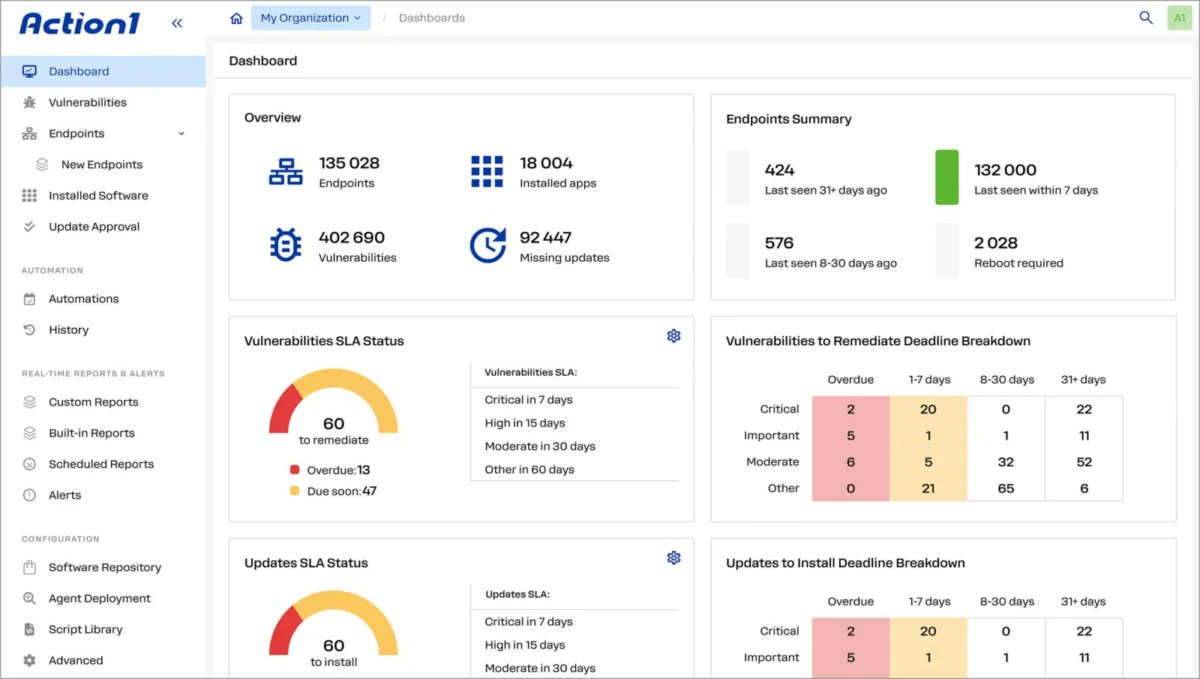
Advanced platforms have begun addressing this challenge by shifting away from isolated vulnerability assessment tools toward unified ecosystems. For instance, solutions like Action1 integrate intelligence feeds from diverse repositories—such as specialized vulnerability indices, NIST data, CISA’s Known Exploited Vulnerabilities catalog, Microsoft Security Response Center releases, and proprietary vendor notes—to score vulnerabilities based on real-world threat indicators like active ransomware campaign usage. This multi-factor approach delivers actionable prioritization within minutes rather than days.
Furthermore, this intelligence must be directly tethered to real-time endpoint telemetry. By correlating vulnerability data directly with software deployed across enterprise machines, security teams can instantly isolate true positives and eliminate guesswork. Crucially, the workflow must not end with identification. Modern remediation should never require cumbersome data exports, manual handoffs between siloed teams, or lengthy administrative delays before patching commences.
By unifying vulnerability assessment and patch management into a single, cohesive workflow, organizations can dramatically compress their exposure window. The future of enterprise cybersecurity will not be determined by how quickly IT and security departments can uncover flaws using artificial intelligence or automated scanners. Rather, it will be measured by how rapidly they can comprehend, prioritize, and remediate those risks before adversaries capitalize on the gap. As discovery accelerates into hyperdrive, remediation must evolve in lockstep to keep enterprise defenses intact.
