


Over the past two decades, the architecture of the global internet underwent a silent yet profound transformation. Rather than functioning merely as an open network for communication and information sharing, the modern web evolved around an economic engine that relies on comprehensive personal surveillance. Every application downloaded, every digital account registered, every URL visited, and every online form filled out contributes to an expansive ecosystem engineered explicitly for tracking, behavioral profiling, and the monetization of human identity.
This systemic paradigm is widely identified as surveillance capitalism. Within this framework, user attention and intimate personal data constitute the final product, positioning the everyday internet user not as a customer, but as the foundational raw material. The mechanics driving this machinery operate almost invisibly in the background of daily digital life. A single primary email address frequently serves as the digital thread stitching together disparate aspects of an individual’s existence, binding commercial shopping habits, sensitive health inquiries, granular location histories, and interpersonal social networks into a unified dossier.
Specialized commercial entities known as data brokers exist solely to harvest, aggregate, cross-reference, and trade these digital fragments. By continuously piecing together seemingly innocuous data points, these firms construct comprehensive behavioral profiles that often outstrip a person’s own self-awareness regarding their digital footprint. Crucially, the assembly of these extensive profiles does not depend on a malicious security breach, zero-day exploit, or unlawful hack; it is simply the default operational state of the contemporary web. Data brokers remain among the most consequential handlers of private citizen data, operating largely outside the realm of consumer awareness or truly informed consent.
Consequently, passive privacy has become an obsolete concept. Preserving confidentiality on the modern internet now requires deliberate, active construction against the structural grain of nearly every digital service consumed. The negative externalities of this surveillance model are intentionally diffused and delayed. Unlike the immediate shock of a compromised credit card or an unauthorized bank transfer, the consequences of data broker profiling manifest gradually. They surface downstream as relentless targeted spam, predatory price discrimination, sophisticated identity theft, and a systematic erosion of personal agency over one’s digital presence.
The introduction of advanced artificial intelligence systems has exponentially accelerated these systemic risks. Modern data broker operations increasingly leverage advanced machine learning models and automated identity resolution algorithms to correlate fragmented behavioral datasets at a scale previously deemed impossible. Equipped with sophisticated analytical capabilities, AI engines can rapidly synthesize millions of disconnected data points, turning seemingly anonymous metrics into high-value, actionable target profiles. Given this pervasive architecture, the central question facing modern netizens is whether the privacy pendulum can ever be swung back, and whether maintaining genuine safety and security online remains viable.

Countering Surveillance Capitalism Through Structural Compartmentalization
If the core mechanism of surveillance capitalism relies on the continuous correlation of an individual’s diverse online actions into a single, highly exploitable profile, the most effective countermeasure must be structural rather than merely legal or regulatory. The objective is to systematically break the correlating identifiers that tie digital activities back to a physical person. This foundational principle drives the concept of digital compartmentalization.
Rather than relying on a monolithic set of universal identifiers—such as a single primary email address, one mobile phone number, a singular payment method, or a universal username—across every aspect of online existence, users can deliberately partition their digital lives into distinct, purpose-built personas. Under this strategy, an individual might maintain one dedicated persona for e-commerce transactions, an entirely separate identity for digital dating platforms, another for travel arrangements, a distinct profile for online peer-to-peer marketplaces, and yet another for engaging with unverified newsletters or subscription services.
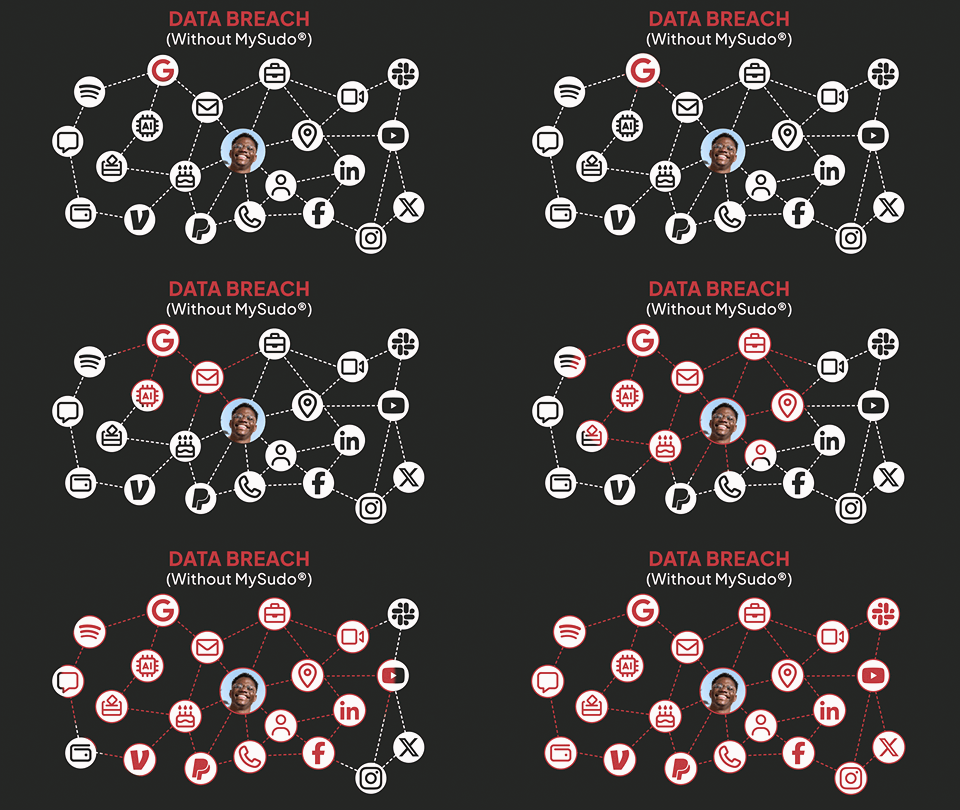
Each individual persona functions as a completely self-contained digital identity equipped with its own dedicated email address, unique phone number, isolated payment instruments, dedicated browser environments, and distinct communication handles. Most importantly, these secondary personas remain entirely decoupled from one another and disconnected from the user’s true physical identity in any manner observable by advertisers, trackers, or data aggregators. If a specific persona becomes compromised in a corporate data breach, gets harvested by marketing lists, or starts attracting unsolicited spam, the operational damage remains strictly quarantined to that single, disposable container without endangering the user’s broader digital ecosystem.
This operational philosophy represents a radical departure from traditional cybersecurity models. Conventional security tools primarily focus on hardening a single, unified digital identity through more complex passwords, multi-factor authentication, robust encryption protocols, and restrictive privacy settings. Compartmentalization, conversely, operates on the pragmatic assumption that any singular identity will eventually be exposed, correlated, or compromised. By ensuring that no single identity holds systemic value or a permanent connection to the user’s real-world persona, this architecture replaces the pursuit of an impenetrable defensive wall with a resilient strategy of risk distribution and disposability.
Furthermore, this structural approach offers a distinct advantage: it requires no systemic overhaul of the broader internet infrastructure. Users do not need to wait for multi-national corporations or regulatory bodies to suddenly prioritize ethical data handling practices. Instead, individuals can deploy an intermediary privacy layer that sits directly between their activities and the external web, dynamically generating and managing these segregated personas on demand.
Operationalizing Digital Personas for Everyday Users
While the conceptual benefits of digital compartmentalization and persona-based security are clear, translating these abstract privacy theories into practical, user-friendly tools has historically presented a significant engineering hurdle. Designing systems that allow average consumers to implement strict compartmentalization without requiring advanced degrees in computer science or enduring constant operational friction has been a central focus of modern privacy innovation.
Platforms such as MySudo have emerged to operationalize this paradigm, providing users with the ability to generate multiple distinct digital personas—often referred to as Sudos—within a single, unified interface. Each Sudo functions as an autonomous operational environment, granting users distinct communication channels, secure virtual phone numbers, private email aliases, and isolated payment solutions tailored to specific online interactions. This multi-layered ecosystem allows individuals to seamlessly engage with the digital world without ever exposing their primary personal identifiable information (PII).
To maximize utility, these specialized privacy frameworks are frequently deployed across multiple form factors, spanning mobile operating systems and desktop applications. Furthermore, advanced privacy suites are increasingly expanding beyond basic communication masking to incorporate complementary security layers, including zero-knowledge password managers and dedicated virtual private networks (VPNs). This holistic ecosystem approach ensures that every vector of digital exposure—from network traffic routing to credential storage and communication—is enveloped in the same philosophy of structural isolation.
The trajectory of individual online privacy has been defined by continuous surveillance and persistent data extraction since the earliest days of the commercial web. However, the maturation of identity-based security tools provides modern users with the necessary infrastructure to push back. By embracing multi-persona compartmentalization, individuals can systematically dismantle the architecture of surveillance capitalism, rendering their personal data uncollectible and neutralizing the threat profile of the next inevitable corporate data breach. The digital fragments of human identity are constantly being harvested; utilizing modern compartmentalization tools ensures that the pieces left behind remain entirely out of reach.
