

The continuous evolution of the cybercrime economy has reached a sophisticated inflection point with the emergence of industrialized loader-as-a-service (LaaS) platforms. Threat intelligence analysts have uncovered a novel Russian-engineered operation designated as DOUBLECUP. Active since mid-2026, this enterprise-grade framework commercializes advanced social engineering tactics, known colloquially as ClickFix attacks, while pioneering stealth mechanisms that subvert standard endpoint detection tools. By weaponizing ordinary browser caches through steganographic techniques and leveraging blockchain-based smart contracts for command-and-control resilience, DOUBLECUP highlights a concerning shift toward decentralized, high-evasion malware delivery models.
The Rise of Loader-as-a-Service and Operational Structure
The commercialization of cyber threats has transformed independent hacking groups into structured enterprises operating on a software-as-a-service business model. DOUBLECUP exemplifies this professionalization. Threat research divisions tracking the platform have discovered that the service provides its criminal subscribers with comprehensive operational infrastructure. Rather than forcing threat actors to build their own command-and-control networks, encryption mechanisms, and payload staging environments from scratch, DOUBLECUP manages these heavy-lifting components behind the scenes.
Subscribers to the platform are supplied with specialized, Go-based administrative software tailored for Windows environments. This utility allows operators to orchestrate complex infection campaigns with minimal technical overhead. The software acts as a campaign manager, empowering operators to define specific domain properties, URL structures, execution logic, steganography preferences, and final payload designations. Once configured, the application automatically builds an API endpoint architecture that generates customized scripts tailored for nearly every mainstream browser, including Google Chrome, Mozilla Firefox, Microsoft Edge, Brave, and Opera.
While DOUBLECUP handles backend infrastructure duties—such as hosting steganographic assets, managing session telemetry, and dynamically rebuilding encrypted payloads—the individual customers retain specific responsibilities. Affiliates must establish and host the landing pages that display the deceptive ClickFix prompts, integrate the generated frontend code, and apply custom obfuscation layers to bypass security gateways. This division of labor allows less sophisticated threat actors to execute campaigns that rival the technical precision of nation-state operations.
The infrastructure footprint of DOUBLECUP came to light during routine threat hunting when researchers identified an exposed directory containing testing artifacts, which eventually mapped back to the core licensing panel of the service. This accidental exposure unveiled the inner workings of an operation designed to make sophisticated multi-stage infections accessible to a broader ecosystem of cybercriminals.
Mechanics of the Attack: Social Engineering Meets Steganography
At the heart of a DOUBLECUP campaign lies the ClickFix vector—a social engineering methodology that tricks users into executing malicious scripts manually. Unlike traditional drive-by downloads that exploit browser vulnerabilities, ClickFix relies entirely on human error, bypassing many automated perimeter defenses because the victim willingly executes the code.
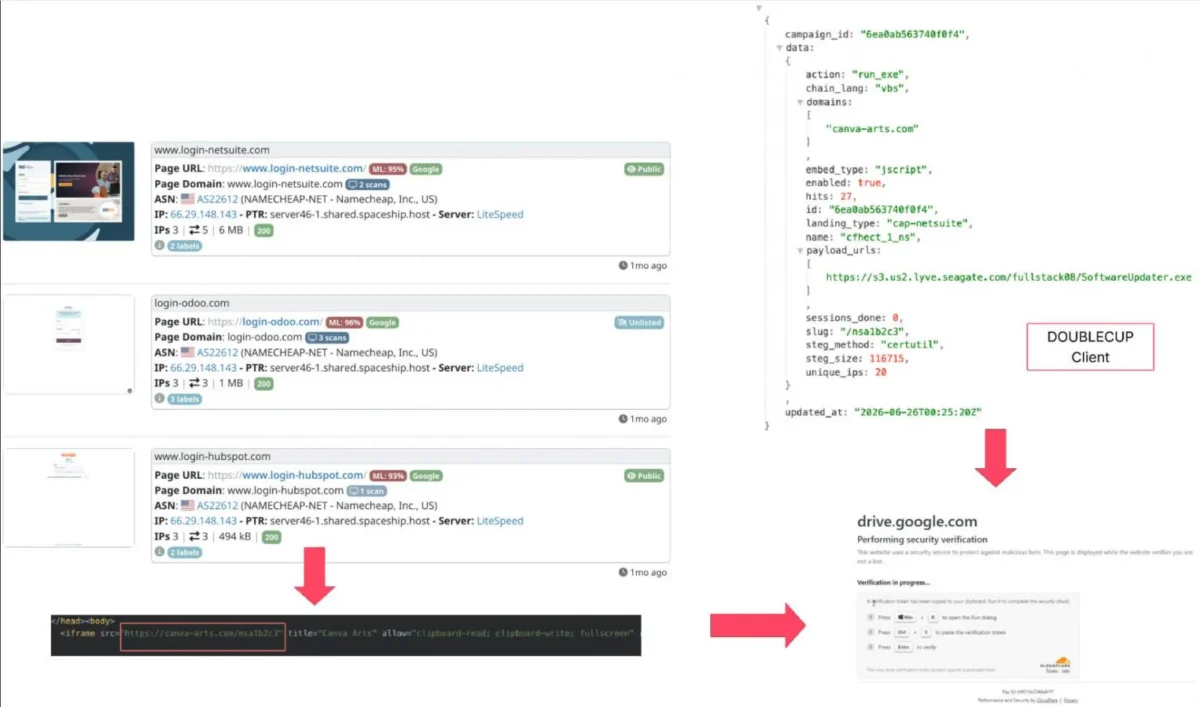
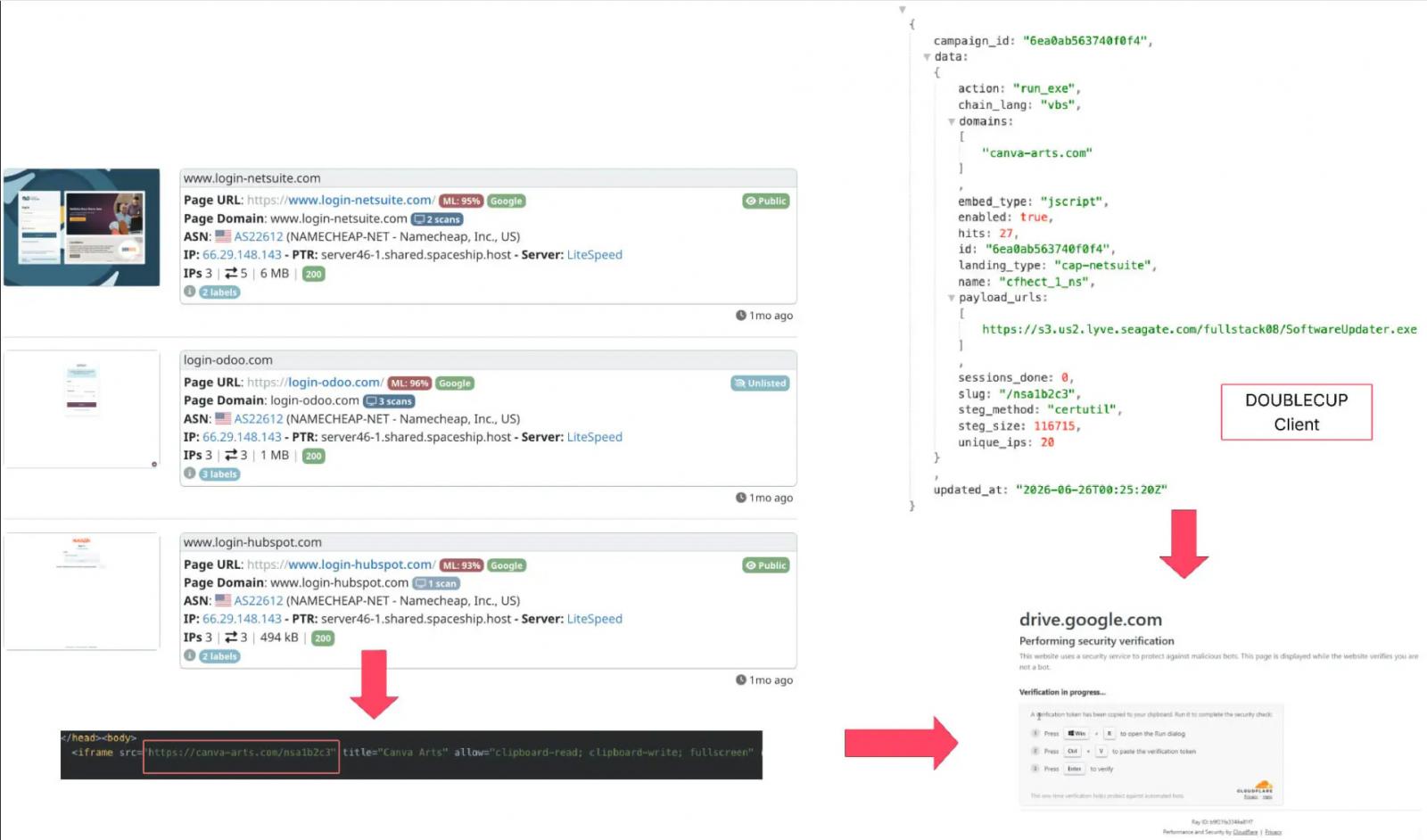
DOUBLECUP campaigns frequently leverage fraudulent authentication and verification portals that mimic prominent enterprise software ecosystems, including NetSuite, Odoo, HubSpot, and Salesforce. Victims visiting these compromised or attacker-controlled domains are greeted by authentic-looking interface elements, often injected via hidden iframes. The user is then confronted with a deceptive instruction, typically disguised as an interactive CAPTCHA challenge or a browser security validation screen.
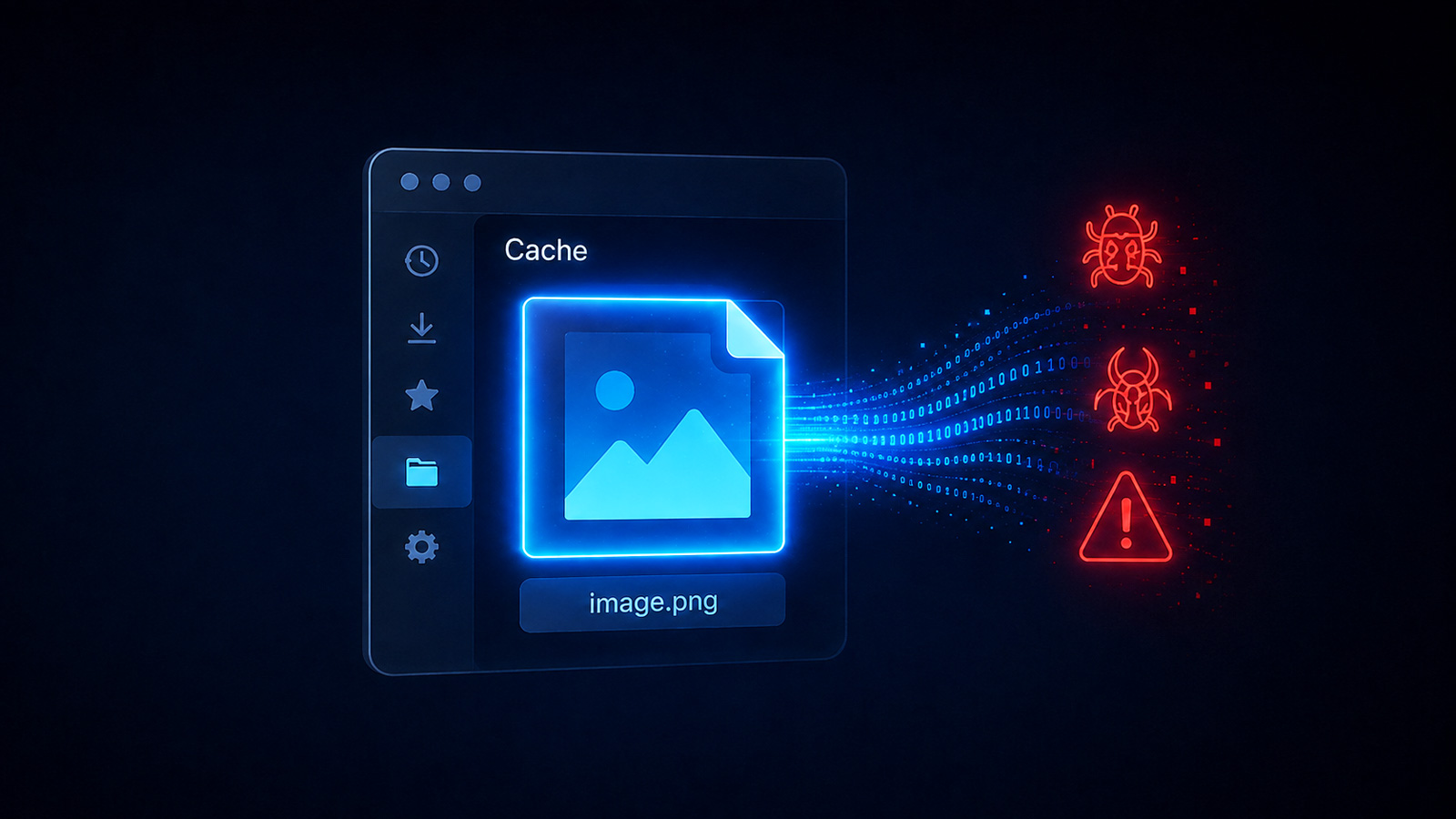
Behind the scenes, the DOUBLECUP script establishes a session upon page load, queries the victim’s public IP address, and forces the browser to download an innocent-looking PNG image. Crucially, this image is preloaded directly into the victim’s local browser cache. Simultaneously, the malicious webpage copies a meticulously crafted command string onto the user’s system clipboard, accompanied by urgent prompts urging the visitor to open a terminal or run dialog box, paste the contents, and press enter.
When executed, this initial command initiates a quiet search through the browser’s cache directories, locating the steganographic PNG file based on precise file-size parameters. Leveraging native operating system utilities such as findstr or certutil, the script extracts hidden shellcode embedded within the image’s data structure. This first-stage execution triggers a fileless second-stage dropper.
To ensure the payload is executing in the correct environment and to hinder automated sandboxing, the dropper queries the victim’s public IPv4 address. This IP serves as a dynamic input parameter to generate a specialized decryption key. The malware then compares the resulting decrypted payload against a hardcoded SHA-256 cryptographic hash. Once verified, the final payload is injected directly into memory, leaving minimal forensic artifacts on the underlying storage drive.
Multi-Platform Payloads: CountLoader and DeviceManager RAT
The ultimate objective of the DOUBLECUP ecosystem involves deploying robust, highly capable post-compromise tooling. Investigations into the service have linked it to two primary malware families: an updated iteration of CountLoader capable of crossing operating system boundaries, and a previously undocumented remote access trojan (RAT) known as DeviceManager.

CountLoader has evolved into a versatile multi-platform threat capable of compromising both Windows and macOS architectures. On Windows systems, CountLoader acts as an aggressive information harvester. It methodically searches infected endpoints for cryptocurrency wallet installations, browser extensions, and communication apps like Signal Desktop. To maintain persistent access across system reboots, the malware establishes scheduled tasks. Furthermore, its modular design enables it to download and execute supplementary payloads, including malicious MSI packages, dynamic link libraries (DLLs), and custom PowerShell scripts.
Recognizing the enterprise shift toward macOS in corporate environments, the developers behind CountLoader engineered a variant compiled natively for both Intel and Apple Silicon processors. This macOS-centric iteration establishes persistence by installing a malicious LaunchAgent. It utilizes native Unix and macOS utilities—such as curl, sw_vers, system_profiler, and ioreg—to profile the host system and communicate with attacker-controlled command-and-control (C2) servers while blending in with legitimate background processes.
Accompanying CountLoader is DeviceManager, a modular, Python-based remote access trojan engineered specifically for Windows environments. DeviceManager acts as a deep reconnaissance and control asset. In systems located outside the Commonwealth of Independent States (CIS), the RAT systematically harvests sensitive system telemetry, including machine global unique identifiers (GUIDs), disk identifiers, user security identifiers (SIDs), hostnames, usernames, OS version details, architectural data, domain memberships, and installed security software.
What sets DeviceManager apart is its resilient C2 communication architecture. Instead of relying on hardcoded domain names or static IP addresses that can be easily sinkholed or blocked by defensive teams, DeviceManager employs a technique known as EtherHiding. The malware queries legitimate blockchain smart contracts hosted on decentralized networks like Ethereum or Polygon to retrieve its active C2 infrastructure addresses. This blockchain-based lookup mechanism provides exceptional resilience against law enforcement takedowns and infrastructure disruption efforts. Once the active server address is resolved, the RAT utilizes standard DNS A and TXT records to exfiltrate stolen data, receive operational commands, and deliver additional payloads.
Industry Implications and the Evolution of Defensive Strategies
The proliferation of sophisticated LaaS platforms like DOUBLECUP underscores a troubling asymmetry in modern cybersecurity. While security vendors continuously improve behavioral monitoring and signature-based detection, cybercrime syndicates are increasingly bypassing these controls by weaponizing standard web caching mechanisms and trusted operating system binaries. By hiding malicious payloads inside innocuous image files that reside temporarily in standard browser caches, attackers effectively weaponize the very caching features designed to optimize web performance.
This technique challenges traditional incident response frameworks. Security operations centers (SOCs) and endpoint detection and response (EDR) agents are trained to scrutinize unusual network downloads and foreign process executions. However, when a payload is retrieved locally from a browser cache using native utilities like certutil—and subsequently injected directly into memory—traditional perimeter visibility often fails.
Furthermore, the integration of blockchain technology for C2 resolution signals a maturing adversary profile that can withstand infrastructure ablation. As decentralized web3 technologies become integrated into malware command frameworks, traditional threat-intelligence-sharing models predicated on blocking malicious IP addresses and domains face diminishing efficacy.
To counter these sophisticated vectors, modern security postures must evolve beyond simple endpoint signatures. Organizations must implement rigorous breach and attack simulation (BAS) to continuously test their SIEM and EDR rules against multi-stage fileless attacks and steganographic data concealment. Moreover, user education must adapt; security awareness training can no longer rely solely on spotting phishing emails, but must actively educate employees on the dangers of executing untrusted clipboard commands prompted by deceptive web interfaces.
Ultimately, DOUBLECUP represents a watershed moment in threat engineering. As loaders become more modular, evasive, and accessible via automated service models, enterprise security teams must adopt a zero-trust mindset that continuously validates every layer of the digital environment—before malicious actors exploit the blind spots.
