


The fragile cybersecurity posture of the modern healthcare sector has once again been cast into sharp relief following a major data breach at Medical Computer Business Services (MCBS), a regional medical billing and practice-management firm headquartered in Augusta, Georgia. Federal filings submitted to the U.S. Department of Health and Human Services reveal that the sweeping cyber incident compromised the sensitive personal and medical data of 1,261,464 individuals. The breach underscores the systemic vulnerabilities inherent in third-party vendor ecosystems, where a single compromised node can expose millions of patient records across multiple medical providers.
MCBS functions as a critical intermediary within the regional healthcare ecosystem, providing comprehensive administrative, financial, billing, coding, and accounts receivable management services to various medical practices and clinics. Acting as a centralized data aggregator, the organization processes and stores extensive volumes of protected health information (PHI) and personally identifiable information (PII) on behalf of its client organizations, known legally under federal regulations as "covered entities."

According to forensic disclosures published by the company, unauthorized threat actors successfully infiltrated the MCBS internal network architecture over a four-day window, moving undetected between September 22 and September 26, 2025. Despite the intrusion occurring in the autumn of 2025, the organization’s forensic investigation into the full scope, breadth, and impact of the breach required months to complete, only concluding on May 28 of the following year. Public notification followed weeks later, leaving many affected individuals unaware that their personal data had been compromised for nearly a year.
The fallout from the breach extends far beyond MCBS itself, directly impacting a network of regional medical providers whose administrative operations relied on the billing firm. Official notifications identify several covered entities whose patient databases were exposed due to their business associate agreements with MCBS. Among the affected practices are South Georgia Radiology Consultants, SkinPath Solutions, and Stephen W. Brown and Radiology Associates, alongside several other specialized regional clinics. Because the nature of outsourced medical billing requires the transmission of extensive clinical and financial details, the compromised datasets vary significantly from person to person, potentially including names, addresses, dates of birth, social security numbers, medical diagnoses, treatment histories, and health insurance policy details.
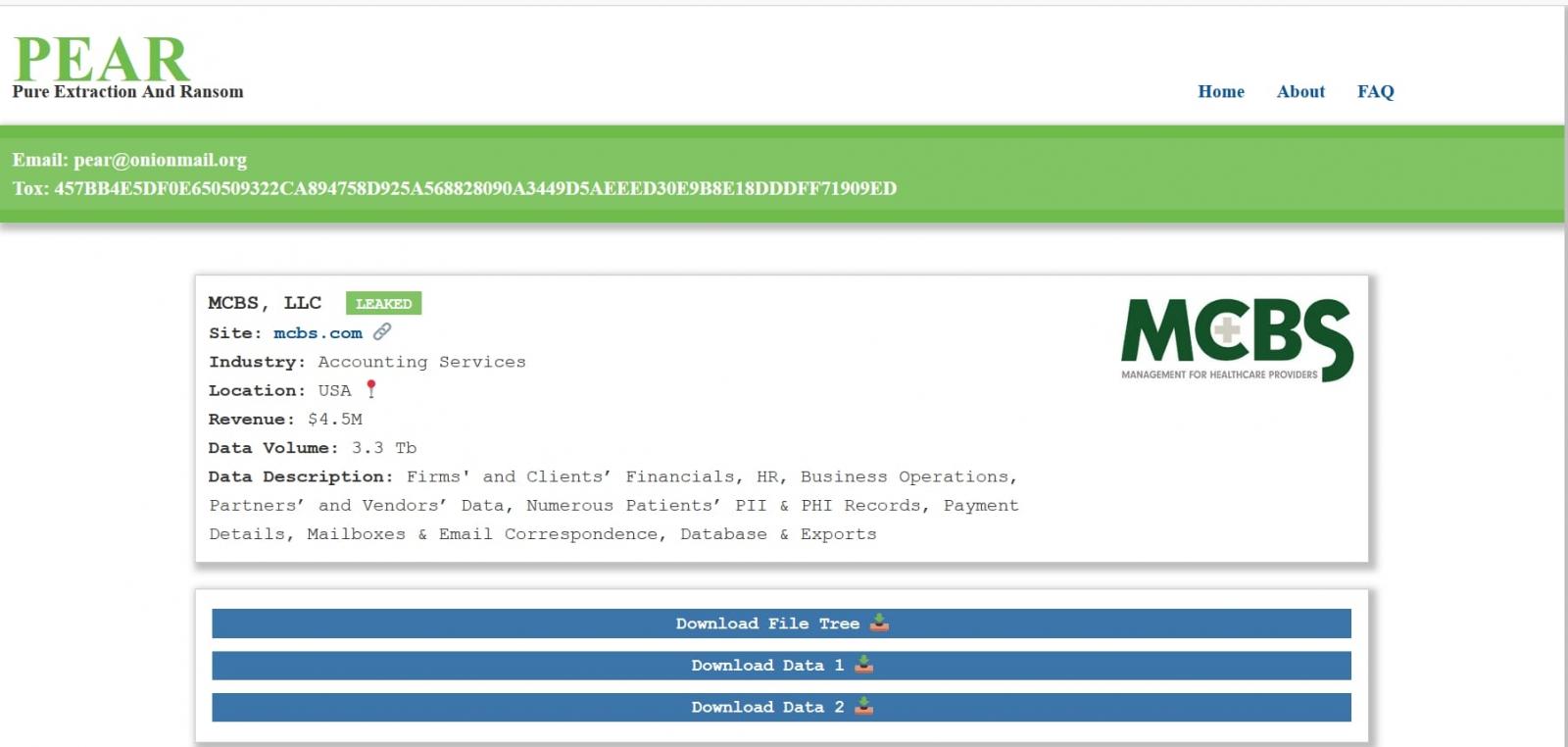
The security crisis escalated further when the notorious PEAR (Pure Extraction and Ransom) ransomware syndicate stepped forward to claim responsibility for the attack. In public postings on their extortion portal, cybercriminals belonging to the PEAR group asserted that they successfully exfiltrated a staggering 3.3 terabytes of proprietary data from MCBS servers prior to executing their encryption routines. Beyond the patient medical records highlighted in formal regulatory disclosures, the threat actors boast possession of internal corporate assets, including human resources files, proprietary business operations documentation, financial payment details, internal email archives, and various corporate databases. True to the modus operandi of modern extortion gangs, the threat actors ultimately published the entire stolen data cache on the dark web after negotiations or ransom demands presumably broke down.

In the wake of the public disclosures, MCBS leadership has mobilized an advisory campaign urging potentially affected patients to remain vigilant against identity theft and financial fraud. The company recommends that individuals who have received medical care anywhere in Georgia proactively contact their respective healthcare providers to ascertain whether their medical practice utilized MCBS billing services and whether their specific records were compromised. Furthermore, cybersecurity experts advise impacted individuals to place initial fraud alerts on their credit reports and consider implementing formal credit freezes to thwart unauthorized attempts to open lines of credit in their names.
The MCBS incident is emblematic of a broader, deeply troubling trend across the global healthcare landscape. Medical institutions, ranging from sprawling hospital networks down to specialized private billing agencies, have increasingly become prime targets for financially motivated cybercriminal organizations. Healthcare data commands exceptionally high prices on illicit dark web markets because it provides a permanent foundation for identity theft, medical fraud, and sophisticated phishing campaigns. Unlike compromised credit card numbers—which can be quickly canceled and replaced—a victim’s date of birth, social security number, and foundational medical history cannot be altered, making healthcare data breaches uniquely damaging to individuals over the long term.
Furthermore, the breach highlights the critical vulnerabilities associated with third-party vendors and business associates. Healthcare providers frequently outsource non-clinical functions such as billing, transcription, IT support, and payroll to specialized third-party firms. While this outsourcing optimizes operational efficiency and reduces administrative overhead, it simultaneously expands the organization’s attack surface. Cybercriminals have recognized that smaller administrative or billing firms often lack the robust, enterprise-grade security operations centers (SOCs) and continuous monitoring capabilities maintained by major hospital groups, rendering them lucrative and relatively soft targets. Once inside a vendor network, sophisticated threat actors can often pivot laterally to access interconnected client databases or leverage the trusted relationship to extract vast troves of aggregated data.
The lengthy timeline between the initial intrusion in September 2025 and the finalization of the forensic audit in late May 2026 also shines a harsh spotlight on the immense complexities inherent in modern digital forensics. When ransomware groups infiltrate corporate networks, they typically deploy advanced obfuscation techniques, wipe system logs, and encrypt local backups to hinder recovery and investigation efforts. Untangling the precise pathways of an advanced persistent threat (APT) or financially motivated ransomware crew requires meticulous log analysis, endpoint artifact recovery, and data mapping. However, this protracted delay between breach occurrence and public notification often leaves victims defenseless against imminent social engineering attacks and identity theft, prompting ongoing debates among lawmakers and regulatory bodies regarding stricter mandatory disclosure timelines.
As ransomware syndicates like PEAR continue to evolve their tactics—increasingly shifting away from mere file encryption toward pure data exfiltration and public extortion—organizations within the medical sector must fundamentally rethink their defensive postures. Traditional perimeter-based security models are no longer sufficient to protect sensitive health data from determined adversaries. Industry experts advocate for a transition toward Zero Trust architecture, where network segmentation, strict multi-factor authentication (MFA), continuous endpoint detection and response (EDR), and rigorous third-party risk management (TPRM) are treated as non-negotiable baseline requirements.
Ultimately, the massive data compromise at Medical Computer Business Services serves as a sobering reminder of the high stakes involved in digital asset protection. As regulatory penalties increase and public scrutiny intensifies, healthcare organizations and their business associates can no longer treat cybersecurity as a mere compliance checkbox. Protecting patient data requires continuous vigilance, comprehensive threat intelligence sharing, and proactive simulation testing to identify vulnerabilities before opportunistic cybercriminal syndicates exploit them. Until the broader medical billing and administrative ecosystem achieves a higher standard of digital resilience, millions of patients will remain vulnerable to the fallout of supply chain cyber attacks.
