

The modern corporate landscape is currently grappling with a subtle but significant cultural friction: the "bot fatigue" of the virtual meeting era. While the promise of artificial intelligence to automate the drudgery of meeting minutes is universally welcomed, the presence of visible, uninvited "recording bots" in Zoom or Teams calls has become a source of social awkwardness and privacy concerns. It is within this specific psychological niche that Granola, a startup focused on "invisible" transcription and AI-assisted note-taking, has found its explosive growth trajectory. This momentum culminated today in the announcement of a massive $125 million Series C funding round, catapulting the company to a $1.5 billion valuation—a sixfold increase from its $250 million valuation less than a year ago.
The funding round was spearheaded by Danny Rimer at Index Ventures, with significant participation from Mamoon Hamid at Kleiner Perkins. The cap table is further bolstered by a roster of high-profile returning investors, including Lightspeed Venture Partners, Spark Capital, and NFDG. This latest infusion brings Granola’s total capital raised to approximately $192 million, a war chest that signals the market’s belief that meeting intelligence is moving beyond simple transcription and into the realm of enterprise-grade knowledge management.
The Psychology of "Invisible" AI
The core of Granola’s success lies in its architectural philosophy. Unlike competitors that deploy "joiner bots" which appear as participants in a call, Granola operates as a local application on the user’s computer. It captures audio directly from the system, transcribing and summarizing the conversation without the performative presence of an external bot. This "prosumer" approach—initially targeted at individual power users who wanted a better way to remember their day—has proven to be a Trojan horse for enterprise adoption.
In many corporate environments, the presence of a recording bot can stifle candid conversation. Executives and employees alike often feel a sense of surveillance when a third-party bot is listed in the participant gallery. By moving the processing to the edge—the user’s own machine—Granola has bypassed this social barrier, allowing for a more natural flow of information while still providing the high-fidelity data capture that AI requires.
From Individual Tool to Enterprise Ecosystem
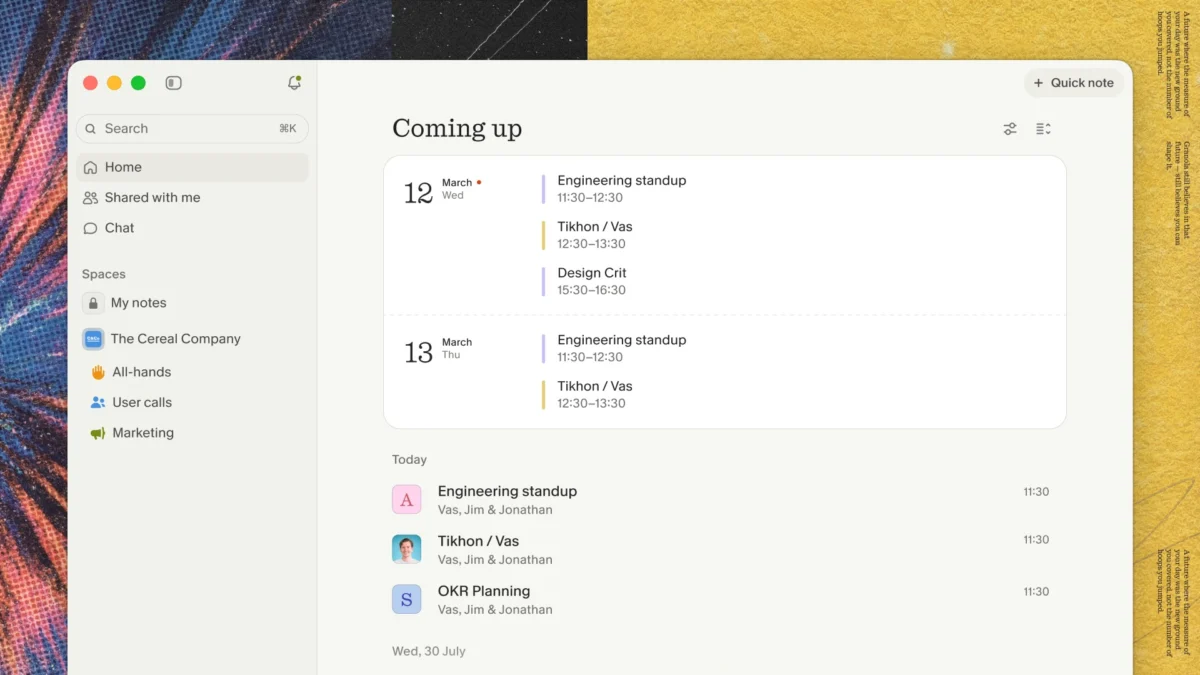
Granola’s evolution from a sleek note-taking app to a comprehensive enterprise AI platform is marked by the introduction of "Spaces." Announced alongside the funding, Spaces represents the company’s pivot toward collaborative intelligence. In the past, Granola notes were largely siloed to the individual user. Now, teams can organize their collective institutional knowledge into dedicated workspaces and folders with granular permission controls.
This structural shift is critical for the enterprise. In a large organization, the value of a meeting isn’t just for those who attended; it is for the broader team that needs to act on the decisions made. By allowing users to query notes across entire Spaces or specific folders, Granola is effectively building a searchable, AI-indexed archive of every conversation held within a company. This transforms the "meeting note" from a static document into a living piece of data that can be cross-referenced, analyzed for trends, and used to onboard new employees.
The startup’s client list already reflects this enterprise-heavy focus, boasting names like Asana, Gusto, Vanta, Thumbtack, and even AI industry leaders like Mistral AI and Decagon. These are companies that operate at the cutting edge of productivity, and their adoption of Granola suggests that the tool is solving a problem that generic, platform-native tools (like those from Microsoft or Google) have yet to fully address.
The API Strategy: Healing the "Scramble"
Perhaps the most significant technical development in Granola’s latest update is the release of two new APIs: a Personal API for individual users on business plans and an Enterprise API for administrators. This move is a direct response to a controversy that erupted earlier this year, colloquially known in tech circles as the "Granola Scramble."
Previously, Granola’s local database was relatively open, allowing sophisticated users and developers to hook into the data to power their own custom AI agents and workflows. However, an update that changed the way data was stored effectively locked this down, breaking the custom setups of many power users—including prominent venture capital partners at firms like Andreessen Horowitz. The backlash was swift and vocal.

Granola’s co-founder, Chris Pedregal, addressed the issue by explaining that the original local cache was not architected to handle the heavy lifting of external AI workflows. The new APIs are the "official" solution to this problem. By providing structured access to meeting data, Granola is positioning itself not just as an app, but as a data layer. Developers can now programmatically pull meeting context into other tools, allowing for the creation of "AI agents" that can perform tasks based on what was discussed in a meeting—such as automatically updating a CRM, drafting a technical specification in GitHub, or triggering a procurement workflow in an ERP system.
The Commodity Trap and the Search for Value
The broader market for AI meeting notes is rapidly becoming commoditized. Zoom, Microsoft Teams, and Google Meet all offer native transcription and summarization features for free or as part of existing subscriptions. Furthermore, a slew of startups like Fireflies, Read AI, and Otter.ai are fighting for the same territory.
To survive and justify a $1.5 billion valuation, Granola must offer more than just a summary. The future of this category lies in "actionable intelligence." The industry is moving toward a world where the AI doesn’t just tell you what happened, but helps you execute the next steps. This is why Granola’s integration with the Model Context Protocol (MCP) is so vital. By serving as an MCP server, Granola allows AI models like Anthropic’s Claude or OpenAI’s ChatGPT to "see" and "understand" the context of a user’s meetings.
When an AI model has access to the specific nuances of your team’s conversations, it becomes exponentially more useful. It can draft follow-up emails that actually sound like the user, suggest meeting times based on discussed deadlines, and pull relevant information from past calls to inform current projects. This "contextual awareness" is the holy grail of enterprise AI, and Granola is betting that its clean, user-consented data is the best fuel for these engines.
Future Implications: The "Ambient Enterprise"
As Granola scales, its impact on the "future of work" will likely be defined by how it handles the delicate balance between utility and privacy. The $125 million Series C provides the runway to tackle the most difficult enterprise challenges: security, compliance, and internationalization. For a company that prides itself on "invisible" capture, the burden of trust is immense.
We are entering the era of the "Ambient Enterprise," where every conversation is captured and transformed into a structured data point. If Granola succeeds, the concept of "forgetting" what was said in a meeting will become an anachronism. The challenge for the company will be to ensure that this total recall enhances human productivity rather than creating a culture of hyper-accountability and surveillance.
With deep integrations into the developer ecosystem—connecting with tools like Figma, Replit, Manus, and Bolt.new—Granola is clearly aiming to be the connective tissue of the modern tech stack. As AI agents become more prevalent in the workplace, they will need a source of truth to understand human intent. Granola wants to be that source of truth.
The involvement of Index Ventures and Kleiner Perkins suggests that the investment community sees Granola as a potential "platform play" rather than just a utility. In the high-stakes world of enterprise software, being the place where decisions are recorded is often more valuable than being the place where work is done. By capturing the "why" behind the "what," Granola is building a moat of context that will be very difficult for incumbents to bridge.
As we look toward 2026 and beyond, the success of Granola will be a bellwether for the broader AI industry. It will test whether specialized, "edge-first" applications can outcompete the bundled offerings of tech giants, and whether users truly value the "silent" approach to AI assistance. For now, with $192 million in the bank and a soaring valuation, Granola is proving that sometimes, the best way to be heard is to listen quietly.
