

The landscape of mid-range smartphones in 2026 has become an increasingly competitive battlefield. With devices like the Pixel 10a and Samsung’s Galaxy A57 setting high benchmarks for performance, the Nothing Phone 4a Pro has emerged as a distinct contender, blending unique aesthetic design with robust internal hardware. However, as consumers shift toward viewing smartphones as long-term investments rather than disposable gadgets, the question of physical resilience has taken center stage. Recent stress-testing of the Nothing Phone 4a Pro has revealed a device that is arguably the best-built iteration in the company’s history, though it simultaneously highlights a specific design vulnerability that raises questions about the industry-standard approach to port placement and ingress protection.
The Evolution of Build Quality in the Mid-Range Segment
Historically, "mid-range" was synonymous with plastic bodies, lack of water resistance, and structural compromises. Over the past few years, the gap between flagship premium devices and the mid-tier market has narrowed significantly. The Nothing Phone 4a Pro represents this transition, utilizing materials and structural reinforcements that were once exclusive to the four-figure price bracket.
The recent comprehensive stress test of the handset provides a valuable data point for industry analysts. By subjecting the device to the standard gamut of scratch, burn, and structural bend tests, we gain a clear window into how the manufacturer prioritizes longevity. The screen, utilizing hardened glass technology, performed exactly as expected, showing superficial marring at level six on the Mohs hardness scale and more pronounced damage at level seven. This is the current industry gold standard for display glass, confirming that Nothing is not cutting corners on its primary interface.
The Hidden Risk: Port Geometry and User Error
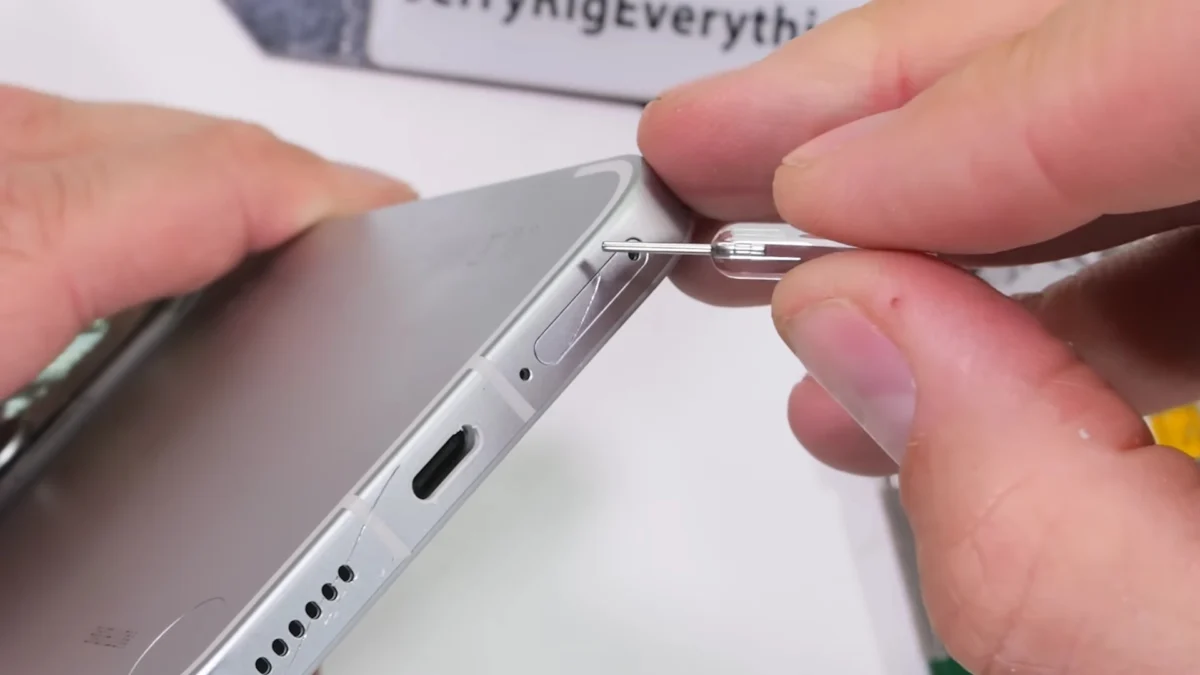
The most significant takeaway from the recent evaluation concerns a nuanced, yet critical, design flaw related to the phone’s IP65 ingress protection rating. In the pursuit of minimalist aesthetics, manufacturers often group ports, microphones, and trays in close proximity. On the Nothing Phone 4a Pro, the SIM card tray and the microphone aperture are situated dangerously close to one another.
This proximity creates a classic "user error" scenario. A standard SIM removal tool, if inadvertently inserted into the microphone port, bypasses the protective outer casing. While the device utilizes a waterproofing mesh to maintain its IP65 rating, this layer is susceptible to puncture. In many competing flagships, the internal architecture is designed to prevent a tool from reaching the waterproofing membrane, often by offsetting the microphone hole at an angle or placing a physical barrier directly behind the aperture.
The implication here is twofold. First, it underscores that IP ratings are not universal in their implementation; they are dependent on both the sealing material and the physical layout of the chassis. Second, it serves as a cautionary tale for designers. As phones become thinner and more densely packed with components, the "ergonomics of maintenance"—how easily a user can navigate ports without damaging internal seals—is becoming an overlooked metric of design excellence. While Nothing has included a secondary layer of protection to mitigate total failure, the fact that the primary seal is compromised by a simple, common tool suggests that future revisions will need to incorporate a more fail-safe internal geometry.
Material Choices and Thermal Resilience
Beyond the structural integrity, the use of materials on the Nothing Phone 4a Pro warrants further scrutiny. The inclusion of a plastic-based covering for the rear screen and the brand’s signature transparent deco elements is a calculated choice. Plastic offers better impact resistance than glass in certain scenarios, as it is less prone to shattering upon high-impact drops. However, as the heat-resistance tests demonstrated, this material comes with trade-offs.
When exposed to direct flame for extended periods, the plastic panels exhibited permanent aesthetic degradation. While this is an extreme use case—unlikely to be replicated in daily life—it speaks to the thermal threshold of the device’s rear chassis. For the average user, this is irrelevant, but for a brand that prides itself on "transparent technology," the degradation of these visual elements is a consideration for long-term resale value. The device’s ability to dissipate heat under sustained high-performance loads remains a more critical metric, yet the durability test reminds us that structural material choice is always a balancing act between cost, aesthetics, and thermal management.
The Bend Test: A Testament to Structural Engineering
Perhaps the most impressive aspect of the evaluation was the device’s performance under intense physical pressure. For years, "bend tests" have been the ultimate arbiter of a phone’s structural competence. A device that flexes or snaps indicates a failure in internal framing, often involving weak points around the antenna lines or the volume buttons.
The Nothing Phone 4a Pro exhibited remarkable rigidity. Under significant force, the frame showed no signs of failure, screen separation, or internal component shifting. This suggests that the internal chassis design—likely involving a combination of reinforced alloy or a well-engineered internal skeleton—is top-tier. In an era where large-screen smartphones are increasingly susceptible to "pocket bending" or accidental damage during transport, this structural rigidity is a significant selling point. It effectively distances the Phone 4a Pro from the perception of mid-range devices as "fragile," positioning it instead as a reliable, daily driver that can withstand the rigors of modern life.
Industry Implications and Future Trends
The findings from this testing cycle have broader implications for the smartphone industry. As companies like Nothing continue to capture market share from established incumbents, they are being held to the same rigorous standards as long-standing tech giants. The "microphone hole" issue is a perfect example of a detail that might have been ignored in a startup phase but is now under the microscope of a global consumer base.
Moving forward, we can expect a greater emphasis on "repairability-by-design" and "ingress-protection-proofing." Companies are beginning to realize that the durability of a phone is a core component of its brand identity. Consumers are increasingly wary of planned obsolescence, and devices that demonstrate resilience in the face of accidents are likely to see better long-term adoption rates.
Furthermore, as the Nothing Phone 4a Pro proves that mid-range handsets can be structurally sound, the market will likely see a push for higher ingress protection ratings across the entire price spectrum. What was once a "flagship-only" feature is becoming a baseline expectation. The challenge for engineers will be to achieve these ratings while simultaneously "idiot-proofing" the port design to prevent the exact type of accidental puncture observed in recent testing.
Conclusion: A Benchmark for the Mid-Range Tier
The Nothing Phone 4a Pro arrives at an interesting intersection of ambition and reality. By acing the structural durability tests, it has cemented its position as one of the most robust mid-range devices currently on the market. Its ability to withstand bending and its overall build quality suggest that the company is maturing rapidly in its manufacturing processes.
However, the discovery regarding the microphone aperture serves as a sobering reminder that perfection is elusive. It highlights the tension between aesthetic design and practical engineering. For the consumer, the advice is clear: exercise caution when handling SIM tools, as even the most well-built phones possess inherent, design-specific vulnerabilities. As Nothing looks toward its next generation of devices, addressing these minute but impactful oversights will be the final step in transitioning from a "challenger" brand to a true industry leader in hardware reliability. The Phone 4a Pro is, by all accounts, a triumph of structural engineering, provided one respects the nuances of its unique architectural layout.
