

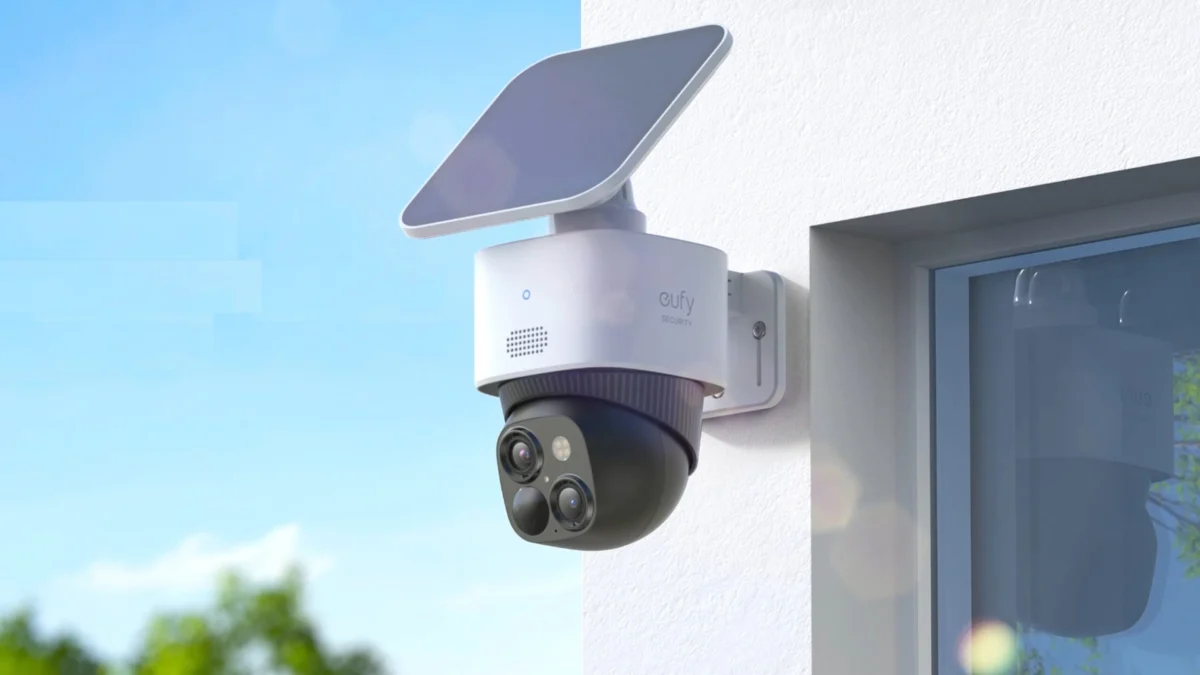
The annual cadence of home improvement and security reassessment often accelerates as seasonal transitions conclude, leading consumers to re-evaluate the protective infrastructure surrounding their properties. For those seeking to transition toward a more sophisticated, yet entirely wire-free, perimeter defense system, a notable opportunity has emerged concerning one of Eufy Security’s flagship outdoor monitoring units. The Eufy Security 3K Dual Camera SoloCam S340 has recently seen its retail valuation plummet by a substantial 40%, aligning its current price point with previous peak promotional benchmarks, specifically those historically observed during major holiday sales events.
The standard retail positioning for the Eufy SoloCam S340, which typically hovers around the $$199.99$ mark, has been temporarily revised to $$119.99$. This reduction of $$80$ represents not merely a marginal saving but a return to the lowest recorded price for this device, signaling a strategic market maneuver that merits closer inspection by security-conscious consumers. While many entry-level outdoor cameras offer rudimentary fixed-view monitoring, the allure of the S340 lies intrinsically in its innovative optical architecture.
The Technological Edge: Dual-Lens Coverage and High Resolution
The defining characteristic setting the SoloCam S340 apart from conventional single-sensor cameras is its integrated dual-lens system. This configuration strategically pairs a high-resolution 3K wide-angle lens—responsible for capturing the comprehensive peripheral view of a designated area—with a secondary, dedicated telephoto lens. This secondary lens is engineered for optical zoom capabilities, enabling the system to provide simultaneous viewing of both the expansive overview and a tightly focused, high-detail inset of any activity detected within that broad field of view.
This dual functionality, further augmented by the camera’s mechanical ability to pan and tilt across a full 360-degree horizontal axis, fundamentally redefines the scope of wireless surveillance. Where standard fixed-position cameras necessitate multiple units to cover adjacent areas or rely solely on digital cropping for detail, the S340 aims to consolidate coverage, offering a granular, panoramic monitoring solution from a single mounting point. The 3K resolution ensures that even when zoomed in, the captured imagery retains sufficient pixel density for effective identification, a critical factor often compromised in lower-resolution wireless alternatives.
Addressing the Power Dilemma: Sustainable Autonomy
A primary friction point in the adoption of advanced outdoor security cameras remains the necessity of constant power access. Hardwiring sophisticated motorized cameras is often impractical or aesthetically undesirable for homeowners. The Eufy S340 addresses this through a purely battery-operated design, leveraging a substantial internal power cell. Crucially, the package includes a detachable solar panel, designed to passively harvest ambient light and maintain the battery charge.
In environments receiving consistent daylight, this solar integration promises a near-perpetual operational state, drastically reducing the routine maintenance cycle associated with manually recharging battery-powered devices. This focus on sustained autonomy moves the product closer to the ideal of "set-it-and-forget-it" security, a major selling point for busy homeowners or those deploying cameras in difficult-to-reach locations.
The Business Model Divide: Local Storage vs. Cloud Dependency
In the contemporary smart home ecosystem, the financial model surrounding data retention is a significant differentiator. Many market leaders mandate recurring monthly or annual subscription fees to unlock essential features, such as cloud storage for recorded events, advanced AI detection, or extended clip retention. Eufy, maintaining its established brand philosophy, circumvents this pervasive revenue structure.
The SoloCam S340 champions local storage, typically utilizing an integrated or expandable onboard memory solution. This commitment to localized data management offers two core advantages: immediate cost savings for the end-user by eliminating subscription overhead, and enhanced privacy assurance, as sensitive video footage is retained on the user’s property rather than being routed through third-party cloud servers. This model resonates strongly with privacy-conscious consumers or those managing multiple security endpoints who wish to avoid compounding monthly expenditures.
Beyond storage, the device incorporates standard yet essential security functionalities: intelligent motion detection algorithms designed to minimize false alerts, bi-directional audio communication allowing remote interaction, and an integrated high-intensity spotlight to illuminate scenes during nocturnal events, enhancing both color night vision and deterring potential intruders.
Contextualizing the Deal: Market Dynamics and Consumer Behavior
This aggressive repricing of the S340 must be viewed within the broader context of the rapidly maturing smart home security sector. Initially, wireless 4K or 3K cameras were positioned as premium offerings, often exceeding the $$250$ threshold. As component costs decrease and competition intensifies—particularly from rivals pushing subscription-heavy ecosystems—manufacturers are forced to recalibrate pricing strategies to maintain market share penetration.
For Eufy, this specific promotion serves multiple strategic purposes. Firstly, it acts as a powerful market stimulus, attracting buyers who may have been on the fence regarding the S340’s initial premium cost. Secondly, it effectively pulls forward demand that might otherwise have been deferred until the next major shopping holiday. By matching Black Friday pricing now, Eufy is maximizing sales velocity during a period—the onset of warmer weather—when external property monitoring naturally becomes a higher priority for consumers.
Furthermore, the dual-lens technology represents a significant step up from the brand’s ubiquitous single-lens offerings. By heavily discounting this advanced model, Eufy is effectively using the price drop as a mechanism to accelerate the consumer base’s adoption of multi-sensor technology, potentially creating future loyalty toward their higher-tier product lines.
Expert Analysis: The Value Proposition of Integrated Optics
From a technical standpoint, the success of the S340 hinges on the effective integration of its two optical systems. In surveillance technology, the trade-off between field-of-view (wide angle) and detail (zoom) is a classic engineering challenge. A single lens must compromise; if it has a wide field of view, zooming digitally degrades image quality rapidly. If it prioritizes zoom, the coverage area shrinks.
The S340’s solution—a fixed wide lens paired with a dedicated zoom lens, managed intelligently by onboard processing—is a sophisticated approach for a battery-powered unit. Expert analysis suggests that the true utility lies in the system’s ability to flag an event with the wide lens and then immediately switch the contextual data capture to the zoom lens. This minimizes power draw by only engaging the high-magnification hardware when necessary, contrasting sharply with motorized PTZ (Pan-Tilt-Zoom) cameras that often constantly recalibrate or rely on heavy computational zooming for situational awareness. The 40% discount significantly lowers the barrier to entry for consumers seeking this level of optical sophistication without committing to a complex wired installation.
Industry Implications: The Shifting Definition of "Standard" Security
The proliferation of feature-rich, aggressively priced wireless cameras like the S340 is having a profound impact on industry expectations. Consumers are increasingly unwilling to settle for 1080p resolution or fixed viewing angles when 3K and motorized movement are available without substantial infrastructure investment.
This trend forces competitors to either match the feature set or significantly undercut the price point of these advanced standalone units. The no-subscription model employed by Eufy also exerts downward pressure on cloud service revenues across the sector. As more consumers experience the financial liberation of local storage, the perceived value of mandatory cloud subscriptions diminishes, pushing the industry toward offering cloud services as optional, value-added tiers rather than essential prerequisites for core functionality. This ongoing evolution toward feature parity at lower price points is democratizing access to previously high-end security capabilities.
Future Trajectories: AI Integration and Power Efficiency
Looking ahead, the trajectory of devices like the SoloCam S340 points toward deeper integration of localized artificial intelligence processing. While current motion detection is effective, future iterations will likely feature more granular, on-device recognition capabilities—distinguishing between vehicles, known residents, pets, and unknown persons without requiring cloud consultation. This enhances response times and further bolsters privacy.
Furthermore, as battery technology advances, the dependency on the integrated solar panel may lessen, or the panel itself might become smaller and more efficient, leading to sleeker industrial designs. The dual-lens architecture itself is expected to become the norm, moving beyond a niche feature to the baseline expectation for premium outdoor wireless security, especially as manufacturers seek new ways to differentiate themselves beyond simple resolution bumps. The current promotional pricing on the S340 positions it as a leading indicator of where the market is heading: high-fidelity, autonomous, and subscription-free monitoring.
While the Eufy S340 is not the absolute cheapest security camera available—a title usually reserved for basic 1080p models with mandatory fees—its current valuation represents an exceptional convergence of high-end functionality, engineering innovation (the dual lens), and consumer-friendly operational economics (solar power and local storage). For users ready to move beyond rudimentary motion alerts and into truly comprehensive, high-detail wireless surveillance, this limited-time price adjustment provides a compelling justification for immediate system augmentation or initial setup. The opportunity to acquire this level of comprehensive perimeter coverage at a historically low threshold merits serious consideration by anyone planning proactive home security upgrades in the near term.
