

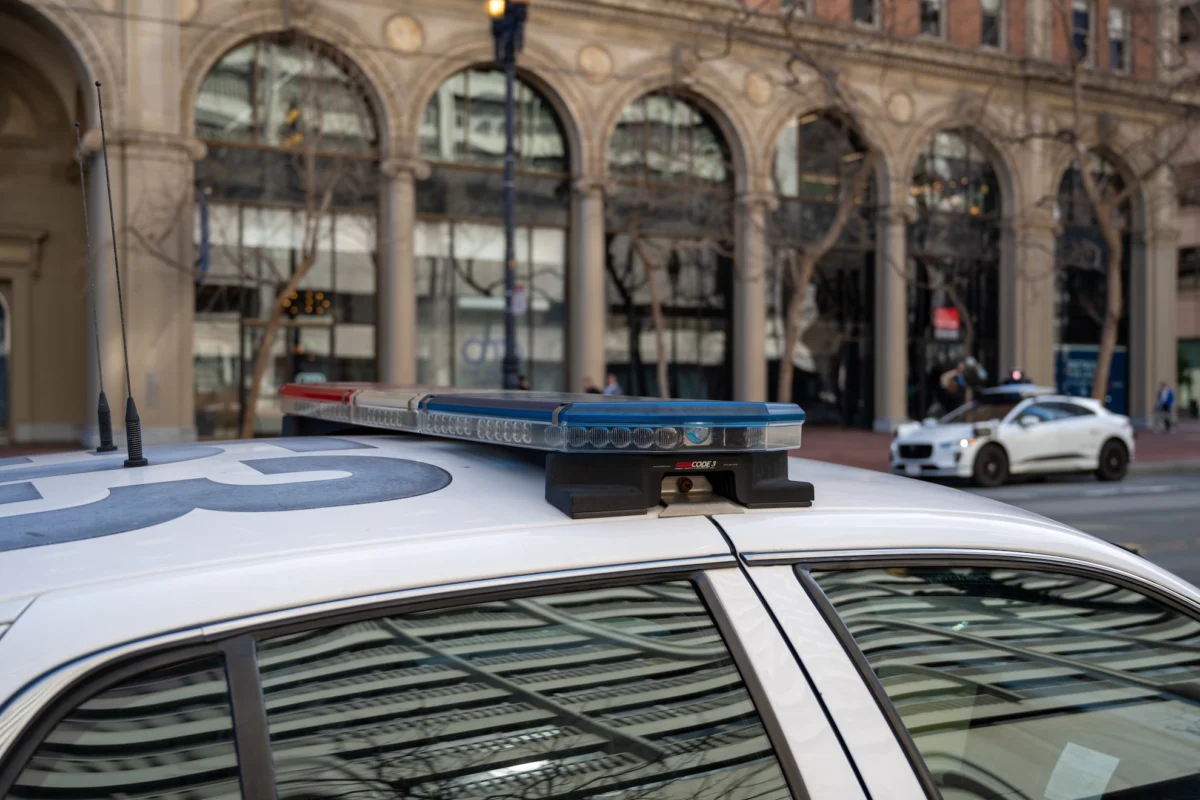
The heat from the August sun was eclipsed only by the intensity of the brush fire that tore through ten acres of dry grass along California’s Interstate 280 near Redwood City. As thick smoke billowed across the asphalt, the California Highway Patrol (CHP) scrambled to manage the ensuing chaos. Firefighters battled the blaze while officers initiated an emergency protocol, directing a long line of trapped motorists to perform U-turns and travel against the flow of traffic to reach the nearest exit. It was a high-stakes, manual intervention designed to clear the freeway for emergency equipment. Most drivers complied instantly. One, however, did not.
A Waymo robotaxi, navigating without a human behind the wheel, found itself at the center of the tactical retreat. According to footage of the incident, the autonomous vehicle (AV) initially attempted to bypass the gridlock by pulling onto the shoulder. When confronted with a line of cars suddenly traveling the "wrong way" under police direction, the machine’s logic reached a stalemate. It reversed tentatively, then ceased movement entirely, effectively anchoring itself in the path of the evacuation. Despite the efforts of Waymo’s remote assistance team—humans monitoring the fleet from hundreds or even thousands of miles away—the vehicle remained paralyzed.
The solution did not come from a software patch or a remote command. Instead, Waymo’s operations center did what any stranded motorist would do: they called 911. “Highway patrol turned everyone around, but unfortunately our car is not able to turn around,” a Waymo remote assistance worker told a local dispatcher, according to recordings of the call. The request was unprecedented yet becoming increasingly common: the company needed a taxpayer-funded police officer to physically enter the vehicle, take the wheel, and drive the robotaxi to safety.
This Redwood City episode is not a singular "edge case." It represents a growing friction point in the deployment of autonomous technology. As companies like Waymo—the Alphabet-owned frontrunner in the space—race to scale their services across major American metropolitan areas, a pattern of reliance on public first responders is emerging. While the promise of the robotaxi industry is built on the elimination of the human driver, the reality on the ground suggests that the "human in the loop" is frequently a police officer or a firefighter whose primary duty is public safety, not corporate fleet management.
The Architecture of Assistance
To understand why a multi-billion-dollar technology company requires police intervention, one must look at the layers of human support that underpin "driverless" operations. Waymo’s fleet is supported by three distinct tiers of human oversight. The first is the Remote Assistance (RA) team. Comprising approximately 70 individuals split between the United States and the Philippines, these workers provide high-level "advice" to the vehicles. When an AV encounters a scenario it does not recognize—such as a construction zone with ambiguous hand signals—it sends a request to an RA worker who suggests a path forward.
Waymo is careful to distinguish "advice" from "control." RA workers do not use joysticks to steer the cars; they provide a "path of intent" that the car then executes using its own sensors. However, this system has documented vulnerabilities. In early 2026, the National Transportation Safety Board (NTSB) investigated an incident in Austin, Texas, where a robotaxi approached a school bus with its stop arm extended and lights flashing. The AV queried the RA team, and a worker incorrectly signaled that the car could proceed. The Waymo drove past the bus while children were boarding—a move that would result in a heavy fine and license points for a human driver.
The second tier is the Event Response Team, a U.S.-based group trained to handle post-collision protocols and coordinate with emergency services. Finally, there is the Roadside Assistance team—the "boots on the ground" meant to physically retrieve stalled or damaged vehicles.

The problem, as highlighted by city officials in San Francisco and beyond, is the delta between the moment a car gets stuck and the moment the company’s own roadside assistance arrives. In the Redwood City fire, it took roughly 30 minutes for a CHP officer to move the car to a park-and-ride lot. During that half-hour, the vehicle was a physical obstruction in a disaster zone.
The "Default Roadside Assistance" Controversy
The tension reached a boiling point during a March hearing in San Francisco. City officials, weary of robotaxis stalling during power outages or obstructing fire trucks, voiced a sentiment that is beginning to resonate across the industry’s expansion markets. Mary Ellen Carroll, executive director of San Francisco’s Department of Emergency Management, stated bluntly that public safety officers were becoming the "default roadside assistance" for autonomous fleets.
This creates a significant policy dilemma. First responders are trained and funded to manage life-threatening emergencies, not to act as a free concierge service for private technology companies. When a police officer has to stop directing traffic at a fire or leave a crime scene to move a stalled robotaxi, the "cost" of that AV’s failure is externalized onto the public.
The stakes are not merely logistical; they are increasingly tied to critical emergency outcomes. In Austin, an officer recently had to manually move a Waymo that was blocking an ambulance attempting to reach the scene of a mass shooting. In Atlanta, a robotaxi drove into an active crime scene, forcing a first responder to disengage the vehicle manually. In Nashville, a police officer had to take the wheel of a Waymo that had "bricked" in the middle of a busy intersection on Broadway.
These incidents challenge the narrative of "Level 4" autonomy. If a vehicle requires a police officer to drive it during a routine emergency traffic diversion, is it truly autonomous? Or is it a sophisticated tool that operates only within a narrow band of "normalcy," failing precisely when the environment becomes most chaotic and the need for clear roads is highest?
Scaling Into the Unknown
Despite these challenges, Waymo is moving at breakneck speed. Backed by a $1.6 billion investment round, the company is preparing to launch in approximately 20 more cities this year. The expansion list includes major hubs like Miami, Seattle, and even international markets like London and Tokyo.
The rapid scaling raises questions about the sustainability of Waymo’s support infrastructure. The company has declined to disclose the size of its roadside assistance staff or the specifics of its contracts with third-party providers like Transdev. Furthermore, Waymo has floated the idea of using gig-economy partnerships—similar to its arrangement with DoorDash for closing open vehicle doors—to help move stalled cars. This suggests a shift toward a "distributed" human support model that may still lack the rapid-response capabilities of a centralized, professionalized recovery fleet.
Industry analysts point out that this is the "valley of death" for autonomous vehicle deployment. The technology is good enough to handle 99.9% of driving tasks, but the remaining 0.1% consists of high-variance, high-stakes scenarios like fires, floods, and crime scenes. Solving these "edge cases" through software alone may take years, if not decades. In the interim, companies must decide whether they will invest heavily in their own rapid-response teams or continue to lean on the existing infrastructure of the state.

Expert Analysis: The Regulatory Path Forward
From a regulatory perspective, the "officer-as-driver" phenomenon is likely to trigger a new wave of municipal oversight. Currently, many cities have limited power to regulate AVs, as authority often rests at the state level (such as with the California Public Utilities Commission). However, the drain on local resources is a powerful lever for city councils.
We may soon see "Impact Fees" or "Emergency Response Surcharges" levied against AV operators. If a company’s vehicle requires intervention from a city’s police or fire department, the company could be billed at a premium rate. Some urban planners have suggested that AV permits should be contingent on "Response Time Guarantees"—requiring a company-employed technician to be on-site within ten minutes of a vehicle stalling.
There is also the question of training. Waymo claims to have trained over 30,000 first responders on how to interact with its vehicles. While proactive, this also shifts the burden of education onto the public sector. Officers must now add "robotaxi recovery" to an already crowded curriculum of tactical training and legal education.
The Future of the Human-Machine Interface
As the industry matures, the goal is to move toward better Vehicle-to-Everything (V2X) communication. In a perfect future, a fire department’s command center could broadcast a "digital perimeter" that all robotaxis would automatically respect, rerouting themselves before they ever enter a restricted zone.
Until that infrastructure exists, the industry remains in a paradoxical state. To remove the human from the driver’s seat, we have created a global network of remote monitors, event responders, and local tow partners. And when all those layers of private-sector support fail to meet the urgency of a real-world crisis, the fallback remains the oldest "technology" in the book: a human being with a badge, a uniform, and the manual dexterity to grab a steering wheel and drive.
The Redwood City fire was extinguished, the smoke cleared, and the Waymo was eventually towed away. But the questions it left behind remain smoldering. As robotaxis become a permanent fixture of the urban landscape, the public must decide how much of its safety infrastructure it is willing to lend to the pursuit of an autonomous future. For now, the answer to "who is driving" isn’t just a computer—it’s the very people we call when everything goes wrong.
