

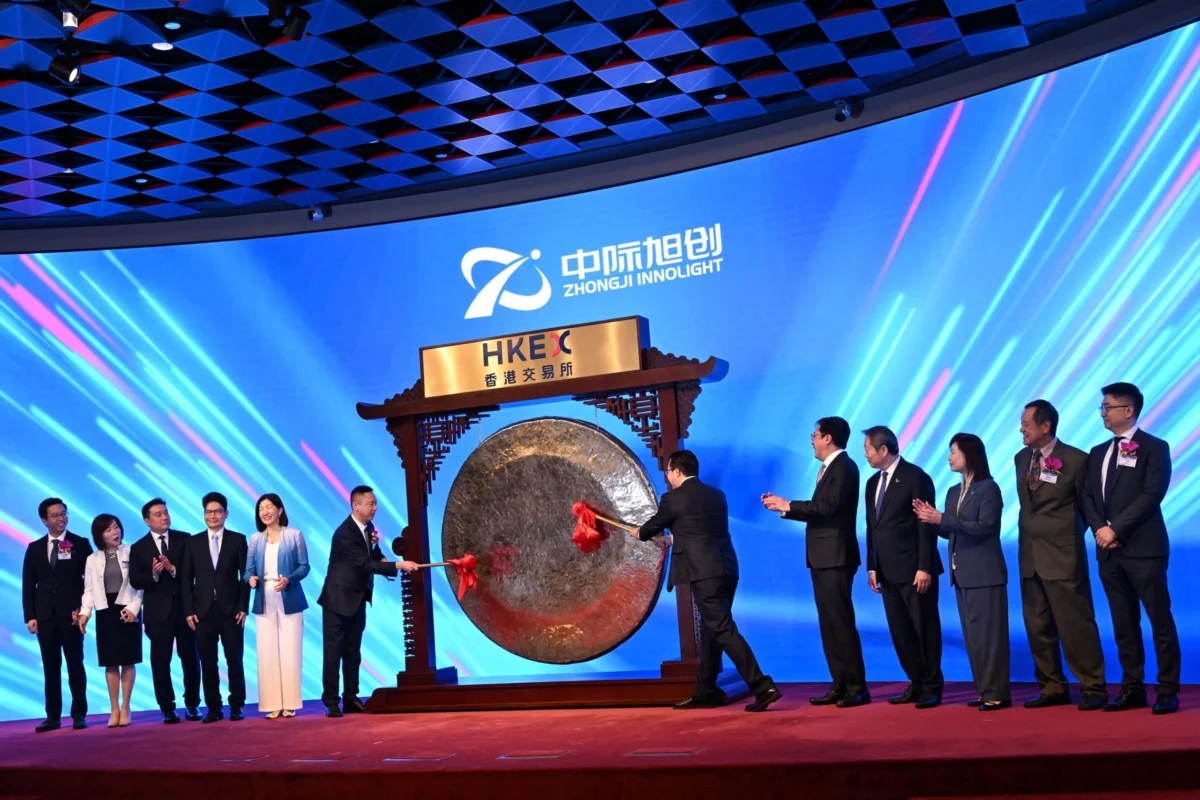
The festive atmosphere at the Hong Kong Exchanges and Clearing Limited (HKEX) on Thursday, July 30, 2026, stood in stark contrast to the sobering reality of the digital ticker tape. As Liu Sheng, Chairman and CEO of Zhongji Innolight, struck the ceremonial gong to mark the company’s secondary listing, the market’s response was immediate and unforgiving. Shares of the Chinese optical component powerhouse, a critical linchpin in the global artificial intelligence infrastructure, tumbled as much as 9.8% in early trading. While the stock eventually clawed back some territory to close approximately 4% lower at the end of its debut session, the volatility sent a clear signal: the unbridled euphoria that has defined the AI trade for the past three years is entering a period of intense scrutiny and structural recalibration.
The listing was by no means a small affair. Zhongji Innolight successfully raised HK$53.4 billion ($6.8 billion) earlier this month, pricing 54.5 million shares at a premium HK$980 each. It represents the largest share sale the Asian financial hub has witnessed in several years and stands as the second-largest listing in Asia for 2026, trailing only the $8.6 billion initial public offering of memory chipmaker CXMT. Yet, the timing of the debut placed the company directly in the path of a burgeoning "AI fatigue" among global institutional investors. Even as the company prepares to use its massive windfall for research and development and the expansion of global production facilities, its existing shares in Shenzhen mirrored the Hong Kong sentiment, plummeting over 9% on the same day.
The Essential Plumbing of the AI Revolution
To understand why Zhongji Innolight is considered a bellwether for the AI sector, one must look at the specific hardware it produces. The company is a global leader in the manufacturing of optical transceivers—small but sophisticated modules that convert electrical signals into optical signals and vice versa. In the world of high-performance computing (HPC) and large-scale data centers, these components are the "plumbing" that allows thousands of GPUs (Graphics Processing Units) to communicate with one another at near-instantaneous speeds.
As AI models like GPT-5 and its successors have grown exponentially in complexity, the traditional copper wiring used in data centers has hit a physical limit. Copper struggles with latency and energy loss over the distances required by massive server farms. Optical transceivers, utilizing fiber optics, provide the ultra-high bandwidth and low latency necessary for the synchronized "training" of neural networks. Without the 800G and emerging 1.6T (terabit) transceivers produced by firms like Zhongji Innolight, the rapid deployment of generative AI would effectively grind to a halt.
This critical role has fueled a meteoric rise for the company. In the first quarter of 2026 alone, Zhongji Innolight reported a staggering 190% year-on-year surge in revenue, reaching 19.5 billion yuan ($2.9 billion). Net profits followed an even more aggressive trajectory, jumping nearly 300% to 6.3 billion yuan. This financial performance catapulted Chairman Liu Sheng into the ranks of the world’s billionaires and established the firm as a darling for investors looking to play the "picks and shovels" side of the AI gold rush.
A Shift in Global Sentiment: From Growth to ROI
The lackluster Hong Kong debut, however, suggests that "picks and shovels" are no longer immune to the broader anxieties surrounding the AI "supercycle." For much of 2024 and 2025, the market operated on a "build it and they will come" mentality. Hyperscalers—including Microsoft, Google, and Meta—spent hundreds of billions of dollars on hardware, assuming that the eventual software monetization would justify the capital expenditure (CapEx).
By mid-2026, that narrative is being challenged. "AI hardware stocks are experiencing a correction that coincided precisely with Zhongji Innolight’s listing process," notes Kenny Ng, a Hong Kong-based securities strategist at Everbright Securities International. Ng points out that the fundamental question has shifted from "Can we build it?" to "How long can this level of growth be sustained?"
This skepticism was catalyzed by recent developments in the United States and South Korea. In July 2026, reports surfaced that Meta, the social media giant led by Mark Zuckerberg, was exploring the possibility of leasing out excess computing power from its own data centers. This move sent shockwaves through the supply chain, as it suggested that even the biggest spenders might have over-provisioned their hardware requirements. If Meta has "too much" compute, the logic goes, their future orders for optical transceivers and chips will inevitably slow down.
The "spillover effect" from the U.S. markets was compounded by disappointing news from South Korean memory giant SK Hynix. Despite the massive demand for High Bandwidth Memory (HBM), SK Hynix reported earnings that failed to meet the lofty, perhaps unrealistic, expectations of analysts. When even the most successful hardware providers begin to miss targets, investors start to fear that the peak of the cycle has passed.
The Geopolitical and Strategic Tightrope
Zhongji Innolight occupies a unique, albeit precarious, position in the global technology landscape. Despite being a Chinese entity, it derives nearly two-thirds of its revenue from the United States. Its client list includes the world’s most influential tech companies, most notably Google. This high level of integration into the U.S. tech ecosystem has been its greatest strength, allowing it to bypass some of the stagnation seen in purely domestic Chinese sectors.
However, this reliance on Western markets is a double-edged sword. As the U.S. continues to tighten export controls and "de-risk" its supply chains from Chinese dependencies, companies like Zhongji Innolight must navigate a complex geopolitical minefield. The proceeds from the Hong Kong IPO are earmarked for "global production expansion," a phrase that many analysts interpret as a plan to build manufacturing hubs in Southeast Asia, Mexico, or Europe to mitigate the risks of future trade disruptions.
The company’s ability to maintain its technological lead is also under pressure. The industry is currently transitioning from 800G modules to 1.6T modules, and the race to perfect Silicon Photonics—a technology that integrates laser and silicon chips—is heating up. While Zhongji Innolight has shown a formidable ability to scale, competitors in the U.S. and Japan are racing to develop proprietary interconnect technologies that could potentially reduce the reliance on external transceiver modules.
Analyzing the "Correction" vs. the "Crash"
It is important to distinguish between a market correction and a fundamental collapse of the AI thesis. The 4% drop in Zhongji Innolight’s debut is significant, but it must be viewed in the context of its previous 400% rally on the Shenzhen exchange. For many institutional players, the Hong Kong listing provided a much-needed liquidity event—a chance to take profits after years of vertical growth.
The current market volatility reflects a transition from the "Excitement Phase" to the "Execution Phase" of the AI revolution. In the Excitement Phase, every piece of news is viewed through a lens of infinite potential. In the Execution Phase, investors demand proof of utility. They want to see how AI-integrated services are driving enterprise efficiency and consumer spending.
For Zhongji Innolight, the path forward involves proving that the demand for bandwidth is structural rather than cyclical. Even if the initial build-out of AI "training" clusters slows down, the subsequent "inference" phase—where AI models are actually used by billions of people—will require a different, but equally massive, expansion of edge computing and data center interconnects.
Future Outlook: The Maturation of the AI Trade
As the dust settles on the company’s Hong Kong debut, the broader tech sector will be watching closely for signs of stabilization. The $6.8 billion raised provides Zhongji Innolight with a massive war chest to defend its market share and innovate through the next generation of optical networking.
However, the days of "easy gains" in AI hardware appear to be over. The market is becoming more discerning, rewarding companies not just for being part of the AI trend, but for their ability to navigate cyclical downturns and geopolitical shifts. The debut of Zhongji Innolight may well be remembered as the moment the AI trade grew up—a transition from a speculative frenzy to a more mature, albeit more volatile, industrial reality.
In the coming quarters, the focus will shift to the company’s ability to execute its global expansion strategy. If Zhongji Innolight can successfully diversify its manufacturing base and continue to secure Tier-1 contracts with U.S. hyperscalers, the current dip in share price may be viewed as a minor hiccup in a long-term growth story. But for now, the message from the Hong Kong floor is clear: the AI boom is no longer a rising tide that lifts all boats indiscriminately. From here on out, performance, profit margins, and proof of sustainable demand will be the only metrics that matter.
