

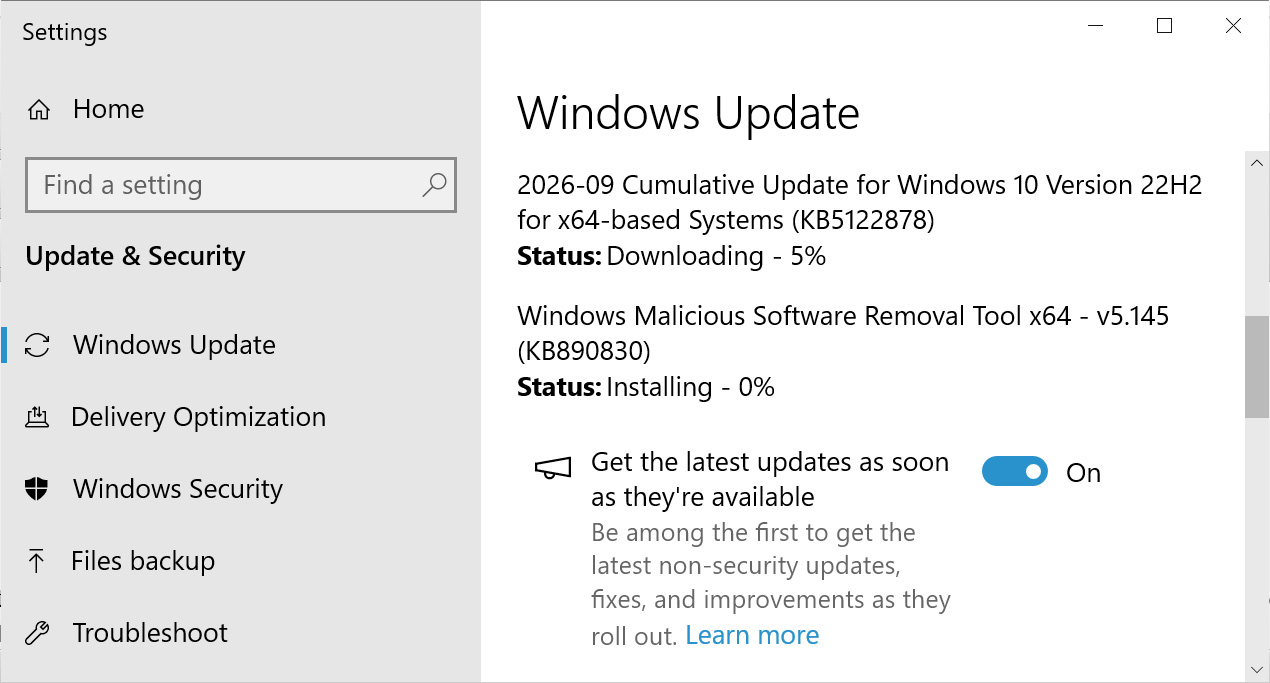
As the technology landscape marches deeper into the post-support era for legacy operating systems, Microsoft has formally initiated the distribution of update KB5122878. This critical extended security patch is tailored specifically for qualifying Windows 10 installations, arriving in lockstep with a monumental corporate patching cycle that has sent ripples through the enterprise security community. Far from bringing functional enhancements or user-facing interface modifications, this deployment serves as a vital structural reinforcement for organizations worldwide that continue to rely on Windows 10 while charting their eventual migration paths toward newer platform paradigms.
System administrators managing eligible environments—most notably Windows 10 Enterprise LTSC editions and organizations formally participating in the dedicated Extended Security Update (ESU) framework—can now acquire this package through standard administrative delivery channels. By navigating to the native update utility within the operating system’s control panels and executing a manual query for new software packages, system maintainers can pull down the latest binaries. Upon successful application of the software package, standard Windows 10 deployments will experience an internal version elevation to build 19045.7725, while localized iterations such as Windows 10 Enterprise LTSC 2021 will see their internal architecture advanced to build 19044.7725.
The arrival of this build comes at a remarkably complex juncture for global cybersecurity operations. The release package is explicitly bound to the broader software payloads distributed during the September 2026 Patch Tuesday initiative, a deployment event that has shattered historical records within the software industry. During this massive remediation cycle, developers and security engineers isolated and patched an astonishing 966 distinct vulnerabilities spanning the entirety of the corporation’s expansive software catalog. Among this unprecedented harvest of bugs were two actively exploited zero-day flaws—vulnerabilities that malicious actors were already weaponizing in the wild prior to the public availability of an official mitigation.
Because Windows 10 has officially graduated past its feature-development lifecycle, packages such as KB5122878 are strictly restricted to core defensive hardening, stability improvements, and critical vulnerability mitigation. The absence of feature updates highlights a strategic pivot by Microsoft: guiding global enterprise fleets toward total obsolescence of the platform while providing temporary, paid, or specialized lifelines for organizations unable to execute immediate hardware or software transitions. This dynamic highlights the delicate tightrope walk enterprise IT departments must perform as they balance prohibitive upgrade expenditures against mounting operational risk.
To fully understand the weight of this deployment, one must examine the broader macro-trends currently governing corporate IT infrastructure. Millions of desktop computers and enterprise workstations remain anchored to Windows 10 due to legacy software dependencies, proprietary custom-built applications, or hardware compatibility hurdles associated with strict firmware requirements enforced by modern operating systems. When Microsoft officially halts mainstream support for a dominant operating system, the burden of protection shifts heavily onto extended support subscriptions, third-party endpoint protection solutions, and rigorous internal patch management protocols.
The sheer volume of vulnerabilities resolved in the concurrent patching cycle—nearing one thousand distinct issues—illustrates the escalating complexity of modern software ecosystems. Every line of code, legacy protocol, and integrated subsystem represents a potential vector for compromise. For organizations still operating within the extended support umbrella, packages like KB5122878 are not merely routine maintenance tasks; they are mission-critical shields preventing systemic enterprise compromise. Failing to apply these mitigations leaves corporate networks acutely vulnerable to automated exploit frameworks that rapidly reverse-engineer security bulletins the moment they are made public.
From an analytical perspective, the release of this security package underscores a growing industry-wide challenge regarding credential misuse and initial access persistence. Contemporary threat intelligence reveals that malicious actors are increasingly shifting their tactics away from complex zero-day exploitation and toward credential harvesting, social engineering, and the abuse of legitimate administrative tools. Once an adversary successfully acquires valid user credentials, perimeter defenses and standard prevention tools frequently experience a dramatic drop in efficacy. Reports analyzing simulated enterprise environments demonstrate that a staggering majority of post-compromise attacker actions slip past standard automated defenses when valid credentials serve as the entry point.
This reality fundamentally transforms how security architects must view updates like KB5122878. While patching underlying operating system flaws remains an indispensable foundational requirement—the bedrock upon which all other security controls are built—it represents only a fraction of a holistic defense-in-depth strategy. Securing an aging operating system requires a multi-layered approach that integrates continuous behavioral monitoring, robust identity and access management (IAM), multi-factor authentication (MFA) enforcement, and strict network segmentation. If an enterprise relies solely on operating system patches while neglecting identity hygiene, attackers can easily bypass localized system hardening by walking right through the front door using stolen credentials.
Furthermore, the lifecycle management of Windows 10 serves as a critical case study for the future of enterprise software. As operating systems age, the cost of maintaining backward compatibility while simultaneously engineering defenses against evolving adversarial techniques grows exponentially. For Microsoft, supporting legacy platforms through paid extension programs acts as a bridge, giving sluggish corporate buyers the time they need to overhaul complex infrastructure without exposing themselves to catastrophic breaches. However, this bridge is deliberately temporary. The ultimate trajectory of the industry points firmly toward aggressive cloud integration, automated lifecycle management, and hardware-enforced virtualization security that renders legacy architectures fundamentally obsolete.
Looking ahead, enterprise technology leaders must use deployment events like this latest update as catalysts for long-term strategic planning. Relying indefinitely on extended security updates is an expensive and ultimately unsustainable proposition. Organizations must leverage the breathing room provided by these patches to aggressively audit their software inventory, containerize legacy applications, and accelerate hardware refresh cycles. The goal must be to transition away from legacy environments entirely before the mounting frequency of zero-day exploits and software vulnerabilities outpaces the protective capacity of extended support models.
In conclusion, the deployment of Windows 10 update KB5122878 is far more than a routine monthly chore for system administrators. It is a vital intervention operating against the backdrop of a historic vulnerability landscape, providing a necessary defensive barrier for millions of enterprise devices worldwide. As the digital threat matrix continues to accelerate in sophistication and scale, the intersection of rigorous patch management, advanced identity governance, and proactive architectural modernization will remain the definitive battleground for enterprise security professionals safeguarding the remainder of the Windows 10 ecosystem.
