

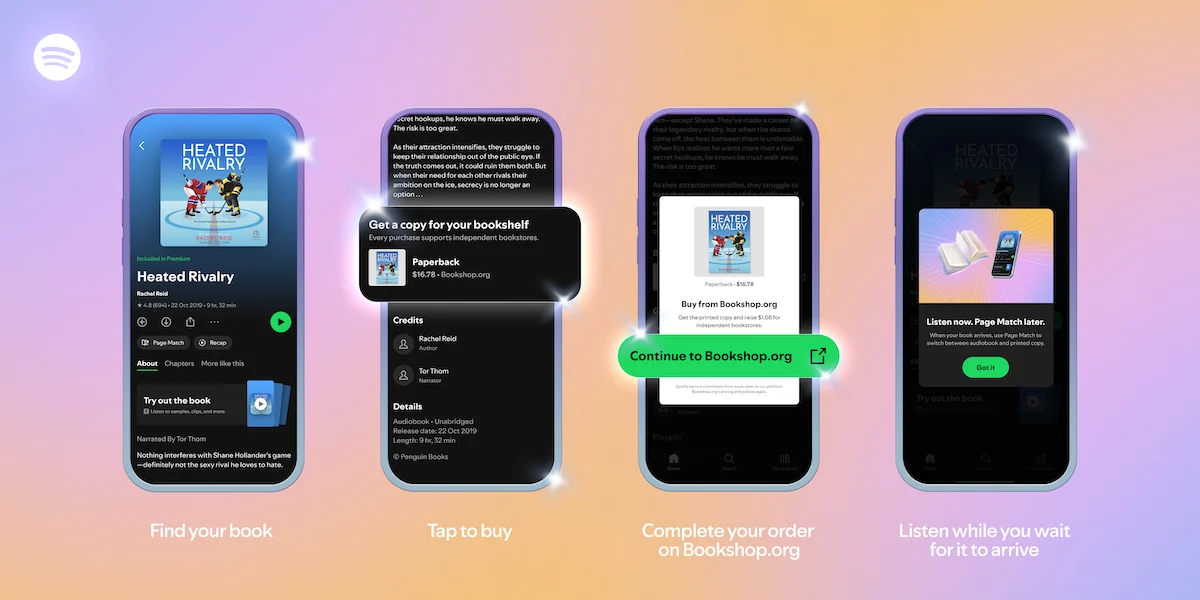
The boundary between digital consumption and physical ownership is blurring as Spotify, the world’s largest audio streaming platform, officially transitions into a tangible goods retailer. In a move that signals a significant evolution of its business model, Spotify has launched a new feature in the United States and the United Kingdom that allows users to purchase physical books directly through its mobile application. This initiative, which began as a pilot concept earlier this year, represents a strategic partnership with Bookshop.org, an online marketplace designed to bolster the sales of independent, local bookstores. By integrating a "Get a copy for your bookshelf" button on its audiobook pages, Spotify is effectively positioning itself as a direct intermediary between the ephemeral world of streaming and the enduring world of print.
This expansion is currently live for Android users, with an iOS rollout scheduled for the coming week. The logistics of the operation—including pricing, inventory management, and fulfillment—are handled by Bookshop.org, allowing Spotify to leverage its massive user base of 751 million monthly active listeners without having to manage the complexities of a physical supply chain. While the move may seem counterintuitive for a tech giant built on the premise of digital convenience, it reflects a sophisticated understanding of modern consumer behavior: the "hybrid reader" who oscillates between the convenience of an audiobook during a commute and the tactile satisfaction of a physical book on a nightstand.
The Strategic Pivot Toward Physical Retail
For over a decade, Spotify’s primary mission was to move the world away from physical media, replacing CDs and MP3 downloads with a cloud-based subscription model. However, as the streaming market reaches a state of saturation in Western territories, the company has pivoted toward a strategy of aggressive diversification and profitability. Audiobooks, which were integrated into the premium subscription model last year, have become a cornerstone of this new direction.
The partnership with Bookshop.org is a masterstroke in brand positioning. By aligning with a platform that supports independent retailers, Spotify avoids the "big tech" stigma often associated with Amazon’s dominance through Audible and Kindle. It allows Spotify to present itself as a champion of literary culture while simultaneously encroaching on Amazon’s territory. This "omnichannel" approach—offering the same content in multiple formats—is designed to maximize the lifetime value of a user. If a listener discovers a life-changing memoir via a Spotify audiobook, the platform now provides an immediate friction-free path to owning that book in a physical format, capturing a segment of the transaction that previously would have migrated to a competitor.
Technical Innovations: Page Match and the Hybrid Experience
Beyond the simple addition of a "buy" button, Spotify is deploying advanced technological tools to synchronize the physical and digital reading experiences. One of the most notable features is the expansion of "Page Match." This tool utilizes smartphone camera technology and optical character recognition (OCR) to allow users to scan a page of a physical book. The app then analyzes the text and instantly identifies the corresponding moment in the audiobook version.
The data behind Page Match suggests a profound shift in how users engage with long-form content. Spotify reports that users who utilize Page Match stream an average of 55% more audiobook hours per week than those who do not. This indicates that rather than one format replacing the other, the two formats act as "force multipliers." Furthermore, the company found that 62% of titles engaged through Page Match were books the user had never previously streamed, suggesting that the tool is a powerful driver for discovery. By expanding this feature to support 30 additional languages—including German, Swedish, and French—Spotify is preparing for a global rollout that transcends English-speaking markets.
Enhancing Retention Through AI-Driven Recaps
In the attention economy, the greatest hurdle for audiobooks is "listener drop-off." Unlike a three-minute song or a 40-minute podcast, a 15-hour audiobook requires a sustained commitment. To combat this, Spotify has introduced "Audiobook Recaps" on Android devices. This feature uses generative technology to provide short audio summaries of previous chapters, tailored specifically to where the listener last stopped.
This addresses a common pain point: the frustration of returning to a book after a week-long hiatus and forgetting the nuances of the plot or the names of secondary characters. By lowering the cognitive barrier to re-entry, Spotify is effectively reducing churn within its audiobook vertical. This focus on "jump-back-in" usability is a direct application of the user-retention strategies Spotify perfected with its music playlists and podcast recommendations.
The Profitability Puzzle and Market Dynamics
The launch of physical book sales comes at a pivotal moment for Spotify’s finances. The company has been under intense pressure from investors to transition from a high-growth "cash burner" to a consistently profitable enterprise. This pressure has manifested in several ways, including multiple rounds of subscription price increases across the U.S. and Europe.
The move into physical books and enhanced audiobook features serves two financial purposes. First, it diversifies revenue streams. While Spotify may only take a small commission on physical sales through Bookshop.org, these are high-margin transactions that require zero infrastructure investment from Spotify itself. Second, it justifies the increased subscription costs. By transforming the app into a "super-app" for culture—where one can listen to music, watch video podcasts, stream audiobooks, and buy physical merchandise—Spotify makes its monthly fee feel more indispensable to the consumer.
The international expansion of "Audiobook Charts" into Germany further illustrates this data-driven approach to market domination. By mirroring the success of its music charts, Spotify is creating a feedback loop of popularity. When a book trends on the Spotify charts, it drives more streams, which now drives more physical sales, creating a self-sustaining ecosystem of consumption.
Industry Implications and the Future of Publishing
The entry of Spotify into the physical book market sends a clear signal to the publishing industry: the era of the "siloed" book is over. Publishers are increasingly looking for ways to integrate audio, digital, and print into a single marketing lifecycle. Spotify’s platform offers a level of granular data that traditional bookstores and even Amazon are often hesitant to share. Spotify knows exactly when a listener pauses a book, which chapters they replay, and now, which audiobooks inspire them to buy a physical copy.
This data could eventually influence how books are written, marketed, and sold. If data shows that listeners in the UK are scanning Page Match for a specific genre of thriller at a high rate, publishers may shift their physical distribution strategies to match those digital trends.
However, this move is not without its risks. By expanding into so many different verticals—music, podcasts, audiobooks, physical retail, and live events—Spotify risks "feature creep." The once-simple interface that users loved for its minimalism is becoming increasingly crowded. The challenge for Spotify will be maintaining a seamless user experience while acting as a gateway to a massive catalog of physical and digital goods.
A New Chapter for the Streaming Giant
As Spotify rolls out these features to iOS users and continues its global expansion, the tech industry will be watching closely to see if the "Spotify Effect" can revitalize the physical book market in the same way it transformed the music industry. The partnership with Bookshop.org is a savvy tactical move that balances corporate ambition with a community-focused narrative.
Ultimately, Spotify is betting that the future of media is not purely digital, but "phygital"—a world where our digital discoveries lead to physical artifacts. By allowing users to build a physical library through a digital app, Spotify is attempting to capture the entirety of the intellectual life of its 751 million users. Whether this will lead to the long-sought-after goal of sustained profitability remains to be seen, but one thing is certain: Spotify is no longer just an app for your ears; it is an app for your bookshelf.
