


The decentralized finance landscape faces constant scrutiny regarding its underlying structural integrity, a reality painfully underscored by a dramatic security incident on the Cronos blockchain. Operations across the decentralized network have officially normalized following a high-stakes, rapid-fire price-manipulation campaign targeting Tectonic, a premier decentralized lending and borrowing platform operating within the ecosystem. The incident, which unfolded over a compressed window of just twenty minutes, exploited economic loopholes to inflate asset valuations artificially, triggering emergency validator interventions, sweeping transactional freezes, and a consequential network rollback to safeguard ecosystem participants.
At the heart of the security breach was an aggressive attack vector known colloquially as an oracle or price-manipulation exploit. Threat actors targeted Tectonic’s native governance and utility asset, the TONIC token, driving its market valuation upward by a staggering one-hundredfold within minutes. By manipulating the price feed and liquidity metrics of the token, the malicious actors successfully positioned the artificially inflated asset as high-value collateral within the lending protocol. Leveraging this distorted collateralization ratio, the exploiters initiated massive borrowing operations, successfully extracting a notional total of $74 million in underlying digital assets from the liquidity pools.
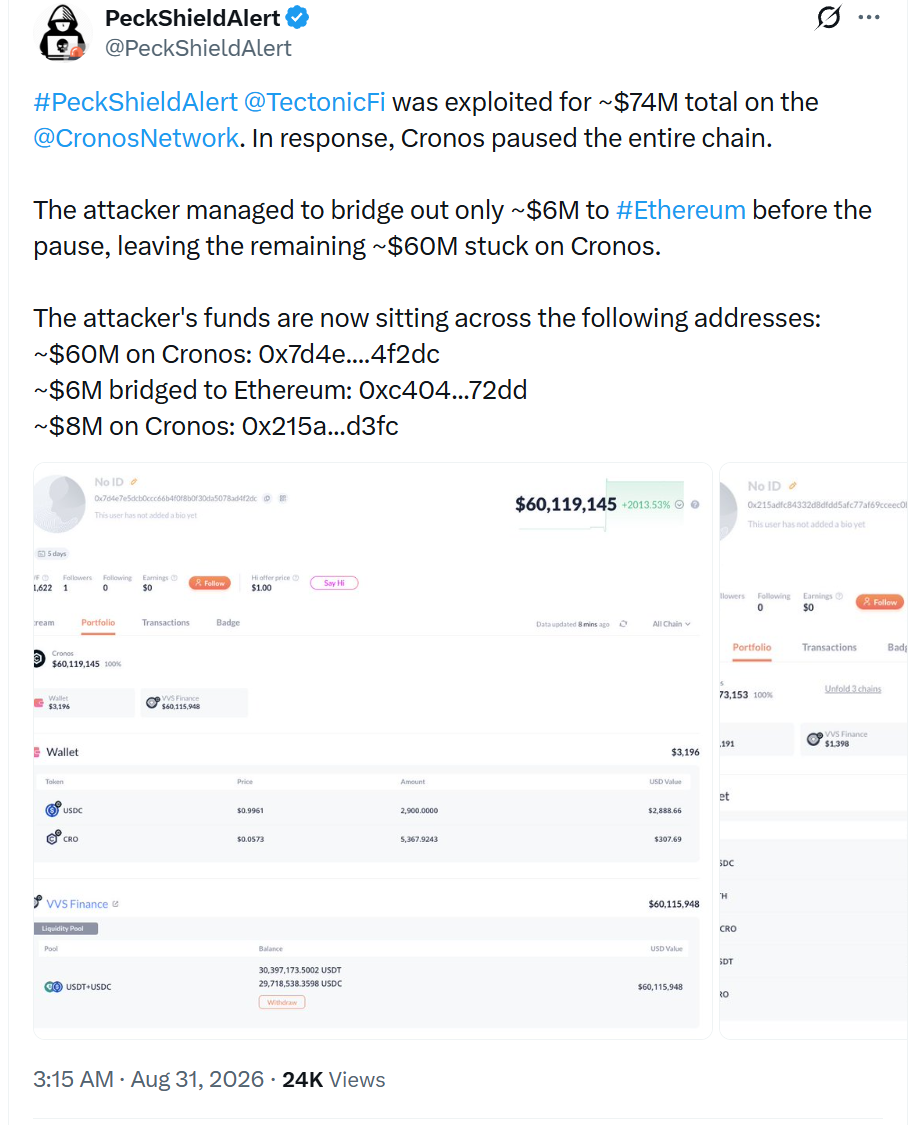
However, the rapid and decisive technical response executed by network participants and security analysts significantly limited the final financial impact. According to insights published by prominent blockchain security and data analytics firm PeckShield, the overwhelming majority of the drained funds ultimately remained trapped within the Cronos network architecture due to subsequent emergency measures. The threat actor successfully laundered and moved approximately $6 million worth of Ethereum off the chain, but the bulk of the exploited capital stayed stranded, unable to be bridged or extracted before validators pulled the emergency brake.

To fully comprehend the gravity of the event, one must examine the operational positioning of the protocols involved. Cronos serves as an Ethereum Virtual Machine (EVM)-compatible blockchain network closely aligned with the broader infrastructure of Crypto.com, designed to foster interoperability and high-speed execution for decentralized applications. Tectonic occupied a dominant position within this ecosystem, functioning as the premier lending protocol on Cronos. Before the security incident, Tectonic boasted an impressive Total Value Locked (TVL) of approximately $122 million, serving as a foundational pillar for decentralized liquidity, yield generation, and collateralized debt positions on the network.
The immediate aftermath of the exploit drastically reshaped this metric. According to data tracked by DeFiLlama, Tectonic’s TVL plummeted precipitously in the wake of the incident, falling to just under $3 million as panicked depositors scrambled to withdraw remaining funds and protocol liquidity dried up entirely. The severe contraction highlights the fragile nature of user confidence in decentralized finance, where systemic shocks can trigger catastrophic liquidity outflows in a matter of hours.
The sequence of events leading to the network’s stabilization showcases the complex governance and emergency response mechanisms inherent in modern proof-of-authority or delegated proof-of-stake blockchain architectures. As soon as anomalous transactional behavior and abnormal borrowing volumes were detected, Tectonic’s core development team mobilized. The platform issued an urgent advisory warning users via social channels and developer dashboards, explicitly commanding the community to cease all interactions with the protocol and to avoid modifying existing positions until a formal security all-clear could be established.
Simultaneously, the Cronos network operators and validator nodes executed a coordinated emergency response. Recognizing the existential threat posed to user assets and the integrity of the ledger, validators made the contentious yet necessary decision to halt the Cronos blockchain entirely. This drastic step froze all pending and in-flight transactions, effectively trapping the exploiter’s remaining ill-gotten gains within the network’s state machine and preventing further capital flight.
Following intensive diagnostics, synchronization checks, and coordination among network validators, Cronos officially brought the network back online. In a public statement detailing the recovery, network administrators clarified that the restart was achieved through a consensus-driven validator emergency action designed explicitly for user protection. Rather than allowing the exploited state to persist, the engineering teams orchestrated a network rollback, restoring the blockchain state to precisely where it stood prior to the early morning exploit window.
According to official network notices, the Cronos blockchain successfully resumed block production starting at block height 90,896,189. System operators confirmed that the ledger is producing blocks normally and that the network is fully operational. Nevertheless, engineering teams, security auditors, and validator nodes continue to maintain an aggressive, round-the-clock monitoring posture, scrutinizing transactional throughput, cross-chain bridge compatibility, and node synchronization stability to ensure no residual vulnerabilities persist. Furthermore, core developers have committed to releasing a comprehensive post-mortem report outlining the exact technical vectors exploited within the Tectonic codebase and detailing future hardening measures for the network.
This incident serves as a critical case study regarding the persistent structural vulnerabilities plaguing decentralized finance protocols, particularly concerning decentralized lending architectures and oracle dependencies. Lending applications rely heavily on accurate, real-time price feeds to determine borrowing capacities and liquidation thresholds. When an attacker manages to temporarily distort the liquidity or market pricing of a low-cap collateral asset, the automated logic of lending smart contracts frequently fails to distinguish between organic market appreciation and malicious manipulation.
The Cronos and Tectonic episode also shines a harsh spotlight on the ongoing debate surrounding blockchain immutability versus pragmatic emergency intervention. In traditional software engineering, rolling back a database or freezing a server cluster to mitigate a cyberattack is a standard administrative procedure. In the decentralized web, however, halting a blockchain and reverting state requires overwhelming consensus among independent validators, a process that inherently tests the decentralized ethos of a network. While purists often argue that halting a chain undermines the core principle of censorship resistance, events of this magnitude frequently leave stakeholders with few viable alternatives to prevent catastrophic financial collapse.
Looking ahead, the fallout from the Tectonic exploit is expected to accelerate regulatory scrutiny and internal risk management reforms across the broader decentralized finance ecosystem. Institutional participants and retail investors alike are increasingly prioritizing rigorous smart contract audits, decentralized time-weighted average price (TWAP) oracles, and dynamic circuit breakers capable of automatically pausing borrowing functions during abnormal volatility spikes. Protocols that fail to implement multi-layered defensive engineering will likely find themselves increasingly ostracized by risk-averse liquidity providers and bridge operators.
As the Cronos ecosystem works to rebuild confidence and restore liquidity to its premier lending markets, the episode reinforces both the resilience of cooperative validator networks and the persistent fragility of composable smart contract applications. The swift containment and successful network restoration prevented a $74 million disaster from becoming an unmitigated catastrophe, yet the steep drop in Total Value Locked demonstrates that regaining user trust is a far more arduous challenge than restarting a blockchain.
