


The modern smart home relies heavily on a delicate, invisible boundary: the residential gateway. Acting as the vanguard between the chaotic expanse of the public internet and the sensitive ecosystem of local connected appliances, the home router uses Network Address Translation (NAT) and stateful firewalls to shield internal servers, security cameras, and storage systems. However, a severe, unpatched security vulnerability discovered in widely deployed high-performance consumer hardware threatens to obliterate this digital perimeter. This oversight leaves hundreds of thousands of residential environments vulnerable to arbitrary, unauthenticated manipulation by external actors.
Tracked formally as CVE-2026-75501, the critical defect resides within specific firmware iterations running on high-end gateway architecture utilized extensively by major telecommunications and broadband service providers across North America. The flaw centers around a fundamental access-control failure in how the device handles Universal Plug and Play (UPnP) control messaging. Without immediate mitigation, malicious entities operating anywhere on the global internet can effortlessly punch permanent holes through targeted residential firewalls, turning private domestic networks inside out and exposing deeply personal infrastructure to widespread cyber threats.
The vulnerability was independently unearthed and documented by independent security researcher Brian Khan Quintana. Following standard responsible disclosure timelines, Quintana initiated contact with the hardware manufacturer on June 7, seeking to establish a secure dialogue to remediate the exposure before public awareness grew. Regrettably, those initial outreach efforts, along with subsequent follow-up communications, were met with radio silence from the vendor. Faced with an unresponsive manufacturer and a ticking clock regarding consumer safety, Quintana escalated the findings to the Carnegie Mellon University Software Engineering Institute’s CERT Coordination Center (CERT/CC).
When continued coordinated attempts by CERT/CC failed to elicit a substantive response or a timeline for an emergency firmware patch, a public advisory became unavoidable. The disclosure laid bare the precise technical mechanics of the weakness, offering insight into an architectural oversight that compromises sophisticated next-generation networking hardware.

The focal point of the security breakdown is the Calix GS7 XGS hardware line, structurally cataloged as the GS5239XG and marketed commercially as the GigaSpire 7u10txg. Representing the bleeding edge of consumer-grade telecommunications hardware, these advanced gateway devices combine blazing-fast Wi-Fi 7 wireless capabilities with an integrated XGS-PON fiber-optic network terminal. Because major telecommunications brands—including prominent entities such as Cox Communications, Brightspeed, ALLO, CityFibre, and Conexon—deploy these premium gateways to deliver multi-gigabit fiber services to residential and small-business subscribers, the deployment footprint of the affected hardware is substantial.
The root cause of CVE-2026-75501 stems from improper network service binding within the device’s internal software stack. Specifically, affected units running firmware version EXOS/6.6.47 inadvertently expose the MiniUPnPd control endpoint directly onto the public WAN interface via TCP port 5000. Under normal operating conditions, UPnP services are designed strictly for local network consumption, allowing trusted devices within the household—such as video game consoles or media servers—to dynamically request port mappings so external connections can reach them without manual configuration.
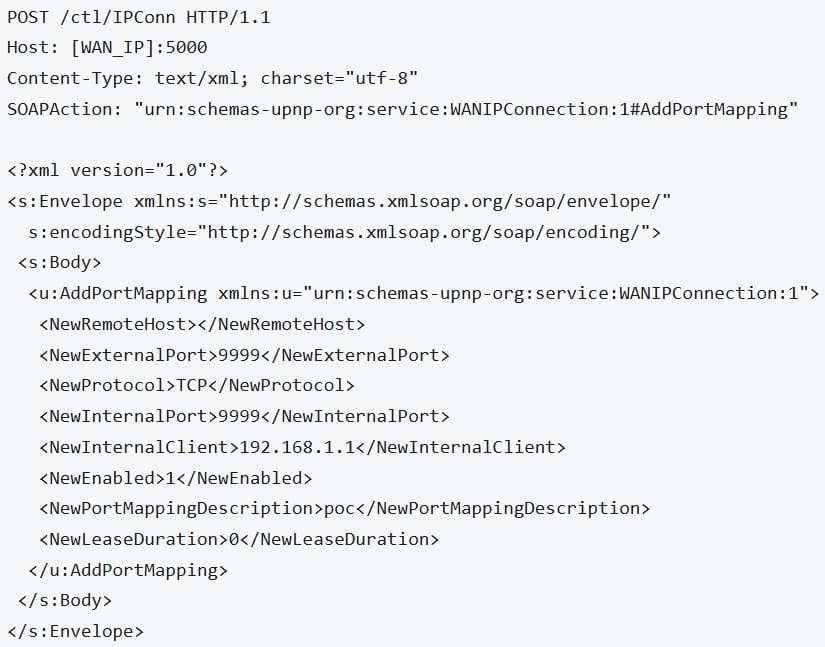
By erroneously binding the UPnP WANIPConnection Simple Object Access Protocol (SOAP) service to the public-facing side of the router rather than restricting it to the local bridge interfaces, the firmware creates a catastrophic architectural loophole. CERT/CC explicitly warned in its technical advisory that this configuration error strips away all localized boundaries, permitting any unauthenticated entity on the public web to transmit arbitrary SOAP commands directly to the router’s external IP address.
Through these unauthenticated requests, an external malicious actor can systematically add, delete, or enumerate port mappings, as well as query external routing parameters. The real-world implications of this capability are profound. An attacker can instruct the targeted residential gateway to forward incoming traffic from any chosen public port directly to an internal IP address within the home network. This effectively weaponizes the router’s own built-in port-forwarding engine against the homeowner, reducing stateful firewall protections to a nullity.
The mechanics of the attack surface are frighteningly trivial to execute. According to technical documentation published by Quintana, a single unauthenticated request originating from anywhere on the planet is all it takes to carve a permanent passage through the firewall perimeter straight into the heart of a domestic local area network. The process requires no administrative password, triggers no graphical confirmation prompt, and displays no warning indicators on connected client screens. Compounding the severity of the flaw, malicious port-mapping rules established via this attack vector exhibit persistence, surviving even a hard power cycle or a complete reboot of the gateway hardware.

Security analysts emphasize that this vulnerability places a diverse array of sensitive internal hardware directly in the crosshairs. Once a remote attacker successfully establishes an unauthorized port mapping, devices that were previously safe behind the NAT boundary—such as interior security cameras, Network-Attached Storage (NAS) units containing private family archives, legacy Internet of Things (IoT) sensors, and administrative web management portals—become accessible from the open internet. If any of these internal endpoints suffer from weak default credentials, unpatched local software flaws, or missing authentication barriers, the intruder can transition rapidly from a network-layer breach to full-scale internal compromise, potentially pivoting to steal data, deploy ransomware, or conscript home devices into a sprawling malicious botnet.
Laboratory testing conducted by the discoverer confirmed the worst fears of defensive engineers. By scripting basic HTTP/SOAP payloads outside his localized home network environment, Quintana successfully forced his test gateway to generate functional, persistent port mappings pointing toward private internal assets. Because the resulting rules lacked any native expiration parameters, the pathways remained stubbornly active and open to external traffic even after the physical router underwent a complete power-cycled reboot sequence.
Because Calix has yet to issue a verified firmware update or an emergency security patch to remediate CVE-2026-75501 as of the time of public disclosure, affected subscribers are left in a precarious defensive posture. The absence of an official vendor-supplied software fix places the burden of protection squarely on the shoulders of end users and regional broadband providers.
To mitigate the catastrophic exposure risks associated with this vulnerability, security experts strongly advise owners of the affected Calix GigaSpire gateway models to manually disable UPnP functionality. This protective measure can typically be accomplished by logging into the local administrative management interface of the router, navigating through the menu hierarchy via Advanced, then Security, and finally locating and deactivating the UPnP toggle switch.
Disabling UPnP successfully closes TCP port 5000 on the WAN interface, cutting off the unauthenticated SOAP attack vector and restoring the integrity of the firewall perimeter. However, network administrators and consumers must weigh the operational trade-offs of this workaround. Turning off UPnP means that trusted household applications—such as peer-to-peer software, multiplayer video games, and certain media streaming utilities—will no longer be able to automatically open incoming communication channels. For applications requiring inbound access, users will be forced to configure specific port-forwarding rules manually using secure, authenticated administrative procedures.
Furthermore, CERT/CC has highlighted a significant administrative hurdle: in certain customized deployments managed strictly by upstream telecommunications providers, end-user access to advanced router settings may be restricted or locked entirely behind operator-managed provisioning profiles. Subscribers who discover they lack the interface permissions required to toggle UPnP off independently must immediately contact their internet service provider’s technical support desk to formally request the manual deactivation of the service on their assigned gateway.
As the cybersecurity community awaits an official response, software patch, or firmware remediation from Calix, this incident serves as a stark reminder of the fragile nature of modern consumer IoT architecture. The rush to deploy high-speed fiber hardware and advanced wireless standards like Wi-Fi 7 often outpaces rigorous secure-by-design engineering practices. Until device manufacturers universally implement robust input validation, strict interface binding controls, and rapid-response patching pipelines, the invisible walls protecting modern digital homes will remain dangerously susceptible to remote, unauthenticated subversion.
