


The evolving landscape of cybercrime has increasingly favored a sophisticated strategy known as "Living off Cloud" and "Living off Trusted Sites," where threat actors bypass traditional security barriers by co-opting legitimate administrative utilities. A striking illustration of this paradigm shift emerged recently when security researchers uncovered an ongoing campaign leveraging the legitimate Faronics Deploy endpoint-management platform to establish deep administrative persistence inside enterprise networks, culminating in the unauthorized installation of ConnectWise ScreenConnect.
The multi-stage intrusion campaign, meticulously mapped out between July 21 and August 20, highlights a troubling reliance on trusted software ecosystems. During this observation window, automated telemetry flagged more than 457 unique endpoints targeted by tailored, Faronics-themed social engineering lures. These malicious communications were deliberately crafted to mimic routine corporate interactions, arriving in corporate inboxes disguised as critical financial invoices, tax compliance documents, or essential workflow updates designed to provoke immediate action from unsuspecting staff members.
To fully understand the severity of this methodology, one must examine the nature of the tool being weaponized. Faronics Deploy is a heavily utilized, cloud-hosted endpoint management solution designed to streamline the duties of over-extended IT departments. It grants administrators the capacity to remotely enroll systems, govern network policies, distribute complex software packages, and execute arbitrary scripts across dispersed fleets of computers from a centralized dashboard. By weaponizing this robust infrastructure, malicious operators effectively short-circuit traditional endpoint detection and response (EDR) rules that are typically fine-tuned to block unsigned, foreign binaries or unknown command-and-control frameworks.
Analysts specializing in managed detection and response at Huntress spearheaded the investigation into this campaign, mapping out the precise mechanics of the attacker’s attack chain. According to their technical telemetry, the malicious journey begins when a user interacts with an embedded hyperlink inside a phishing email. This link directs the browser to a sophisticated staging website engineered to profile the incoming visitor. If the hosting environment indicates an automated sandbox, a virtual machine, or an active security researcher analysis tool, the site instantly pivots into a benign posture, displaying a harmless error message or redirecting to generic content to evade detection.

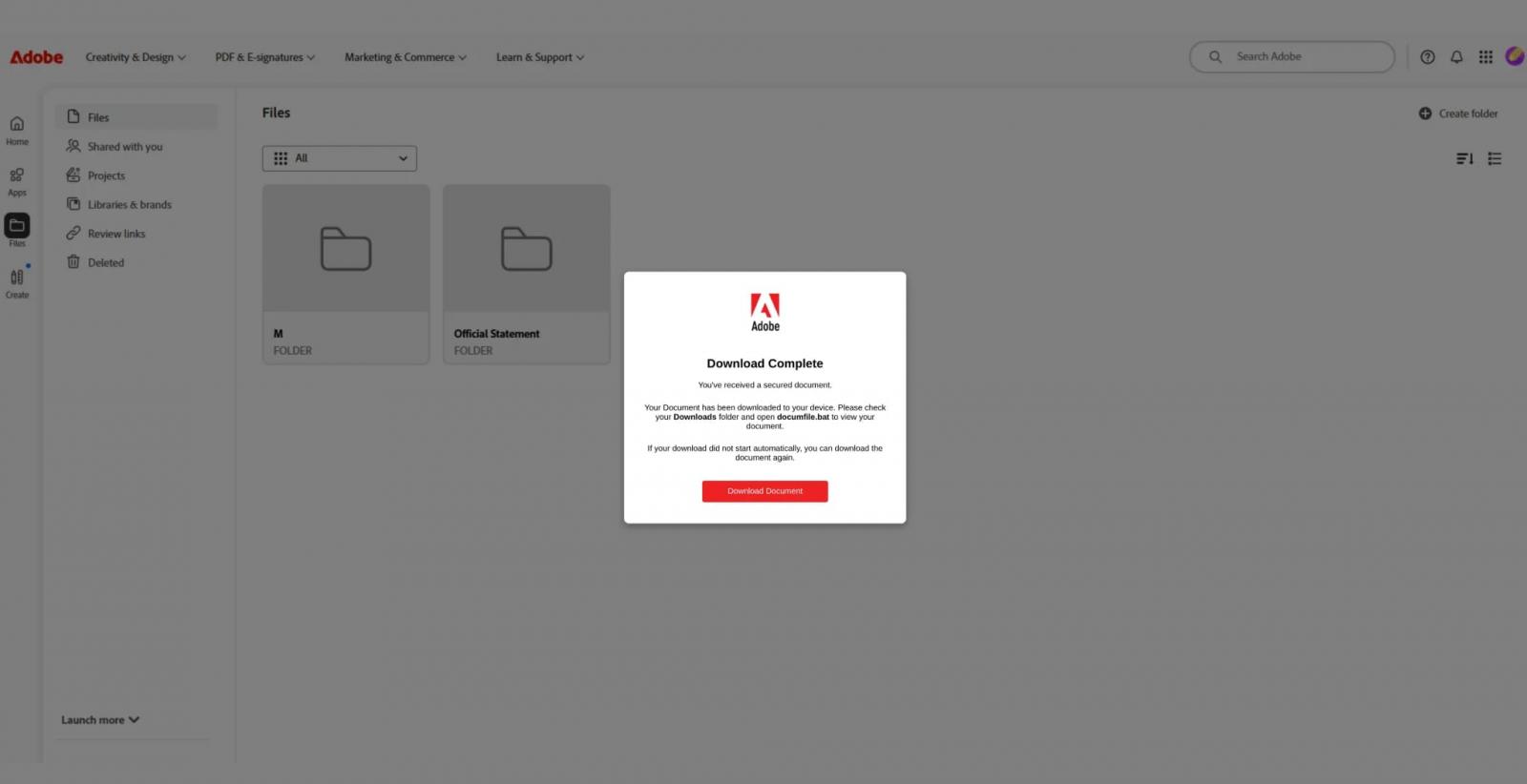
However, if the incoming connection originates from a genuine corporate workstation, the web portal guides the potential target through an elaborate, highly convincing download funnel. Victims are prompted to download what is ostensibly an Adobe document, a specialized PDF reader utility, or a critical plugin update. In reality, the downloaded file is a legitimate, cryptographically signed Faronics Deploy installer, frequently masked under deceptive titles such as "Adobe.exe." Because the file possesses a valid digital signature issued to a trusted developer, it effortlessly slides past perimeter defenses and native operating system warnings that would otherwise flag untrusted executable files.
Once the victim executes the masqueraded installer, the trap closes. The target computer is seamlessly enrolled into a Faronics deployment architecture entirely governed and monitored by the external threat actors. This initial foothold transforms a legitimate enterprise management agent into an internal vector for compromise. Leveraging the native, authorized remote-deployment capabilities built directly into the Faronics platform, the malicious operators gain the ability to push arbitrary PowerShell scripts straight to the enrolled endpoint without requiring any further user interaction or generating conspicuous privilege-escalation alerts.
These remotely executed scripts act as conduits for secondary payload delivery. Observational data gathered during the investigation reveals that the scripts utilize native administrative binaries—such as curl, mshta, or msiexec—to pull down additional tooling from external repositories, including GitHub repositories and attacker-controlled command-and-control infrastructure. The ultimate objective of this multi-tiered staging process is the deployment of ConnectWise ScreenConnect, another widely trusted remote access application favored by IT professionals and managed service providers alike.
The strategic choice to layer ScreenConnect on top of an already compromised Faronics deployment reflects a high degree of tactical maturity. While Faronics Deploy provides the initial administrative gateway, ScreenConnect establishes an entirely independent, highly interactive remote-control channel tailored for hands-on keyboard operations. Furthermore, this redundancy acts as an operational safety net for the attackers. If defensive teams or automated monitoring systems manage to identify the malicious Faronics deployment, terminate the cloud agent, or revoke the administrative account, the threat actors retain persistent, unobstructed access to the victim environment via the secondary ScreenConnect backdoor.
Recognizing the imminent threat this campaign posed to the broader business ecosystem, security researchers moved swiftly. Huntress formally notified Faronics of the observed malicious activity and platform abuse on August 5. Demonstrating rapid responsiveness, the vendor verified the telemetry supplied by the research team and immediately engineered robust platform-level countermeasures designed to disrupt the specific abuse patterns leveraged by the attackers. In tandem with these systemic defenses, Faronics initiated direct communications with impacted organizations, alerting system administrators to the possibility of active compromise within their environments.
The impact of these collaborative mitigation efforts was swift and measurable. Telemetry data indicates that the volume of malicious deployment activity experienced a sharp, dramatic decline starting on August 21, proving that vendor-side preventative controls and proactive communication can effectively neutralize cloud-abuse campaigns. Nevertheless, organizations that operated within the vulnerability window cannot simply assume safety without conducting thorough internal audits.
To assist security teams in hunting for indicators of compromise, Huntress has published detailed remediation and forensic guidelines. System administrators are strongly advised to inspect the local filesystem path C:ProgramDataFaronicsLogs for the presence of the ScriptRunner.log file. This specific log file often preserves historical records of remotely executed script names and the external URLs from which secondary payloads were retrieved. Additionally, defenders should analyze Faronics configuration requests for anomalies involving the ck parameter, which explicitly identifies the associated customer deployment and can be utilized to pinpoint compromised endpoints or illicitly provisioned administrator accounts. Finally, security personnel must conduct comprehensive baseline audits for unauthorized or unexpected installations of ScreenConnect across all corporate workstations.
This incident underscores a broader, deeply concerning trend in contemporary threat intelligence: the weaponization of legitimate dual-use administrative tooling. As enterprise perimeters become more resilient against traditional malware, cybercriminals have pivoted toward living off trusted environments, abusing cloud platforms, remote monitoring software, and legitimate deployment utilities to blend in with normal network noise. Defending against these sophisticated vectors requires organizations to transcend static signature-based detection, demanding a granular understanding of baseline administrative behavior, continuous verification of cloud-management agents, and rigorous monitoring of internal script execution pipelines.
