


The global cryptocurrency community was thrown into a state of intense panic and speculation following reports that digital asset exchange Binance was facing a massive security breach potentially scaling up to $5.8 billion. If validated by definitive forensic audits, this incident would easily eclipse all previous cyberattacks in the history of decentralized finance and centralized exchanges alike, shattering records previously set by sophisticated state-sponsored operations. The sheer scale of the suspected pilfering has triggered immediate defensive maneuvers across the entire Web3 ecosystem, bringing major stablecoin issuers, blockchain analytics firms, and security researchers into a high-stakes race to intercept stolen funds before they can be laundered through privacy-preserving protocols or decentralized mixing services.
The tremors of this unfolding crisis instantly brought to mind earlier watershed moments in digital asset security, most notably the historic $1.5 billion heist orchestrated against Bybit by notorious advanced persistent threat actors in February 2025. That assault, which was later attributed by federal law enforcement to North Korean cyber warfare units, had previously stood as the largest confirmed single loss in the annals of cryptocurrency history. However, the theoretical ceiling of the current Binance security event dwarfs that milestone by several orders of magnitude. Because modern centralized platforms manage vast liquidity pools to facilitate seamless global trading, any systemic compromise of their hot infrastructure carries catastrophic implications for market stability, institutional confidence, and regulatory oversight.
Reacting with unprecedented speed to mitigate the damage, major stablecoin issuers Tether and Circle executed emergency blacklisting protocols within minutes of the initial suspicious ledger activity. Together, these two foundational pillars of the digital economy successfully froze more than $2.3 billion worth of assets linked directly to the suspicious wallet addresses. This aggressive counter-offensive demonstrates a maturing defensive posture within the cryptocurrency industry, where centralized governance mechanisms can be leveraged in real time to neutralize threat actors before they successfully exit the transparent ecosystem of public blockchains.
As rumors and on-chain alerts cascaded across social media channels, representatives from Binance scrambled to issue clarifying statements to international technology journalists and worried account holders. While confirming that the exchange’s technical committees were reviewing abnormal network telemetry and transaction logs with the utmost urgency, corporate spokespeople steadfastly maintained that customer capital remained entirely uncompromised and fully backed by institutional reserves. Internal engineering divisions immediately initiated comprehensive code reviews and infrastructure audits to determine whether the multi-billion-dollar movements were the result of an unauthorized external intrusion, an internal administrative compromise, or an authorized systemic liquidity realignment that was misinterpreted by external blockchain observers.
Industry leaders quickly weighed in on the unfolding situation, adding layers of authoritative commentary to the chaotic information landscape. Changpeng Zhao, the foundational architect and former chief executive officer of Binance, took to digital publishing platforms to address the public directly. While acknowledging that initial indicators strongly pointed toward a malicious intrusion, Zhao reminded stakeholders that he no longer exercises operational control over day-to-day administrative functions. Nevertheless, he expressed absolute confidence in the current leadership team and reassured the global community that platform solvency and user balances would remain entirely insulated by corporate insurance and capital reserves, regardless of the ultimate financial toll.

Simultaneously, executive leadership at key stablecoin infrastructure providers offered transparency regarding their swift intervention strategies. Tether Chief Executive Officer Paolo Ardoino confirmed publicly that his firm had successfully locked over $1.567 billion in USDT tied directly to the suspicious transfer vectors. Shortly thereafter, Circle CEO Jeremy Allaire validated that his organization had intercepted and frozen upwards of $800 million in USDC associated with the suspect transaction graph. Both executives emphasized that their respective compliance units were working in close synchronization with international law enforcement agencies and specialized blockchain intelligence contractors to preserve forensic evidence and track the malicious actor’s digital footprint.
The catalyst for this global security alert materialized through a series of massive, anomalous transactions originating from recognized corporate hot wallets. Real-time on-chain surveillance mechanisms detected unprecedented outflows of digital capital being shunted away from official storage systems toward a freshly generated, previously dormant Ethereum address. Prominent blockchain sleuths and investigative journalists were among the first to sound the alarm, broadcasting granular details of the capital flight across decentralized and centralized communication networks.
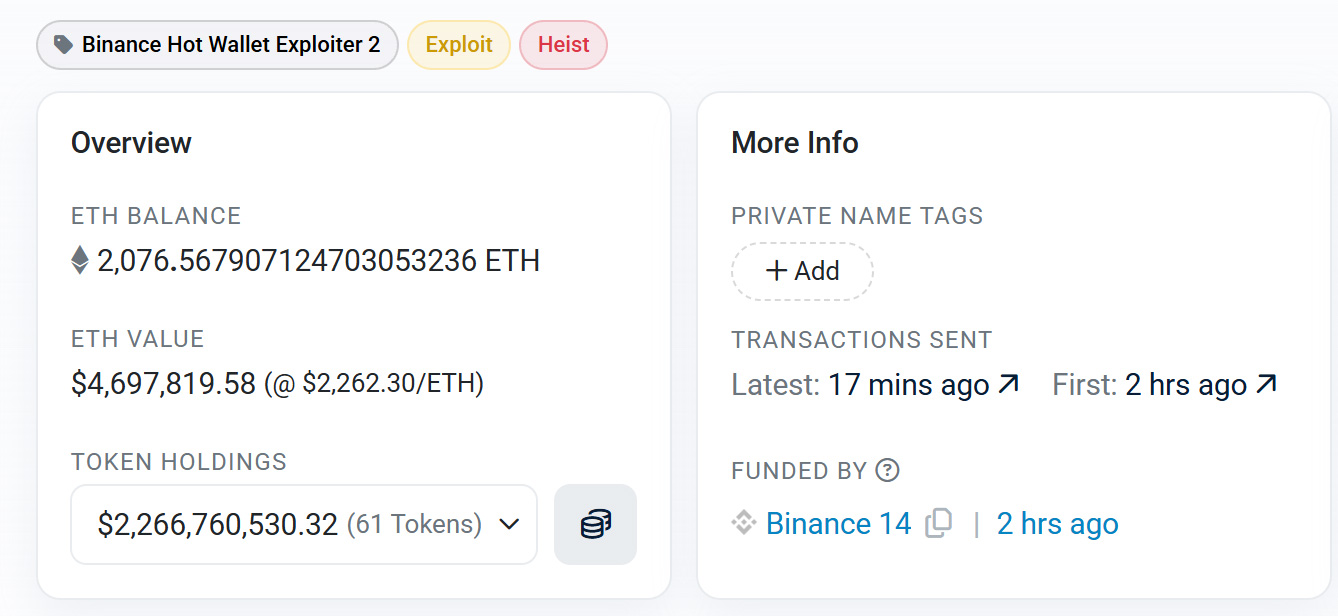
According to forensic accounting breakdowns shared by prominent industry analysts, the capital flight began in earnest when an administrative hot wallet designated as "Binance 14" executed a staggering transfer of approximately $2.53 billion distributed across 64 distinct cryptocurrency tokens. Just 24 seconds subsequent to this initial liquidity drainage, a second corporate wallet released an additional $174.4 million into the digital ether. The severity of the incident escalated further when network observers flagged a third hot wallet executing an additional transfer of 780 million USDC directly into the same destination contract, lifting the aggregate value of the reported immediate transfers to roughly $3.48 billion.
As transactional forensics continued to evolve, prominent blockchain intelligence and attribution platforms expanded their monitoring parameters. Arkham Intelligence mobilized specialized tracking scripts to monitor a sprawling cluster of 55 interconnected digital addresses operating under a unified organizational label. The collective asset valuation sitting within this targeted cluster soon ballooned to an estimated $5.78 billion. A granular breakdown of these monitored holdings revealed a heavily diversified portfolio encompassing roughly $1.77 billion in USDT, $1.44 billion in native Bitcoin, $876 million in Ethereum, and $823 million in USDC, alongside a long tail of alternative digital assets.
Prominent blockchain explorers quickly updated their interface taxonomies to reflect the hostility of the incoming traffic. Etherscan, the leading block explorer for the Ethereum network, flagged the primary receiving contract with explicit warning tags, labeling the account as "Binance Hot Wallet Exploiter 2" and affixing permanent administrative markers for both "Exploit" and "Heist." However, seasoned security analysts were quick to inject a necessary note of analytical caution into the public discourse, clarifying that Arkham’s headline-grabbing $5.78 billion figure represented the total estimated value of all assets pooled across the entire network of tracked addresses rather than a verified, finalized quantification of successfully stolen customer funds.
Despite the wealth of forensic data generated by public ledgers, critical questions regarding the fundamental vector of the attack remain unanswered. Binance has yet to formally confirm whether these massive multi-asset transfers constituted an outright security breach, nor has the company detailed the specific architectural vulnerabilities that might have enabled such a massive bypass of internal withdrawal controls. The absence of a comprehensive post-mortem leaves industry participants to speculate on whether the incident stemmed from a zero-day vulnerability in smart contract routing, compromised private keys belonging to high-level administrative personnel, or an advanced social engineering campaign targeting internal infrastructure engineers.
This developing security crisis arrives at a critical juncture for the broader digital asset economy, underscoring the perpetual tension between the decentralized ethos of public blockchains and the centralized operational models required to service mainstream institutional and retail investors. Centralized exchanges act as the primary liquidity conduits for trillions of dollars in global capital, making them the ultimate high-value targets for nation-state hacking collectives and organized cybercrime syndicates. The speed at which attackers can automate the extraction of multi-billion-dollar positions highlights an ongoing technological asymmetry: while malicious actors need only find a single point of failure within a sprawling, highly complex IT infrastructure, security teams must maintain a flawless defensive posture across every conceivable attack surface 24 hours a day, 365 days a year.
Furthermore, the incident serves as an empirical case study in the evolving efficacy of decentralized cooperation during systemic emergencies. The rapid immobilization of more than $2.3 billion in stablecoin liquidity by Tether and Circle illustrates a powerful new defensive paradigm in financial technology. By utilizing programmable asset controls embedded directly into smart contract tokens, issuers can effectively transform public blockchains into hostile territory for cybercriminals, rendering stolen funds functionally unspendable within compliant commercial channels. This capability marks a significant departure from traditional fiat banking infrastructure, where freezing comparable sums across international correspondent networks often requires days or weeks of judicial intervention and bureaucratic friction.
At the same time, the reliance on centralized freezing mechanisms introduces complex philosophical and regulatory debates within the cryptocurrency community. Critics argue that the ability to arbitrarily blacklist and freeze user funds undermines the core principles of censorship resistance and immutability that form the ideological foundation of digital assets. Yet, in catastrophic scenarios involving multi-billion-dollar systemic thefts, the pragmatic necessity of protecting aggregate user capital frequently supersedes ideological purity. As regulatory frameworks mature globally, the coordination between private sector crypto exchanges, stablecoin issuers, and state intelligence apparatuses will undoubtedly become institutionalized as a standard operating procedure for mitigating systemic risk.
The long-term repercussions of this event will likely reverberate across boardrooms, regulatory halls, and technical architecture teams for years to come. Institutional investors, whose participation is essential for the sustained maturation of the digital asset class, will be watching closely to evaluate how Binance manages communication, transparency, and user compensation throughout the crisis. Heightened scrutiny from international financial watchdogs is virtually guaranteed, potentially accelerating the imposition of stricter compliance mandates, mandatory reserve attestations, and independent security auditing standards across all major centralized trading platforms.
As forensic investigators continue to trace the labyrinthine pathways of the blockchain transactions and security engineers work tirelessly to seal potential architectural vectors, the global cryptocurrency market remains on high alert. The ultimate resolution of this multi-billion-dollar puzzle will set a defining precedent for how the digital economy addresses existential security threats at scale. For now, the crypto industry holds its collective breath, waiting for official verification from exchange leadership and hoping that the robust defensive walls erected by the broader ecosystem will prove sufficient to contain what could have been the most devastating cyber heist in human history.
