


The rapid evolution of cybercrime economics has ushered in an era where sophisticated attack vectors are no longer the exclusive domain of advanced persistent threat (APT) groups. A striking illustration of this democratization of cyber warfare has recently emerged from the shadows of the underground threat landscape. Threat intelligence researchers have uncovered deep operational insights into a potent Phishing-as-a-Service (PaaS) framework designated as BigBear 2.0. This turnkey malicious ecosystem has demonstrated the chilling capability to nullify standard multi-factor authentication defenses, successfully compromising hundreds of enterprise environments and harvesting thousands of critical identity tokens.
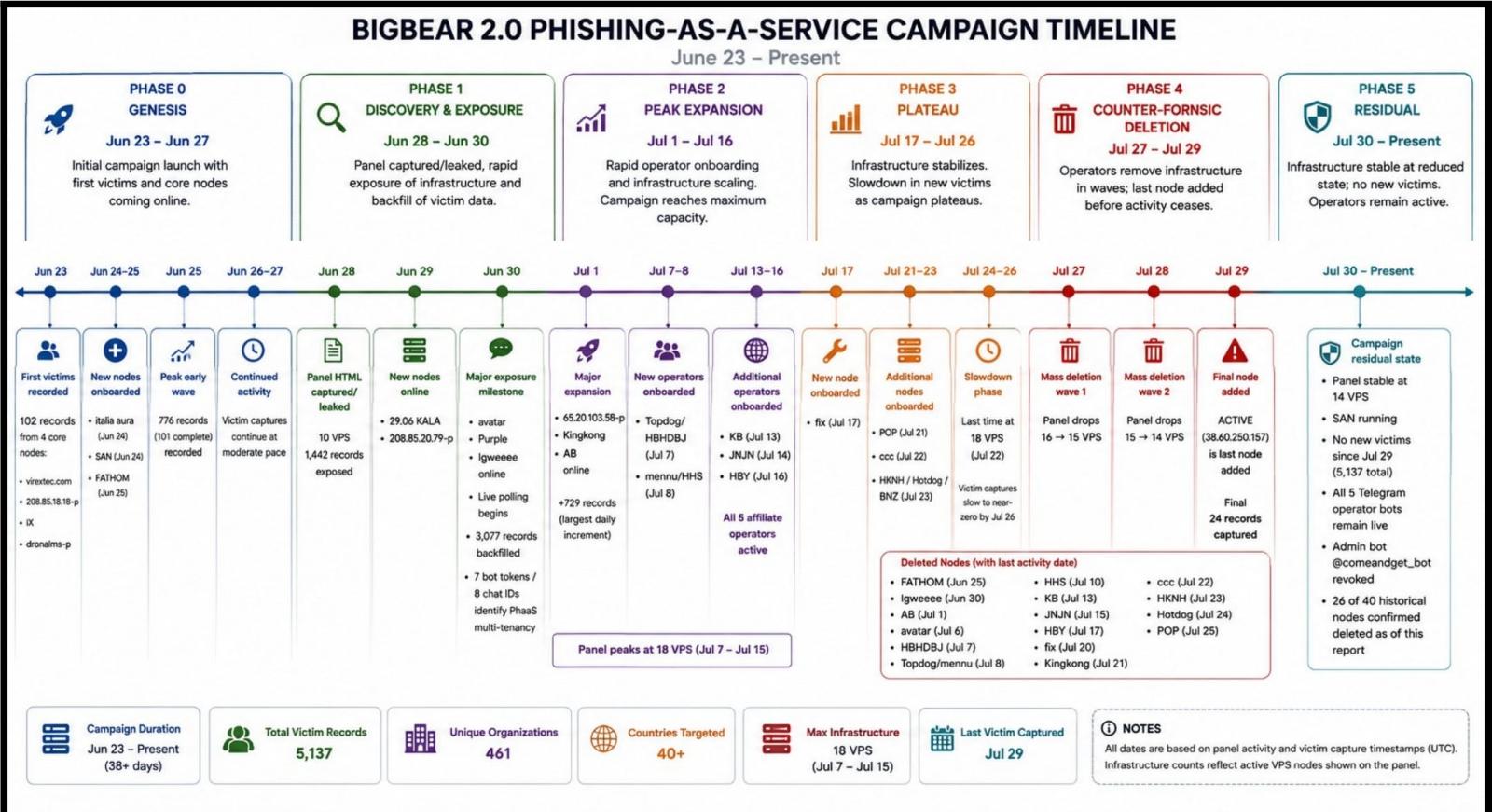
The scale and operational mechanics of the BigBear 2.0 campaign shed light on the professionalization of modern cybercrime syndicates. Investigators managed to penetrate the administrative infrastructure of the service, gaining rare, privileged oversight into the command-and-control center. Their subsequent analysis revealed a meticulously orchestrated operation powered by 42 dedicated Virtual Private Server nodes. Every single node within this distributed architecture was laser-focused on exploiting Microsoft 365 ecosystems, highlighting a deliberate strategy to target high-value corporate productivity suites and identity management portals.
At the core of the BigBear framework lies an advanced adaptation of the Evilginx2 adversary-in-the-middle architecture. Unlike legacy phishing attacks that merely trick users into typing their static passwords into a spoofed landing page, modern tooling of this caliber completely neutralizes traditional verification barriers. The platform leverages a specific operational configuration known internally as "offy." This setup functions as a real-time transparent proxy positioned directly between the unsuspecting corporate user and Microsoft’s legitimate, trusted authentication infrastructure.

When a targeted employee navigates to the malicious landing page, the proxy silently relays every interaction back and forth. As the victim supplies their primary credentials and completes their multi-factor authentication challenge—whether through an authenticator app notification or an SMS code—the proxy intercepts the legitimate session cookies generated by the cloud provider. Armed with these authenticated cookies, malicious actors can bypass any subsequent identity checks entirely. They simply replay the captured tokens through authorized application programming interfaces, effectively hijacking the user’s active session without ever needing to know the underlying MFA secret.
The consequences of such session hijacking within an enterprise cloud environment are profound. Microsoft 365 is rarely just an email client; it functions as an expansive, interconnected digital workspace. Incorporating Exchange Online, Microsoft Teams, SharePoint, OneDrive, and centralized identity orchestration via Entra ID, a single compromised session can unlock a treasure trove of sensitive corporate data. Attackers who successfully hijack these sessions gain unfettered visibility into internal communications, proprietary documents, financial records, and intellectual property. Furthermore, because many enterprise applications rely on single sign-on federation, a breached cloud identity often serves as a digital skeleton key, opening doors to adjacent third-party SaaS platforms integrated into the corporate network.
The empirical data uncovered during the administrative takeover of the BigBear control panel underscores the sheer profitability and reach of this criminal enterprise. According to telemetry extracted by threat analysts, the platform’s database contained over 5,100 discrete credential records. This harvest included more than 4,150 active session cookies, over 1,000 plaintext passwords, and nearly 500 complete, end-to-end multi-factor authentication bypass events. The fallout spanned more than 3,300 unique victim IP addresses distributed across over 40 countries, proving that the threat was not restricted to a single geographic region or industrial vertical.
What elevates BigBear above a standard script-kiddie operation is its multi-tenant business model and sophisticated anti-detection engineering. The framework operates as a leased service, rented out to at least five distinct criminal affiliates. These lower-tier operators are integrated into the platform via live Telegram exfiltration bots, which feed stolen credentials and active session tokens directly to the buyers in real time. While the broader targeting dataset demonstrated that over 460 organizations were scoped for attack, investigators confirmed that at least 258 distinct entities suffered complete, verified MFA bypass compromises.
To ensure high success rates, the developers of BigBear incorporated specialized evasion mechanisms designed to thwart modern defensive controls. For instance, the framework deploys custom JavaScript injections explicitly engineered to disrupt browser interactions with FIDO2 and WebAuthn authenticators. By disabling the native browser capabilities required for hardware-based security keys, the malicious interface forces targeted users to fall back on older, inherently weaker authentication modalities, such as push notifications or one-time passcodes, which are far more susceptible to real-time interception.
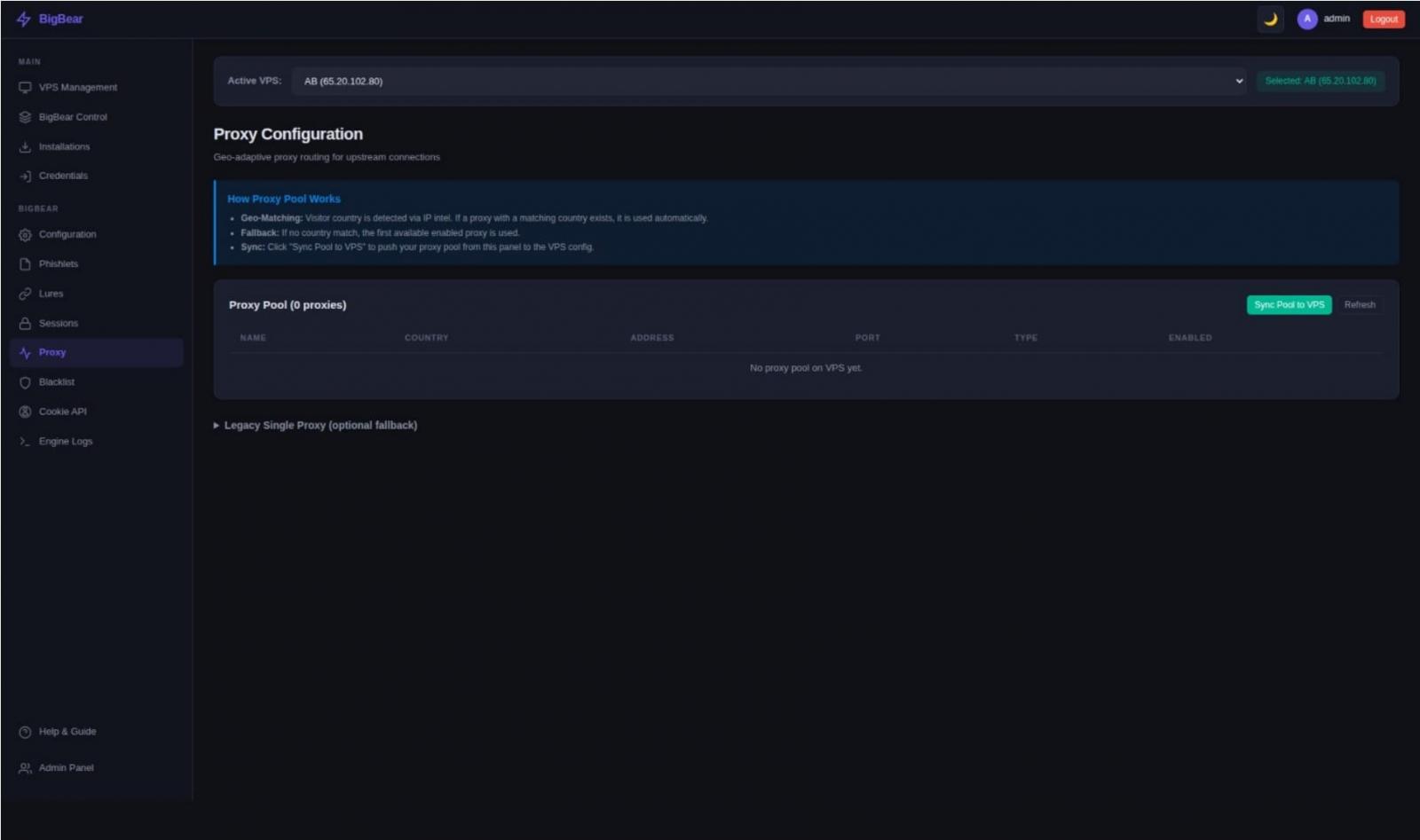
Additionally, the infrastructure addresses one of the primary hurdles facing modern cybercriminals: geo-location anomaly detection. Cloud security solutions frequently flag authentication attempts originating from unexpected parts of the world. To counter this, BigBear integrates geo-matched residential proxy routing across nearly 70 countries. The platform automatically maps the victim’s geographic location to a clean residential IP address in the same region, ensuring that Microsoft’s sophisticated authentication servers perceive the login attempt as entirely benign and native to the user’s usual habits.
The implications of the BigBear campaign extend far beyond the immediate tally of stolen credentials. This incident serves as a glaring reminder that standard multi-factor authentication, while vastly superior to basic passwords, is no longer an insurmountable barrier against dedicated adversaries utilizing adversary-in-the-middle tooling. As long as users can be manipulated into interacting with proxy-based phishing links, threat actors can effortlessly bypass verification prompts and steal the resulting session artifacts. This reality exposes a fundamental vulnerability in how modern organizations approach perimeter defense and identity verification.
Industry analysts emphasize that once initial access is achieved through valid credentials and stolen sessions, traditional security controls experience a massive drop in efficacy. Automated telemetry frequently struggles to distinguish between a legitimate user accessing their corporate inbox from a home office and an attacker replaying a stolen session cookie from a remote location, provided the IP reputation and device characteristics appear consistent. This structural limitation necessitates a paradigm shift in enterprise security architectures, moving away from perimeter-based assumptions toward continuous, zero-trust verification methodologies.
Mitigating the risks posed by sophisticated Phishing-as-a-Service platforms like BigBear requires a multi-layered defensive strategy. Organizations that have reason to believe they were targeted by this campaign must take immediate remediation steps. This includes systematically resetting exposed passwords, globally revoking all active sessions, purging refresh tokens, and forcing immediate re-authentication across all enterprise accounts, with a particular emphasis on high-privileged administrator profiles.
More broadly, security leaders must accelerate the adoption of phishing-resistant authentication technologies. Deploying FIDO2-compliant hardware security keys or platform authenticators (such as Windows Hello or Apple Touch ID/Face ID) fundamentally breaks the adversary-in-the-middle model. Because these protocols rely on cryptographic binding between the device, the user, and the specific origin domain of the legitimate service, an attacker proxying the connection cannot harvest a reusable credential or session token that works outside the authentic exchange.
Furthermore, organizations should refine their Conditional Access policies to enforce stringent device-compliance standards. Relying solely on location signals or basic multi-factor prompts is insufficient in an era of residential proxy routing and real-time cookie theft. By mandating that only managed, healthy corporate devices can access sensitive cloud resources, security teams can significantly narrow the window of opportunity for attackers attempting to exploit stolen identities.
Although the administrative backend of the BigBear campaign remained online following the disclosure, the core phishing infrastructure had reportedly been dormant for several weeks. Law enforcement agencies and affected entities have been alerted, and ongoing intelligence-sharing efforts continue to map out the broader network of affiliates utilizing the service. Nevertheless, the existence of BigBear 2.0 signals a permanent maturation of the cybercrime economy—one where advanced, commodity-based cloud exploitation tools are readily available to the highest bidder, ensuring that identity theft will remain one of the most persistent vectors facing modern enterprises for years to come.
