

When passkeys burst onto the enterprise security landscape, they carried an exceptionally promising mandate: eradicate traditional, vulnerable passwords by anchoring authentication in robust public-key cryptography. By binding digital credentials directly to legitimate web services and isolating private keys away from centralized servers, passkeys offered a formidable shield against decades-old credential theft, dictionary cracking, and mass phishing campaigns. For a time, this narrative went virtually unchallenged, positioning the FIDO2 standard as the near-absolute answer to identity management woes.
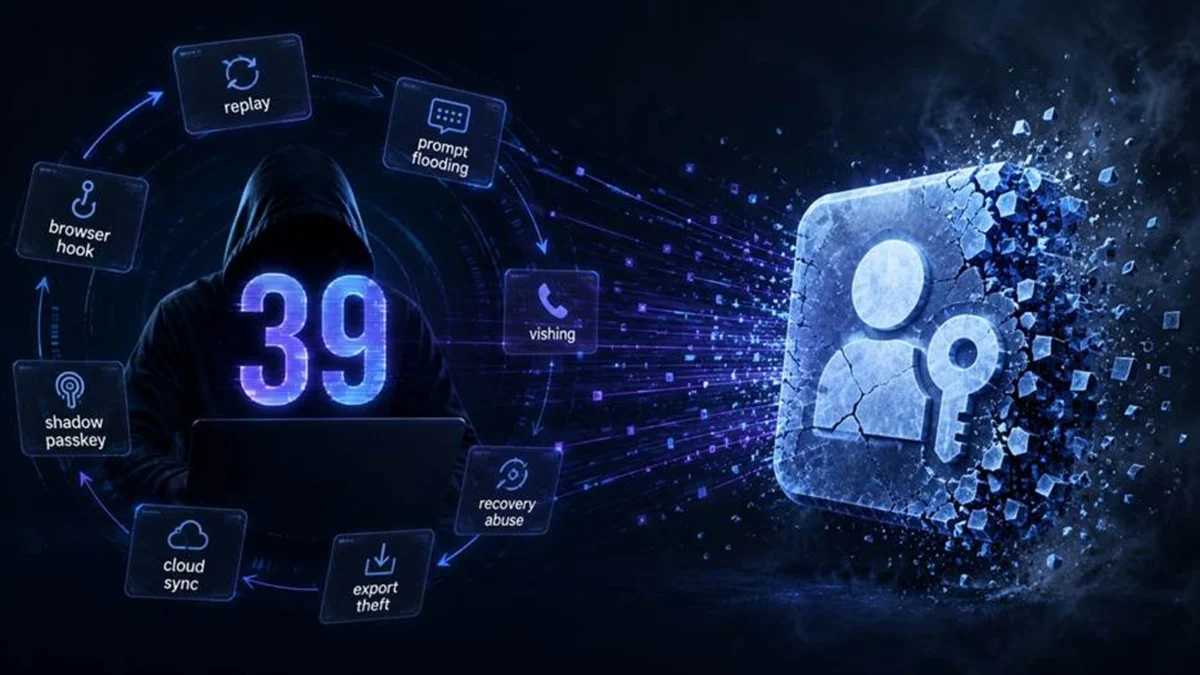
Yet, the dialogue surrounding digital authentication has evolved at a breakneck pace. Security researchers, offensive penetration testers, and academic institutions have collectively mapped at least 39 distinct attack paths, methodologies, and exploitation scenarios targeting passkeys and their surrounding infrastructure. While active threat actors may not have fully operationalized every single vector in the wild, the modern threat playbook is increasingly being authored in public view. Cybercriminals no longer need to invent novel ways to subvert zero-trust frameworks; the blueprint for evasion is readily available, lowering the barrier to entry for sophisticated intrusions.
Underneath these discoveries lies a profound realization that enterprise security architects must urgently digest: the underlying cryptographic equations of FIDO2 can remain utterly unbroken, yet the user account protected by that passkey can still be comprehensively compromised. This decoupling of cryptographic integrity from total account security forces a radical reevaluation of contemporary identity threat models.
The Expanding Perimeter: Moving Beyond the Cryptographic Core
To comprehend how modern authentication ceremonies fail, one must examine the vast array of trust boundaries crossed during a standard passkey transaction. A single authentication event frequently ropes in the web application, the local browser, the underlying operating system, third-party password managers, cloud-based synchronization networks, mobile operating systems, Bluetooth transpiping layers, account recovery portals, IT help desks, and—ultimately—the human user granting approval.
Security researchers have turned their attention to nearly every one of these disparate layers. The catalog of published techniques now reads like an advanced adversary playbook, encompassing assertion mining, assertion replay, circuit-breaker exploits, assertion phishing, browser hooking, challenge injection, detour replay, and explicit manipulations of user presence or user verification indicators.
Landmark research by SpecterOps into "Pass the Passkey" tactics vividly underscored the gravity of this paradigm shift. One of their most critical revelations was that modern malware does not need to extract, steal, or decrypt a private key to achieve its objectives. Instead, a malicious executable operating within a compromised Windows environment can quietly command the legitimate WebAuthn infrastructure to generate a valid, cryptographically signed assertion. The targeted user sees what appears to be an entirely authentic operating system prompt, completes biometric or PIN verification out of routine, and hands the resulting signed assertion directly over to the attacker.
The private key never breached its designated hardware or software container. The mathematical primitives remained secure. Nevertheless, the authentication pipeline was successfully hijacked. This distinction sits at the very heart of the modern passkey threat matrix.
The User Interface as an Active Attack Surface
A substantial portion of the newly documented attack vectors deliberately bypass protocol-level math to target the visual and interactive layers of the operating system. Techniques such as passkey prompt flooding, credential interface deception, application metadata spoofing, window handle spoofing, remote desktop passkey manipulation, and FIDO interface overlays weaponize human psychology and habituation.
This phenomenon mirrors a hard-learned lesson from the era of push-notification multi-factor authentication (MFA). When authentication prompts become mundane, routine visual hurdles, employees naturally slip into autopilot. Adversaries capitalize on this behavioral fatigue by generating, repeating, disguising, or strategically pacing authentication requests until compliance is achieved.
SpecterOps successfully engineered tooling capable of recursively summoning legitimate-looking operating system passkey prompts, tricking users into authenticating malicious transactions disguised as trusted internal applications. The takeaway for enterprise security leaders is stark: absolute cryptographic resilience at the protocol tier offers zero guarantee of deception resistance across the messy intersections of browsers, operating systems, and local user interfaces.
Architectural Risks of Synchronized and Shareable Credentials
The vulnerability landscape expands exponentially the moment digital credentials are designed to be portable—synchronized, exported, restored, or migrated across disparate consumer devices. The modern catalog of threats now includes compromised synced vaults, targeted Apple and Google account takeovers, cloud backup interception, compromised mobile hardware, rooted smartphones, hybrid authentication manipulation, automated export theft from third-party password managers, and attacks leveraging Bluetooth or CTAP communication weaknesses.
Crucially, this is not a cryptographic failure; it is an architectural vulnerability. Once an authentication credential gains the ability to traverse devices, back up to cloud vaults, restore through alternative identity verification channels, or move via synchronization layers, its protective boundary expands far beyond the original authenticator.
An attacker no longer needs to crack public-key cryptography. They simply need to compromise a single, trusted link anywhere in the sprawling surrounding ecosystem. Consequently, a synchronized passkey can leverage flawless cryptography while effortlessly inheriting every single security flaw inherent to the phone, OS, cloud account, browser, and recovery pipeline tasked with its management.
Enrollment and Recovery as Backdoor Vectors
Some of the most devastating enterprise breaches involving passkeys do not rely on stealing existing credentials at all. Instead, attackers simply manufacture new ones.
Published methodologies now feature shadow passkeys, enrollment vishing, attacker-controlled smartphone enrollment, fraudulent passkey registration, help desk social engineering, temporary credential abuse, SIM-swap-based recovery exploits, and migration pretexting.
Consider a scenario where an adversary gains partial control over an employee’s enterprise identity and initiates a legitimate passkey registration workflow. Rather than extracting the victim’s existing credential, the threat actor enrolls an entirely fresh credential onto a hardware device under their absolute control. No math has been broken. No existing authenticator has been breached. The legitimate corporate service itself willingly mints a completely valid, trusted credential for the adversary.
This brings a foundational identity principle into sharp focus: phishing-resistant authentication is fundamentally inadequate if identity enrollment, device replacement, recovery mechanisms, and initial registration workflows are not held to an equally rigorous security standard.
Redefining Security Through Dedicated Biometric Hardware
To truly mitigate these systemic risks, security architects are increasingly looking toward dedicated biometric hardware authenticators, which approach the identity problem from an entirely different angle than passkeys tethered to general-purpose consumer devices.
A purpose-built biometric hardware authenticator retains private cryptographic credentials entirely within secure, tamper-resistant silicon. It incorporates no cloud synchronization mechanisms, no export capabilities, and no reliance on third-party password managers to shuttle credentials across hardware boundaries. Authentication strictly demands a live, physical biometric touch directly on the hardware device alongside verified proximity to the host endpoint.
Equally important, these dedicated authenticators lack the traditional baggage of general-purpose computing. They run no consumer operating systems, maintain no app stores, host no web browsers, and feature no graphical display screens.
This absence of a broad attack surface radically alters the risk equation. Because the authenticator does not support third-party software, malware cannot install malicious variants of trusted applications. Because there is no browser extension ecosystem, malicious extensions cannot hook into authentication sessions. Because there is no internal display screen, malware cannot render deceptive user interfaces or overlay fake login prompts.
The device performs a microscopic set of dedicated security functions and nothing more. This design economics strips away the vast majority of vectors leveraged by modern cybercriminals. Social engineering campaigns may successfully trick an employee into visiting a malicious website or answering a fraudulent support call, but human manipulation cannot force ordinary software onto a hardware device incapable of running arbitrary applications.
The Necessity of Rigorous Service-Side Configuration
Deploying dedicated biometric hardware, however, represents only half of the required defensive posture. The relying party—the enterprise service or identity provider—must enforce strict configuration parameters to preserve the integrity of the hardware-backed trust model.
Within high-security enterprise environments, authentication policies and enrollment ceremonies must be programmatically restricted to approved authenticator classes. Relying parties should actively validate authenticator metadata, strictly enforce user verification flags, rigorously inspect challenges and session states, implement robust signature counter protections, and systematically eliminate weaker fallback authentication pathways.
Enrollment and recovery workflows demand specialized governance. Registering a secondary or replacement authenticator should universally mandate cryptographic proof from a pre-authorized primary hardware authenticator, rather than relying on weaker, out-of-band recovery channels like SMS codes or temporary email links.
When configured correctly, this defense-in-depth architecture ensures that cloud account takeovers, compromised software vaults, mobile malware infections, and malicious browser extensions cannot compromise enterprise access. An attacker cannot simply spin up a software passkey on an untrusted laptop or remotely manufacture the precise physical, biometric, and hardware interaction required to generate a valid assertion.
Strategic Takeaways for Enterprise Security Leaders
The emergence of 39 distinct attack paths targeting passkey infrastructure does not signal the failure of FIDO2 cryptography. Quite the contrary; it highlights the enduring strength of the underlying mathematical frameworks. Threat actors systematically target the software ecosystems, synchronization pipelines, enrollment procedures, operating systems, browsers, recovery channels, and human users surrounding the credential precisely because attacking properly implemented cryptographic hardware directly is extraordinarily difficult.
For enterprise security decision-makers, this reality defines the boundaries of the next generation of identity defense. High-value corporate identities cannot rely on credentials that freely traverse consumer devices and shared cloud ecosystems. They must instead be immutably bound to dedicated biometric hardware, verified individuals, legitimate services, and strictly controlled enterprise lifecycle processes.
Passkeys successfully solved the decades-old vulnerability of static passwords. The expanding catalog of attack methodologies now illuminates precisely what adversaries are targeting next. By deploying dedicated biometric hardware and hardening every stage of the identity lifecycle from initial enrollment to ongoing recovery, organizations can systematically dismantle the surrounding attack surface before threat actors ever find an opening to exploit it.
