


The global enterprise perimeter is facing a renewed test of resilience following confirmation that threat actors have begun actively exploiting a high-severity authentication bypass vulnerability in Citrix NetScaler products. Tracked globally as CVE-2026-19490, this security defect exposes corporate infrastructure to unauthorized remote access if specific configuration parameters are met. The transition of this vulnerability from a theoretical advisory into active exploitation underscores the relentless speed at which modern cybercriminal syndicates and state-sponsored groups operationalize newly released proof-of-concept code.
Security researchers and vulnerability intelligence specialists have documented early waves of scanning and exploitation attempts targeting internet-facing appliances. The emergence of these attacks highlights a persistent operational challenge in enterprise information technology: the dangerous window of vulnerability that exists between the disclosure of a critical software flaw, the release of vendor patches, and the actual deployment of those updates across complex corporate networks. As security teams scramble to verify inventory and apply necessary firmware updates, the incident serves as a stark reminder of the risks associated with perimeter-facing application delivery controllers and remote access gateways.
Anatomizing CVE-2026-19490: Mechanics and Vulnerability Scope
The core risk presented by CVE-2026-19490 lies in its capacity to let unprivileged, remote threat actors entirely bypass the authentication mechanisms of affected systems. This bypass is not universally applicable to all installations; rather, it manifests under precise architectural configurations. Specifically, the vulnerability is triggered when a NetScaler appliance is deployed as an AAA (Authentication, Authorization, and Accounting) virtual server or configured directly as a NetScaler Gateway—encompassing services such as SSL VPN, ICA Proxy, Clientless VPN (CVPN), and RDP Proxy. Furthermore, whether a specific installation is vulnerable depends heavily on the running firmware version and the presence of a configured SAML Action.
When these conditions align, an unauthenticated attacker can construct specialized HTTP requests that slip past the perimeter checks designed to verify user identity. This effectively grants the adversary a bridgehead inside the network perimeter, bypassing the primary line of defense. Because NetScaler devices are strategically positioned at the edge of corporate networks to manage inbound application traffic and facilitate secure remote workforce connectivity, an authentication bypass at this layer is catastrophic. It completely subverts the trust model of the enterprise, allowing malicious actors to masquerade as legitimate users or access backend resources without possessing valid credentials.
The discovery and initial disclosure of CVE-2026-19490 occurred in mid-August, prompting the vendor to issue urgent security bulletins. At the time, the manufacturer strongly advised system administrators to assess their architectures against detailed advisory criteria and immediately upgrade vulnerable builds. However, as is frequently observed in the lifecycle of enterprise software flaws, the issuance of a patch acted as a beacon for reverse-engineers and adversaries seeking to weaponize the vulnerability.

From Disclosure to Weaponization: The Reality of Active Exploitation
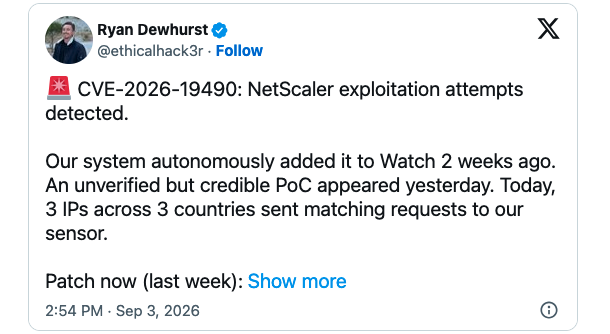
The trajectory of CVE-2026-19490 shifted rapidly from a theoretical risk to an active threat when a credible proof-of-concept (PoC) exploit was published in the public domain. Security intelligence organizations monitoring internet telemetry quickly detected the fallout. Telemetry gathered by vulnerability intelligence firm Previdian revealed that automated sensors configured to monitor NetScaler environments began recording inbound HTTP requests matching the publicly available PoC structure just days after its release.
According to Ryan Dewhurst, founder of Previdian, requests originating from three distinct geographical locations—Australia, the United States, and Germany—targeted monitored sensors simultaneously. While telemetry of this nature provides undeniable evidence of malicious scanning and exploitation probes rather than confirming deep, long-term compromises of live enterprise systems, it signals a critical inflection point. The presence of automated exploitation frameworks in the wild means that threat actors are systematically scanning the global IPv4 and IPv6 space to identify unpatched, exposed NetScaler appliances.
This alarming development prompted international cybersecurity authorities to issue urgent warnings. The Centre for Cybersecurity Belgium, functioning as the nation’s National Cybersecurity Coordination Centre (NCC-BE), issued formal alerts urging network administrators to treat the mitigation of CVE-2026-19490 as an emergency priority. Such governmental interventions reflect the systemic risk posed by edge devices; a successful compromise of a major gateway often yields immediate lateral movement opportunities into critical government and enterprise infrastructure.
The Scale of the Attack Surface and Historical Context
The broader ecosystem vulnerability is magnified by the sheer volume of Citrix NetScaler instances exposed directly to the public internet. Internet-connected device search engines and threat-tracking organizations, such as Shadowserver, routinely monitor tens of thousands of these appliances globally. Current observational data indicates that over 22,000 NetScaler Application Delivery Controller (ADC) appliances and nearly 1,700 dedicated Gateway instances remain accessible via public IP addresses.
However, cybersecurity analysts caution that raw exposure numbers require careful contextualization. This aggregate count includes a mixture of actively utilized production infrastructure, honey-pots deployed by security researchers to track malicious activity, development environments, and systems that may have already received necessary patches but continue to advertise vulnerable version banners. Nonetheless, even a fraction of this exposed population represents a massive, lucrative attack surface for financially motivated extortion groups and advanced persistent threat (APT) actors.
This incident is far from an isolated event in the operational history of Citrix edge infrastructure. The cybersecurity community has witnessed a recurring pattern where NetScaler and ADC platforms become primary targets for sophisticated intrusions. Earlier in the year, administrators were forced to rush emergency patches for a separate cluster of severe flaws, including CVE-2026-3055 and CVE-2026-4368. In that instance, active exploitation of memory corruption and authentication flaws began mere days after initial disclosures.
The U.S. Cybersecurity and Infrastructure Security Agency (CISA) was compelled to add those earlier vulnerabilities to its Known Exploited Vulnerabilities (KEV) catalog rapidly, enforcing strict remediation timelines for federal civilian executive branch agencies. Historical tracking reveals that CISA has cataloged dozens of Citrix vulnerabilities since late 2021, with a significant percentage directly linked to subsequent ransomware deployments and corporate data extortion campaigns. Edge devices remain prime targets because they offer high privileges, operate continuously, and often sit outside the internal endpoint detection and response (EDR) coverage that protects traditional workstations and servers.
Enterprise Implications and the Post-Initial-Access Challenge
The weaponization of CVE-2026-19490 highlights a profound structural vulnerability in modern enterprise defense strategies: the reliance on perimeter security controls that, once breached, leave internal networks dangerously exposed. When an attacker achieves an authentication bypass on an edge gateway, they effectively inherit the network positioning of a trusted remote worker.
Industry analysis on post-exploitation behavior consistently shows that preventing initial access is only half the battle. Enterprise security telemetry indicates that once an adversary manages to acquire valid credentials or bypass authentication gates, traditional automated defense tools struggle to block the majority of subsequent malicious actions. This reality is reflected in broader industry metrics, such as the findings from recent enterprise security simulations, which demonstrate that traditional prevention scores plummet once an attacker successfully establishes a foothold and operates inside the network perimeter.
Lateral movement, privilege escalation, and credential harvesting become the primary phases of an intrusion, where legacy security architectures often lack the granular visibility required to stop an attacker who appears to be authenticated. Consequently, organizations relying solely on perimeter defenses like NetScaler without robust internal segmentation, zero-trust network access (ZTNA) policies, and continuous behavior monitoring are uniquely vulnerable to catastrophic breaches stemming from a single unpatched gateway flaw.
Strategic Remediation and Future Outlook
Mitigating the threat posed by CVE-2026-19490 requires more than simply applying a software patch, though immediate firmware upgrades to the recommended builds specified by the vendor remain the non-negotiable first step. Security leadership must adopt a comprehensive incident response and hardening posture:
- Inventory Verification: Organizations must perform immediate discovery scans to identify every instance of NetScaler ADC and Gateway deployed across on-premises data centers and cloud environments, ensuring no forgotten development or staging servers remain connected to the public internet.
- Log Analysis and Forensic Triage: Security operations centers (SOCs) need to comb through historical and real-time authentication logs, looking for anomalous session establishments, unusual SAML action triggers, or requests exhibiting the structural signatures of the public proof-of-concept exploits.
- Compromise Assessment: Given that exploitation attempts are actively underway globally, any organization that delayed patching following the mid-August advisory must operate under the assumption of potential compromise. Conducting thorough threat-hunting exercises to check for unauthorized administrative accounts, unexpected configuration modifications, or abnormal outbound connections is vital.
- Adoption of Zero-Trust Principles: Enterprises must decouple trust from network perimeter location. Implementing strict multi-factor authentication (MFA) policies that cannot be bypassed via gateway flaws, alongside robust internal micro-segmentation, ensures that an edge compromise does not equate to total network ownership.
As threat actors increasingly automate the translation of vulnerability disclosures into operational exploit code, the timeline between a security advisory and widespread attacks continues to shrink. For organizations operating Citrix NetScaler appliances, CVE-2026-19490 is not just another ticket in the patch management queue; it is a critical test of organizational agility, incident preparedness, and the resilience of the modern digital perimeter.
