


A widespread and severe disruption rippled through corporate digital infrastructures worldwide following a critical service failure within Microsoft’s cloud ecosystem. The incident, which paralyzed email delivery and crippled foundational productivity platforms, highlighted the fragile nature of centralized enterprise architectures. Tens of thousands of organizations found their daily operations abruptly halted as authentication mechanisms failed across the globe, leaving system administrators scrambling for status updates and mitigation strategies while users faced complete lockouts from mission-critical communication tools.
The disturbance began unfolding during peak business hours, triggering an immediate cascade of distress signals across corporate IT networks, community forums, and independent monitoring platforms. Real-time outage aggregators registered an unprecedented spike in error reports originating from Outlook users and broader Microsoft 365 subscribers. The initial manifestations of the failure involved intermittent connection drops and sluggish response times, but these quickly escalated into complete service blackouts. Users attempting to access their corporate inboxes encountered endless login loops, authentication error screens, and catastrophic delays in message dispatch and receipt.
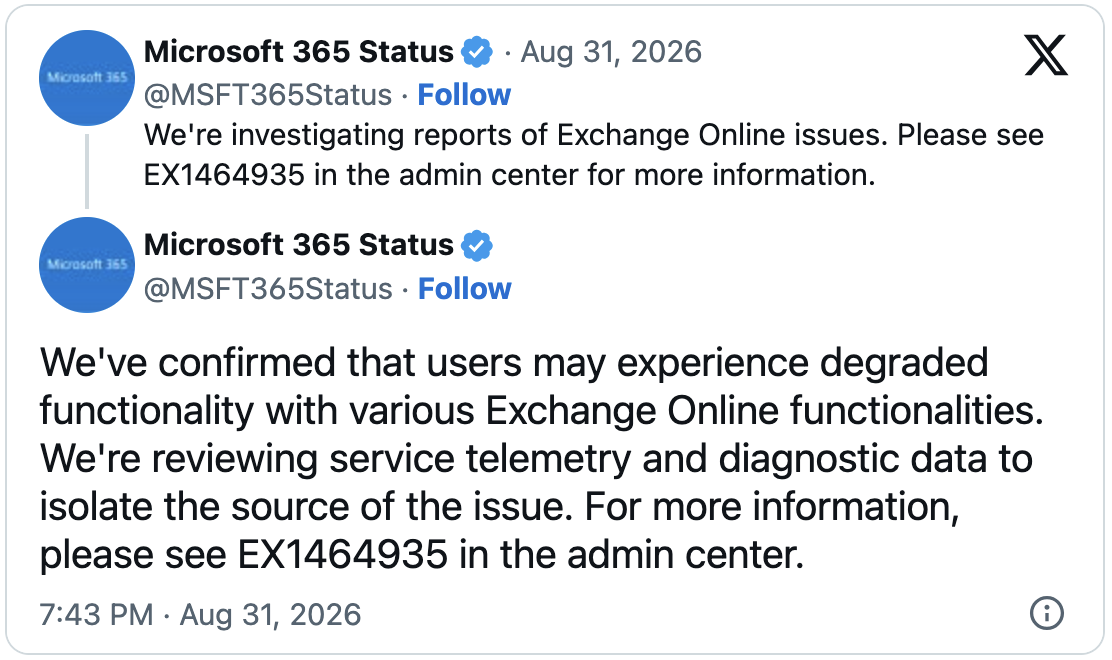
As telemetry data poured into Microsoft’s monitoring centers, the corporation formally acknowledged the unfolding emergency at 5:30 PM UTC. Initially cataloged in the administrative portal under incident identifier EX1464935, the disruption was initially believed to be isolated to Exchange Online—the company’s powerhouse cloud-based email hosting service. However, as diagnostic engineers probed deeper into the root causes of the telemetry anomalies, the sheer scale of the disruption became glaringly apparent.

In subsequent updates, Microsoft expanded the incident scope under tracking code MO1465074, revealing that the core failure extended far beyond email infrastructure. A critical core authentication configuration issue had destabilized a wide array of interconnected Microsoft 365 services. Alongside Exchange Online, enterprise users experienced severe functionality blocks across SharePoint Online, OneDrive for Business, and Microsoft Teams. Furthermore, security and compliance operations were severely impaired, with administrators reporting complete visibility loss and functional failures within Microsoft Defender XDR and Microsoft Purview suites. This domino effect transformed a routine email outage into a multi-tiered enterprise crisis, stripping organizations of both their collaboration tools and their real-time security monitoring capabilities.
Diagnostic insights released by Microsoft’s incident response teams pointed directly to internal configuration abnormalities within the foundational authentication pipeline. Engineers successfully isolated a recurring failure pattern governing protocol connectivity and identity verification requests across the Exchange infrastructure. The underlying trigger was traced back to a core authentication parameter utilized by multiple internal dependencies. To counteract the degradation, support personnel initiated manual troubleshooting procedures, executing server-level configuration resets to test structural stability and evaluate potential recovery timelines.
This latest collapse underscores a troubling pattern of recurring service instability for Microsoft’s cloud division over the past year. Enterprise customers have grown increasingly vocal regarding the frequency of unexpected downtime. Just months prior, global organizations weathered a significant mail flow pipeline failure that disrupted communications spanning North America, Europe, and the Asia-Pacific region. Earlier in the year, administrators grappled with persistent mailbox access barriers that intermittently plagued mobile clients and macOS operating systems for weeks, alongside separate incidents that severed connectivity across web and desktop editions of Outlook via Exchange ActiveSync protocols.
The recurring nature of these systemic interruptions has ignited intense debate within the enterprise technology sector regarding the operational risks associated with hyper-consolidated cloud ecosystems. Modern businesses have aggressively migrated their operational backbones to unified platform-as-a-service and software-as-a-service models, driven by promises of seamless integration, scalability, and reduced infrastructure overhead. However, this architectural consolidation introduces a profound single point of failure. When a centralized authentication fabric or identity management core falters, the resulting blast radius is exponentially larger than traditional on-premises outages, simultaneously neutralizing communication, file storage, teamwork, and defensive posture.
Industry analysts emphasize that cloud reliance forces organizations into a complex dependency model where internal IT departments surrender direct control over disaster recovery and infrastructure resilience. While hyperscale cloud providers boast massive redundancy and geographic load balancing, configuration errors, botched deployment rollouts, and deep internal software dependencies can effortlessly bypass perimeter safeguards. Consequently, Chief Information Security Officers and enterprise architects are increasingly re-evaluating risk mitigation frameworks. Discussions around multi-cloud strategies, hybrid architectures, and localized failover contingencies are gaining renewed urgency as businesses seek to insulate themselves from total operational paralysis during cloud provider failures.
Moreover, incidents of this magnitude carry severe economic ramifications. For multinational corporations, financial institutions, and healthcare providers, even a few hours of complete email and collaboration blackout translates to millions of dollars in lost productivity, delayed decision-making, and compromised customer service delivery. The psychological toll on enterprise IT personnel is equally significant; system administrators are frequently left reacting in real-time to opaque status dashboards, forced to manage frustrated internal stakeholders while awaiting official guidance from the cloud vendor.
As organizations navigate the aftermath of this authentication crisis, the demand for absolute transparency and rigorous root-cause analysis from cloud providers has never been higher. Enterprises require deeper visibility into automated deployment pipelines and stricter pre-deployment testing protocols to prevent configuration anomalies from propagating into production environments. While Microsoft continues to refine its automated telemetry tools and manual remediation workflows to restore full platform stability, the event serves as a stark reminder of the vulnerabilities inherent in modern digital dependencies. The journey toward unbreakable cloud reliability remains fraught with challenges, and enterprise architects must continuously adapt their resilience strategies to weather the inevitable storms of centralized digital infrastructure.
